
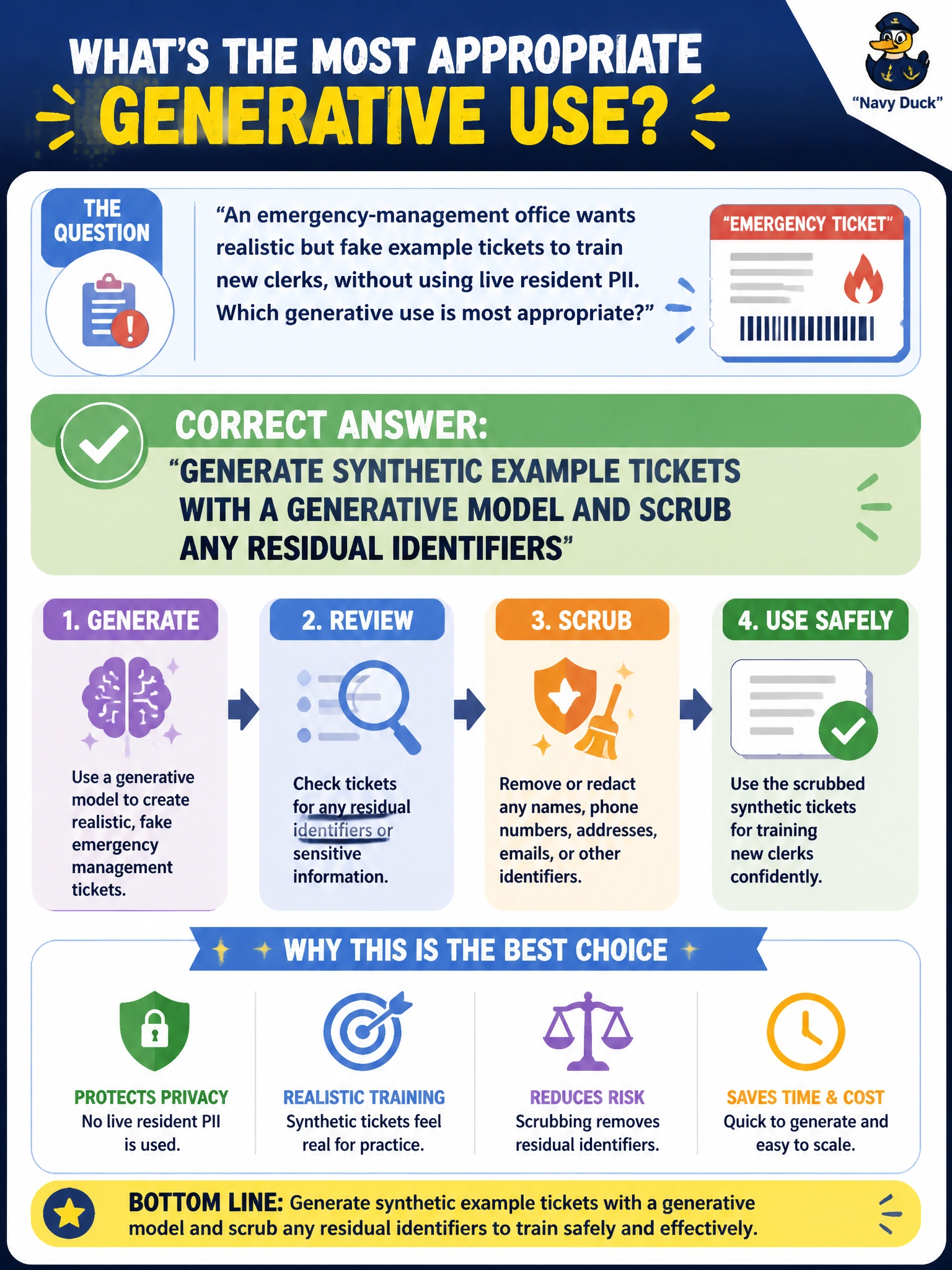
An emergency-management office wants realistic but fake example tickets to train new clerks, without using live resident PII. Which generative use is most appropriate?
Select an answer to reveal the explanation.
Short Explanation
New clerks need practice tickets that feel real without outing real people. Generative models can invent plausible examples; that’s the safe lane. Dumping live PII into training or a public hub is the wrong kind of “realism.”
Full Explanation
Generating synthetic example tickets with a generative model, then scrubbing residual identifiers, is the appropriate use when emergency-management clerks need realistic training material without live resident PII. Synthetic tickets preserve workflow realism—fields, tone, urgency—while avoiding the privacy and records-retention risks of using real names, addresses, and medical or crisis details in classrooms. Fine-tuning on real incident dumps that still contain full names and addresses directly exposes PII and is not justified by training convenience. Publishing live CAD feeds into classroom chat streams operationally sensitive and personal data into uncontrolled channels. Exporting production case files to a public model hub for ‘realism’ is a severe confidentiality failure and may violate law and vendor terms. Exam caveat: generative synthesis is a privacy-preserving technique only when residual identifiers are reviewed and removed; ‘realistic’ does not mean ‘copy production data.’ Operational check: sample synthetic tickets for re-identification risk, ban live CAD in training environments, document generation prompts and scrubbing steps, and align training corpora with records and privacy offices before classroom use.