
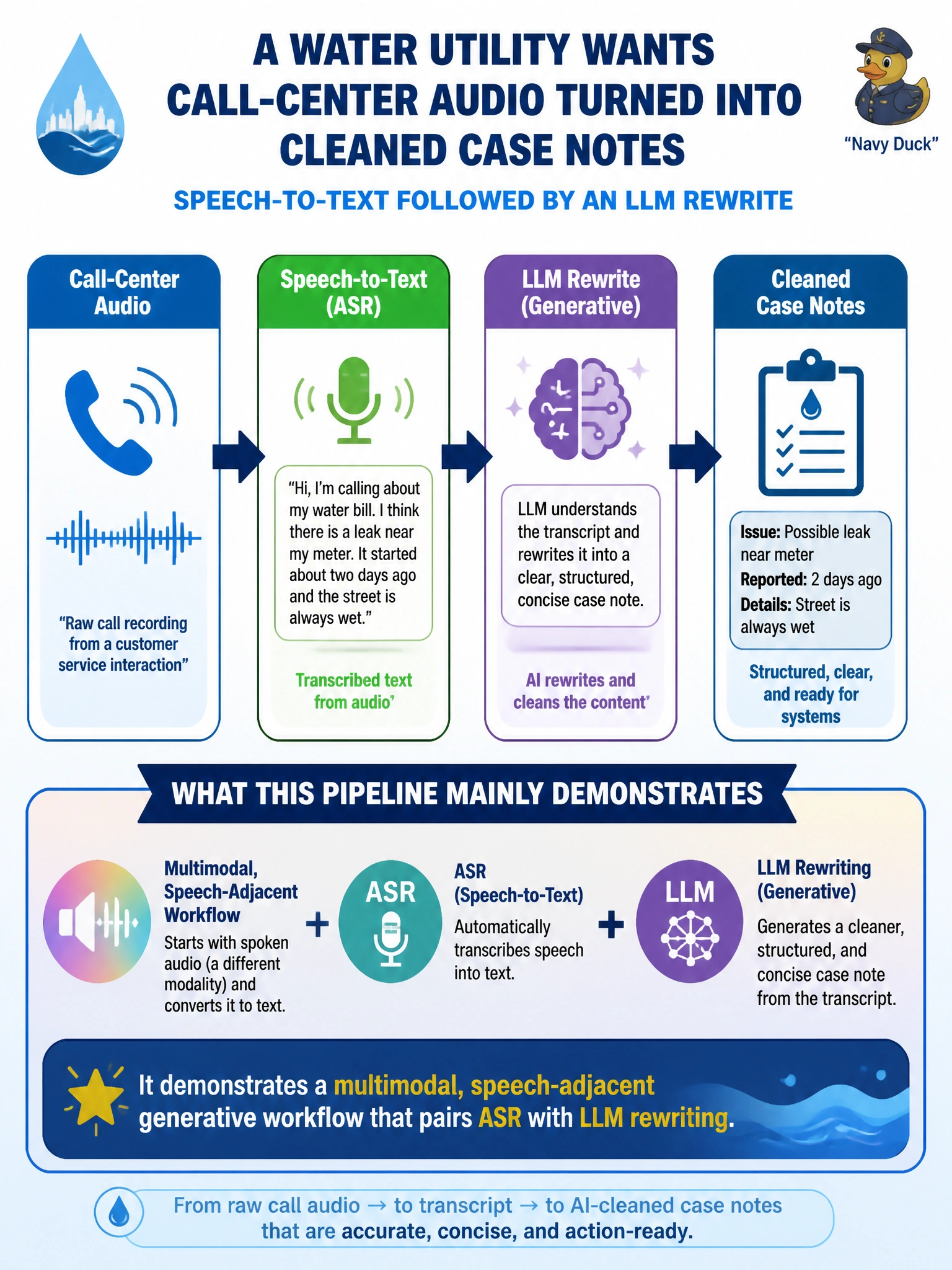
A water utility wants call-center audio turned into cleaned case notes: speech-to-text followed by an LLM rewrite. What does this pipeline mainly demonstrate?
Select an answer to reveal the explanation.
Short Explanation
Picture a two-step assembly line: ears first, then an editor. Speech-to-text captures the call; the LLM tidies it into notes. That’s a speech-adjacent generative pipeline, not a photo generator or a SCADA swap.
Full Explanation
Speech-to-text followed by LLM rewrite demonstrates a multimodal, speech-adjacent generative workflow: automatic speech recognition (ASR) turns call-center audio into text, then a generative language model cleans and structures case notes for the water utility. Utilities need usable notes from noisy calls about leaks, billing, and outages. Separating ASR from rewriting lets each component be reviewed, swapped, or audited without pretending a single magic product is required. Training a diffusion model on meter photographs targets visual generation or enhancement, not call-note production. Replacing SCADA historians with chat transcripts would discard authoritative operational telemetry—generative notes complement, they do not replace OT historians. Exclusive reliance on a rules engine to score water-quality sensors is classical monitoring logic and does not address speech-to-notes conversion. Exam caveat: ‘multimodal’ here means chaining speech and text generative steps; do not equate it with unrelated image or SCADA replacements. Operational check: obtain consent/notice where required for call recording, redaction-check notes for PII before broader sharing, keep ASR confidence and human edit marks, retain original audio per records policy, and verify that rewritten notes still match critical facts (address, meter ID, urgency).