
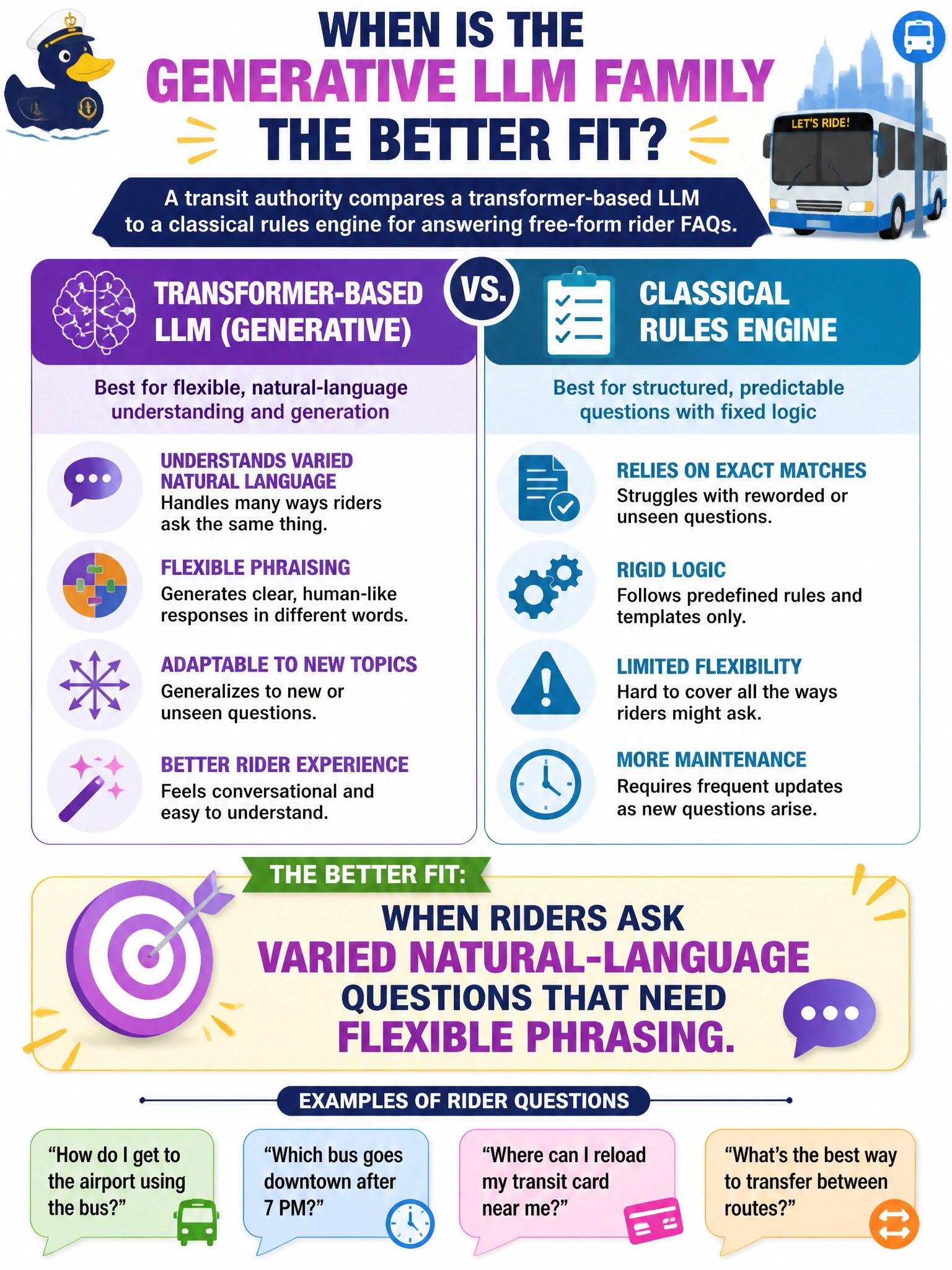
A transit authority compares a transformer-based LLM to a classical rules engine for answering free-form rider FAQs. When is the generative LLM family the better fit?
Select an answer to reveal the explanation.
Short Explanation
Rigid lookup tables are great for barcodes and fare grids. Riders who type messy, everyday questions need something that can bend with the wording—that’s where a generative LLM earns its keep versus a pure rules engine.
Full Explanation
A transformer-based LLM is the better fit when riders ask varied natural-language FAQ questions that need flexible phrasing: generative models handle paraphrase, incomplete queries, and conversational wording that rigid rules struggle to enumerate. Transit FAQs span schedules, accessibility, disruptions, and transfers; riders do not speak in stop-ID keys. An LLM can interpret intent and draft helpful answers that staff or retrieval-grounded systems then constrain to official data. When every answer must be a fixed string keyed only by stop ID, a rules or lookup system is more appropriate—determinism beats generative flexibility. Validating ticket barcode checksums is a cryptographic/integrity check, not language generation. Hard fare-table lookups with no paraphrase require authoritative tabular logic; paraphrasing fare rules with an unconstrained LLM risks incorrect pricing. Exam caveat: generative models excel at open language; they are not automatically preferred for every transit automation problem—keep deterministic fare and barcode logic outside the LLM. Operational check: ground FAQ answers in official GTFS/status feeds or approved knowledge bases, measure hallucination on fare and service questions, escalate money-sensitive answers to lookup systems, and A/B test rider comprehension rather than only model fluency.