
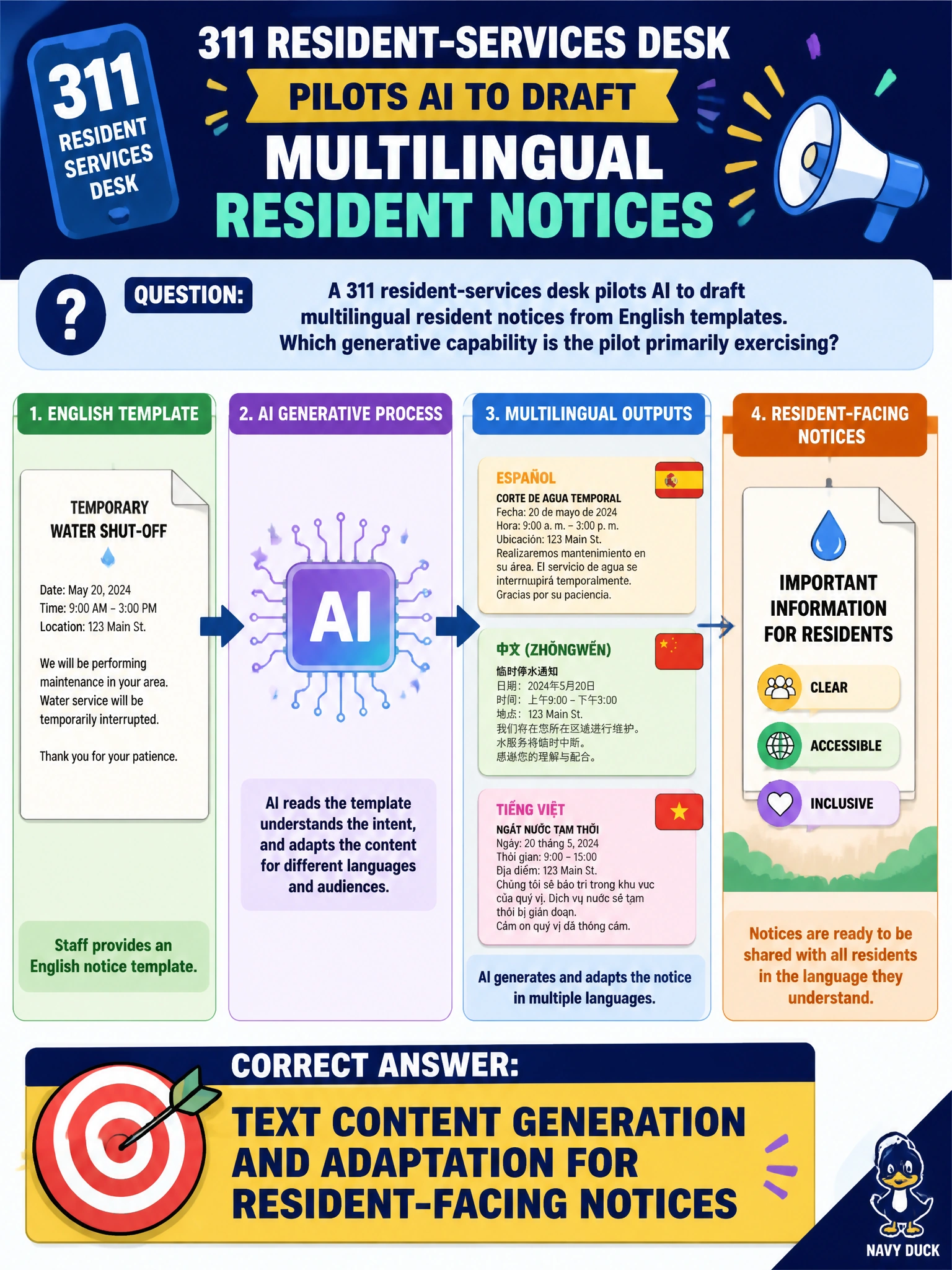
A 311 resident-services desk pilots AI to draft multilingual resident notices from English templates. Which generative capability is the pilot primarily exercising?
Select an answer to reveal the explanation.
Short Explanation
This is plain old writing help—take an English template and spin usable notices in other languages. Generative text models shine at content drafting and adaptation; they’re not about racking GPUs or scoring parking tickets.
Full Explanation
Drafting multilingual resident notices from English templates is text content generation and adaptation: a generative language model produces or rewrites resident-facing copy across languages while preserving the city’s intent. 311 desks need consistent, clear notices; LLMs accelerate drafting and localization so staff spend time on accuracy and tone review rather than blank-page translation from scratch. On-device GPU fabric tuning for inference throughput is infrastructure engineering—it may matter for scale later, but it is not the capability the pilot is exercising when the output is notices. Supervised ranking of parking-citation severity scores is a discriminative or ranking ML task, not generative content drafting. Hardware telemetry from lobby kiosks supports device health monitoring and is unrelated to producing multilingual text. Exam caveat: distinguish generative content use cases from MLOps/hardware or classical scoring problems when the stem describes drafting resident communications. Operational check: have bilingual staff or certified translators spot-check legal and entitlement language, maintain approved glossaries, log model version and prompt templates, and never auto-publish notices without human approval—especially for rights, fees, or emergency instructions.