
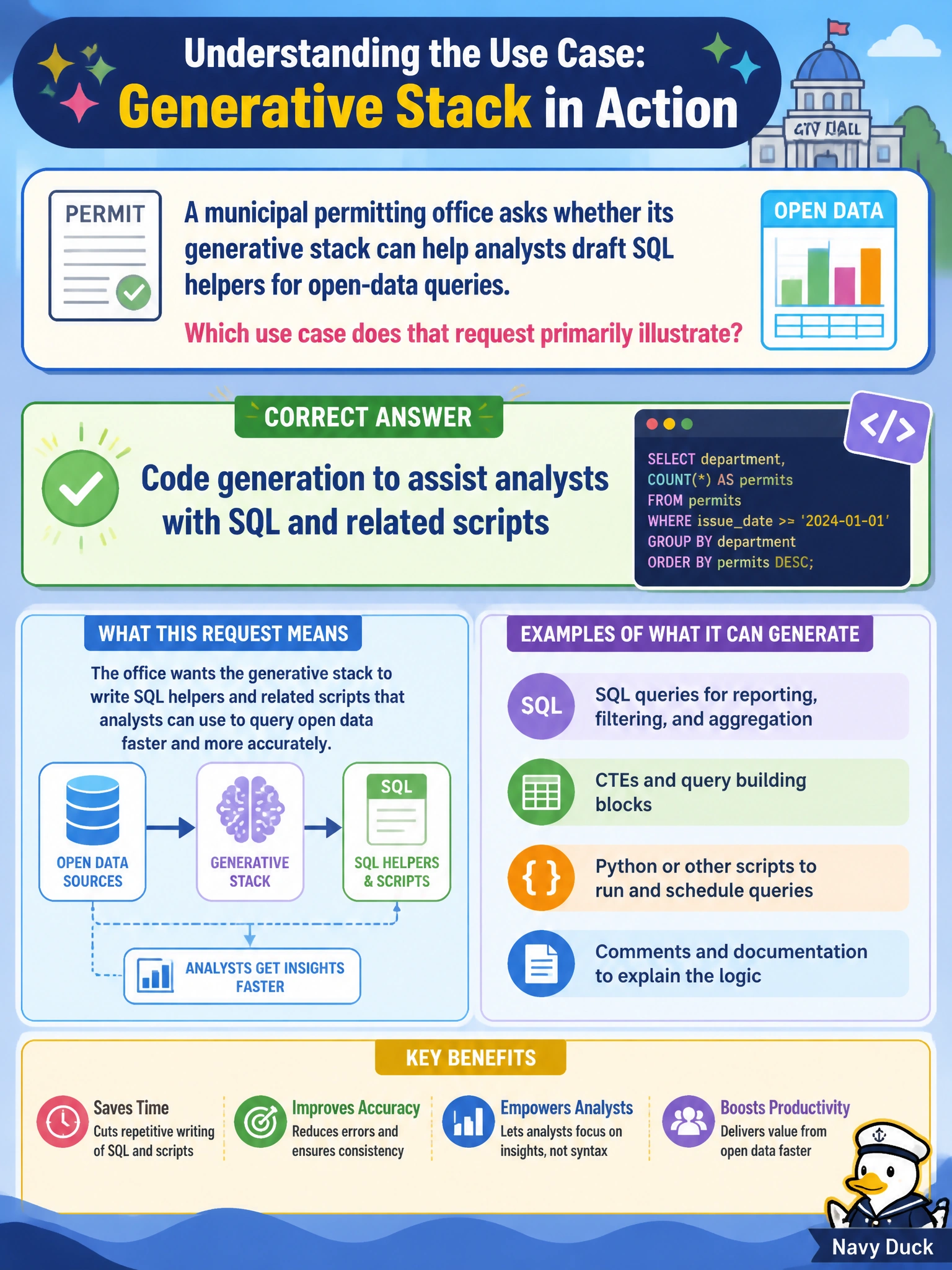
A municipal permitting office asks whether its generative stack can help analysts draft SQL helpers for open-data queries. Which use case does that request primarily illustrate?
Select an answer to reveal the explanation.
Short Explanation
You’re asking for working SQL query helpers, not searchable transcripts, photorealistic permit forms, or inspection-backlog forecasts. That’s code generation: drafting SQL and related scripts for analysts.
Full Explanation
Drafting SQL helpers for open-data queries is code generation: the model produces queries and related scripts to help analysts work with municipal datasets. Permitting offices may publish open data, but analysts still need correct joins, filters, and safe query patterns; generated code can speed up drafting while people validate it against the schema and policy. Transcribing spoken counter conversations into searchable text is a speech-recognition use case for reviewing service interactions, not producing SQL. Photorealistic rendering of permit application forms is image generation, not assistance with querying open data. Forecasting inspection backlogs over time is a quantitative analytics task, not code generation. Exam caveat: simply identifying a system as generative AI is not enough; identify the specific use case, here code assistance, rather than a different modality or analytics task. Practical check: run generated SQL in a read-only sandbox against sample open-data extracts, enforce least privilege, and have queries reviewed before use. Provide schema documentation or retrieval grounding so the model does not invent columns absent from the civic data catalog.