
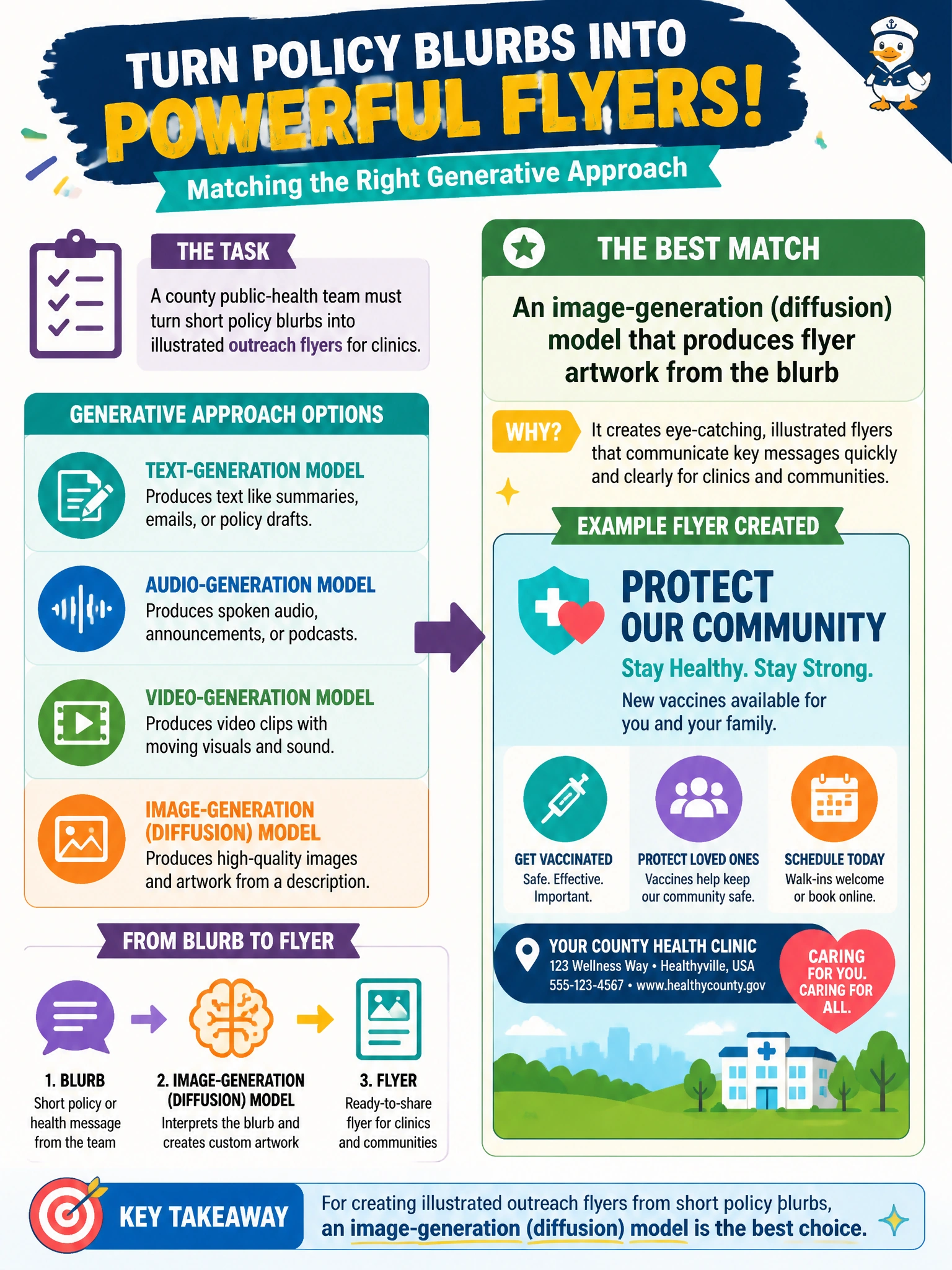
A county public-health team must turn short policy blurbs into illustrated outreach flyers for clinics. Which generative approach best matches that need?
Select an answer to reveal the explanation.
Short Explanation
Words alone won’t hang on a clinic wall. When the deliverable is a picture-heavy flyer, you reach for an image-generation model—the kind that paints from a text cue—not a chat-only LLM or a spreadsheet forecaster.
Full Explanation
When the public-health deliverable is an illustrated clinic flyer, the matching generative family is an image-generation (diffusion) model that turns a short policy blurb into flyer artwork. County outreach needs visuals residents will notice in waiting rooms; diffusion models accept text prompts derived from the blurb and produce creative graphic assets staff can brand-check and publish. A text-only LLM can polish or translate the blurb, but it does not create the illustrated layout or artwork the clinics require—copy alone is not the flyer. Classical clustering on appointment logs discovers utilization patterns for operations planning; it neither designs graphics nor communicates policy visually. Tabular forecasting of foot traffic supports staffing and supply decisions, yet it is an analytics workload, not creative visual generation. Exam caveat: generative AI is not one product—select by modality (text vs image vs speech vs code) against the municipal artifact you must ship. Operational check: require brand and accessibility review of generated art, strip any unintended PII from prompts, keep approved policy wording authoritative in text overlays, and store prompts with the asset for reproducibility when the campaign is audited.