
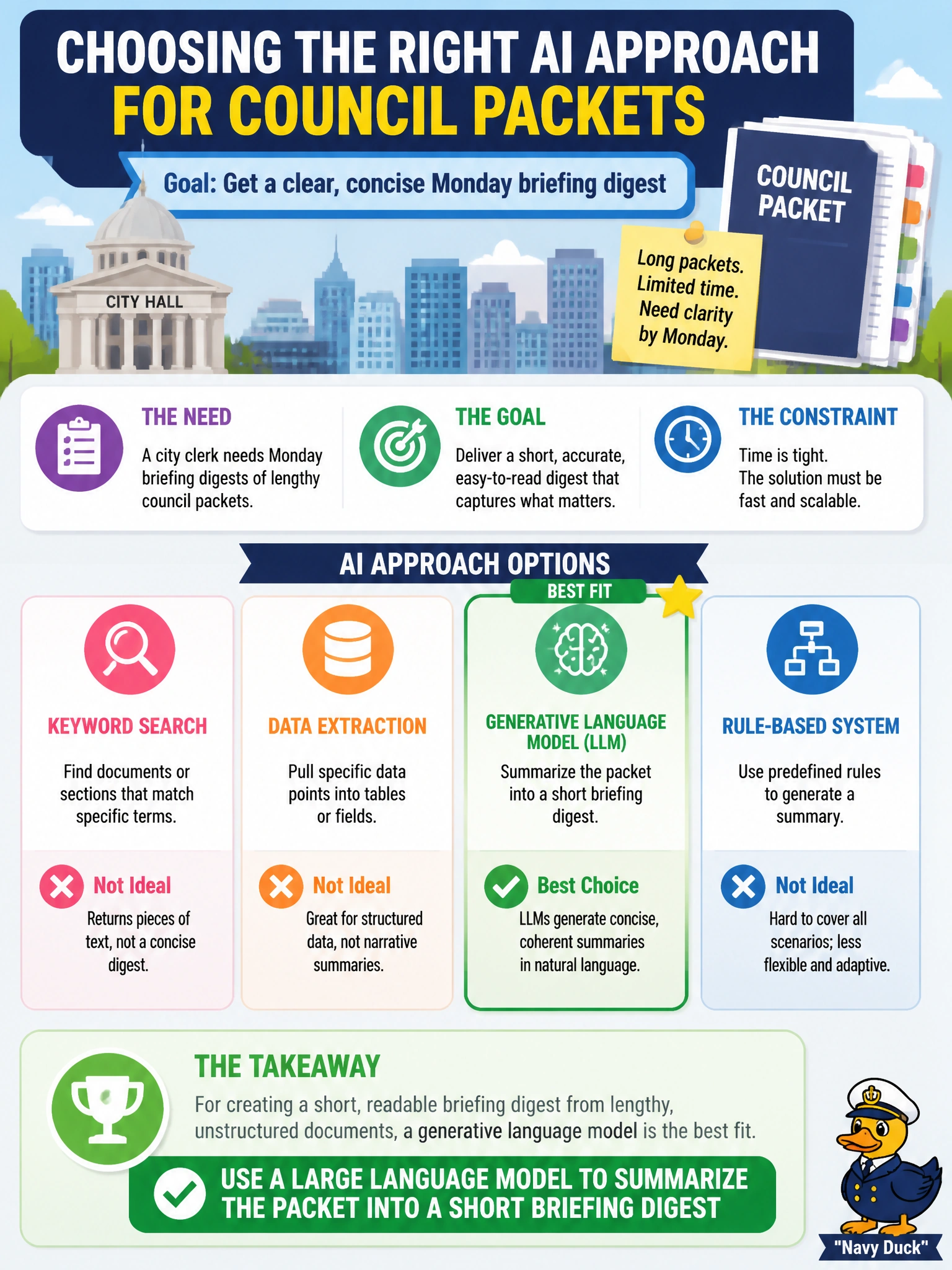
A city clerk needs Monday briefing digests of lengthy council packets and is choosing an AI approach. Which choice best fits a generative language-model use case?
Select an answer to reveal the explanation.
Short Explanation
Think of the packet like a stack of weekend mail—you want the highlights, not a brand-new filing system. An LLM is built to read long text and spit out a digest. Building a custom classifier or a vision model is overkill when summarization is the job.
Full Explanation
Generative language-model families are built for open-ended text transformation: reading long, unstructured council packets and producing a coherent Monday briefing digest is a textbook summarization use case. The clerk’s goal is narrative condensation for elected officials and senior staff—highlights, motions, and watch-outs—not a new filing taxonomy. An LLM can ingest the packet (or chunked sections) and draft that digest in municipal plain language, which human reviewers then verify before distribution. Training a custom multi-label classifier from scratch only tags agenda sections; labels help search and routing but do not compose the briefing narrative the clerk needs. A rules engine that extracts dates and vote totals captures structured fields useful for dashboards, yet it cannot synthesize context, contested items, or plain-language takeaways from narrative staff reports. Fine-tuning a vision model on scanned page images alone optimizes for visual or OCR-adjacent tasks; without a language-generation path it still fails to produce the text digest. Exam caveat: do not confuse ‘AI for documents’ with ‘any model will do’—match modality and output type (generative text summary) to the civic deliverable. Operational check: measure digest usefulness with clerk review time and factual spot-checks against the packet; keep a human-in-the-loop for public and elected communications, and watch context-window limits on very large packets by chunking or retrieving key sections first.