
A university host in VSAN 20 is zoned to an array on a second MDS, and that array is also in VSAN 20. The TE port-channel between the switches allows only VSAN 1. FSPF in VSAN 20 shows no path. What is missing?
Select an answer to reveal the explanation.
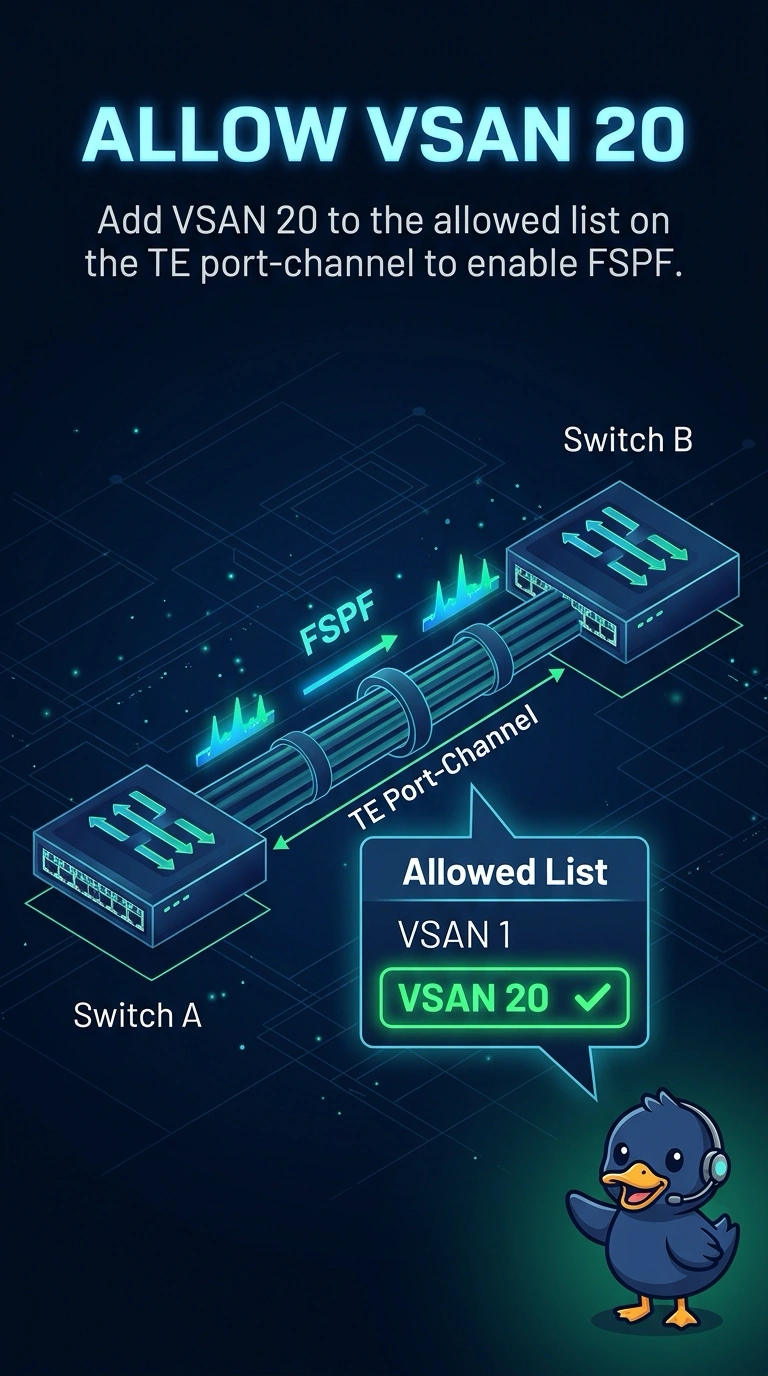
Short Explanation
Your two rooms are on the same floor plan, and the hallway between the buildings is not open to that floor. Zoning in VSAN 20 is local to each switch until a trunk actually carries VSAN 20. This TE port-channel allows only VSAN 1, so FSPF has nowhere to go.
Full Explanation
A TE port carries one or more VSANs, and FSPF builds a topology per VSAN. If VSAN 20 is not allowed on the port-channel, that VSAN has no ISL, the two switches do not share a path, and a zone on each side cannot make the frames cross. Adding VSAN 20 to the allowed list is what creates the path. A zoneset in VSAN 1 would let VSAN 1 members talk. It does not move VSAN 20 traffic onto a trunk that excludes VSAN 20. NPV mode makes an edge switch proxy logins without its own domain ID. These are both full switches that already have a TE port-channel, and NPV is not what adds a VSAN to a trunk. An iSCSI portal is an IP target for iSCSI initiators. It is not a Fibre Channel path inside VSAN 20. Caveat: allow the VSAN on both ends of the port-channel. One side still excluding it keeps the VSAN isolated. Operational check: show the allowed VSAN list on the port-channel, then confirm FSPF in VSAN 20 has a neighbor before you test the host. After the VSAN is allowed, a host that still cannot reach the array is back to a zoning or VSAN-membership problem, not a missing trunk.