
A university builds a Fibre Channel port-channel between two MDS switches. The engineer sets the member interfaces to LACP active mode, the same way the campus Ethernet port-channels are built. The SAN port-channel never comes up. Why?
Select an answer to reveal the explanation.
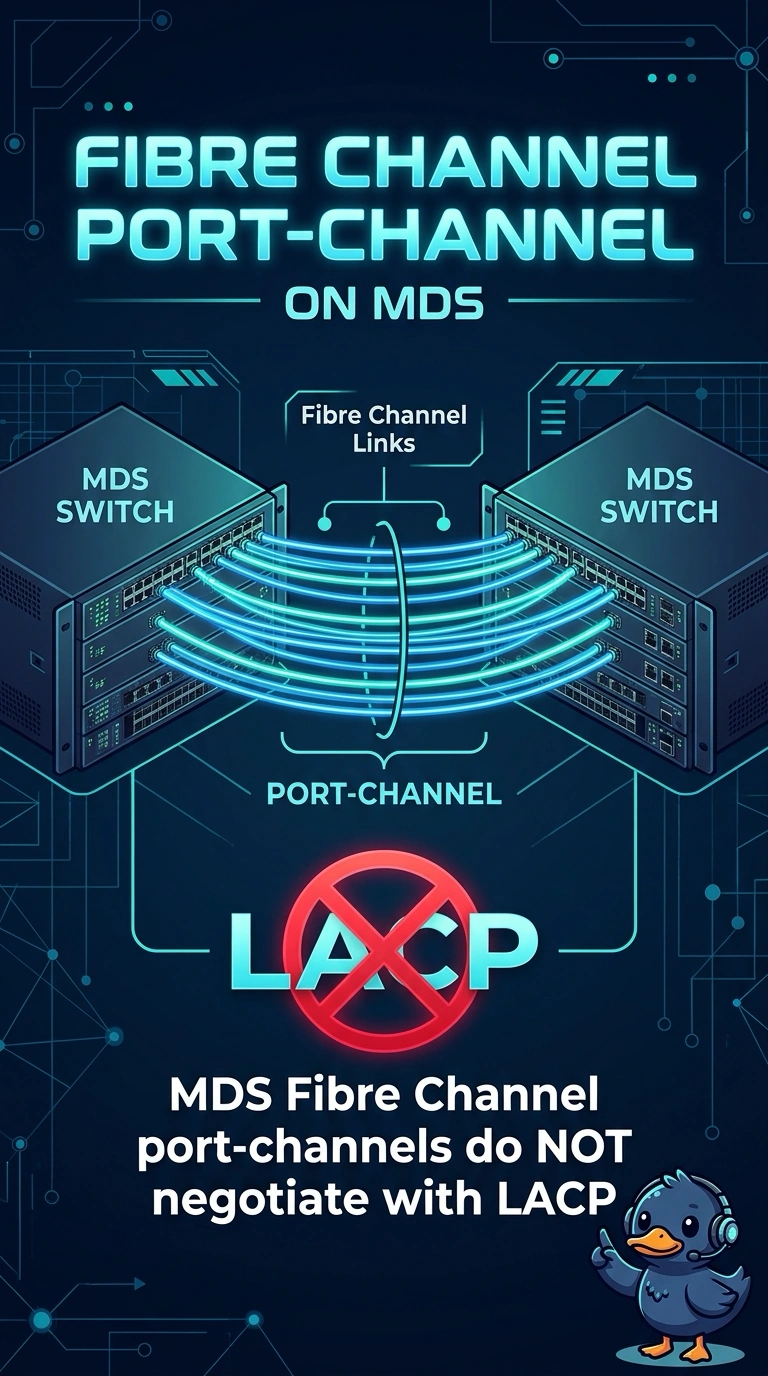
Short Explanation
You brought a highway toll tag to a railroad crossing. LACP is how Ethernet port-channels negotiate. An MDS Fibre Channel port-channel does not speak LACP, so setting the ISLs to LACP active never forms the channel.
Full Explanation
You build an MDS SAN port-channel by creating the port-channel and adding the Fibre Channel ISLs as members on both switches. Speed, trunk mode, and the allowed VSAN list have to agree or a member stays out. LACP active and passive modes are Ethernet. They do not bring up a Fibre Channel port-channel, which is why copying the campus LAN recipe failed. Configuring LACP on only one MDS is still LACP, and a Fibre Channel channel does not need that one-sided trick. OSPF areas belong to IP routing. Fibre Channel ISLs do not form a port-channel by matching or mismatching OSPF. Enhanced device-alias mode changes how device-alias names are stored. It does not disable SAN port-channels. Caveat: both ends still have to be in the port-channel. A channel that exists on only one MDS stays down even after you stop using LACP. Operational check: remove the LACP idea, add the ISLs to the SAN port-channel on both switches, and confirm each member is up in the channel. Match speed and the allowed VSAN list on the members you add. A channel that rejects LACP can still leave a member out for those mismatches.