
A state university has a SAN port-channel up between two MDS switches, but one member stays out of the channel. That member allows a different VSAN list than the channel, and both switches already have the channel configured. What should be corrected?
Select an answer to reveal the explanation.
Short Explanation
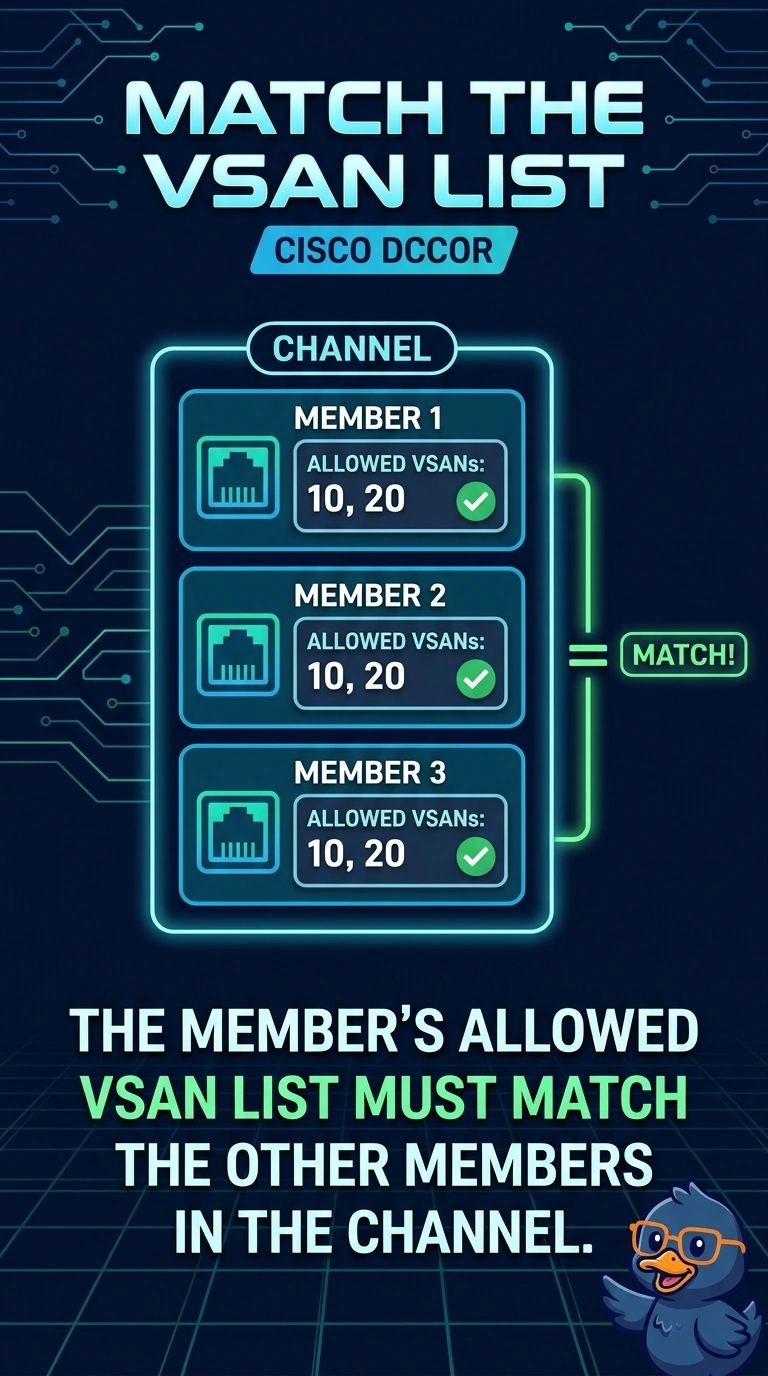
The convoy is moving, and one truck is carrying a different set of permits than the rest. You correct that member's allowed VSAN list so it matches the channel it is supposed to join. Ethernet LACP is the wrong protocol family for this Fibre Channel member, and the channel itself is already configured on both switches.
Full Explanation
An MDS SAN port-channel bundles only members whose parameters are compatible with the channel, including the allowed VSAN list. This university channel is already up and is configured on both switches, so the failure is not a missing peer configuration. The member that allows a different VSAN list stays out until that list matches the other members. Aligning the allowed VSANs is the correction. Ethernet LACP bundles Ethernet ports on NX-OS. A Fibre Channel member does not join a SAN port-channel by enabling LACP. Identical domain IDs are a fabric-merge failure, not a membership requirement. Each switch keeps its own domain, and sharing one would isolate the ISL rather than admit a member. CFS distribution moves databases such as device aliases. It is not a prerequisite that must be enabled before a compatible port-channel member can join. Caveat: speed and trunk mode have to match as well, so a corrected VSAN list can still leave the member out if another parameter differs. Operational check: make the allowed VSAN list identical on that member and the channel, then confirm the member is inside the port-channel and no longer sitting out.