
A state university host completed FLOGI and now appears in the FCNS database, but it still cannot reach the array. An engineer treats the name-server entry as proof the zone allows the pair. What does that entry actually prove?
Select an answer to reveal the explanation.
Short Explanation
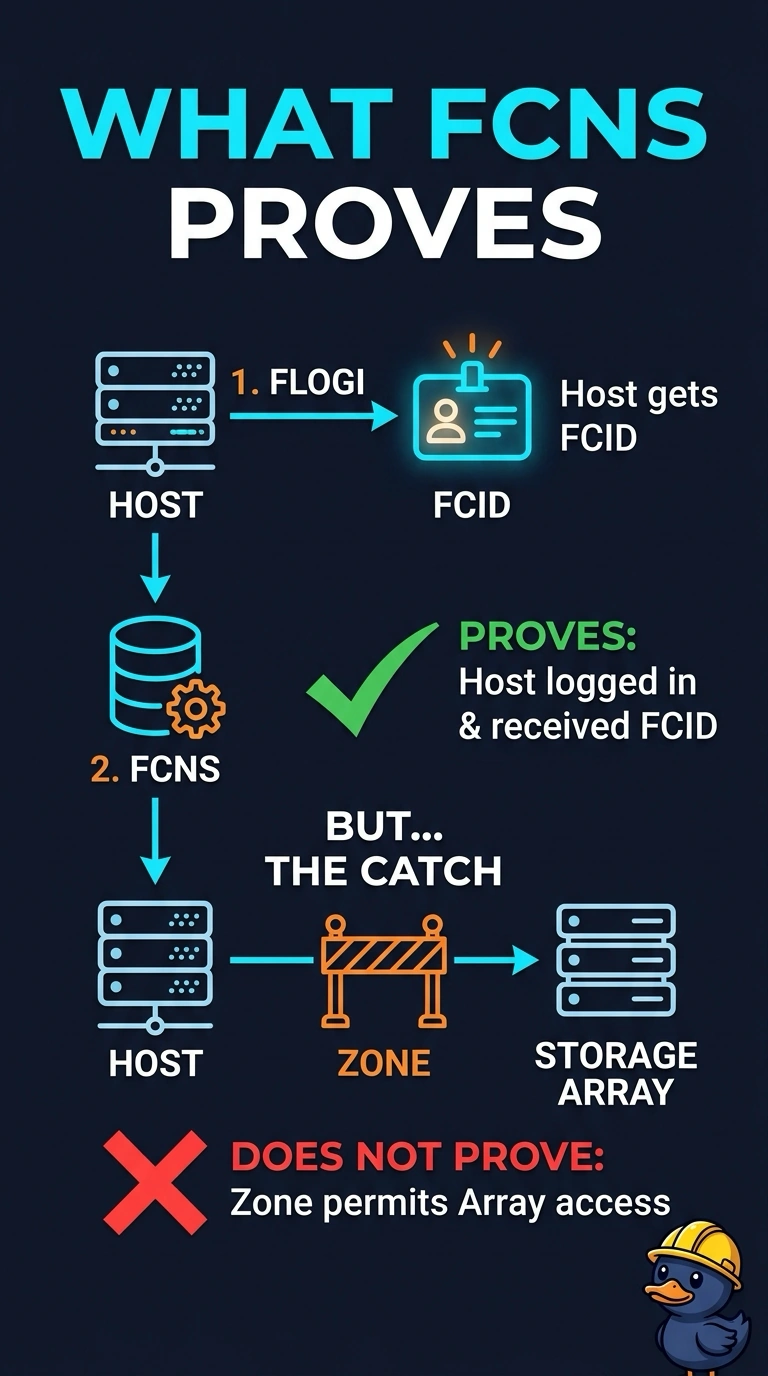
The name server is a sign-in sheet, not a permission slip. You can see the host on that sheet after FLOGI and still have a zone that refuses the array. The entry proves the switch handed out an address and recorded the login, and the active zoneset is a separate book.
Full Explanation
The Fibre Channel name server is populated when a device completes FLOGI. The entry records the FCID, the port name, and related login data for that VSAN. It proves the university host logged in. It does not prove that the active zoneset permits that host to talk to the array, so the host can sit in the name server and still be denied by zoning. The active zoneset is the enforcement database. The name server is not a copy of it, and a login entry does not mean the host was added to a zone. Clearing the name server drops directory records until devices log in again. It does not install a zone. The principal switch allocates domain IDs during fabric bring-up. It does not write host logins into the zoneset as part of the election. Caveat: a host can also be missing from the name server because FLOGI failed, and that is a different fault from a host that is present and still zoned out. Operational check: display the active zoneset, confirm the host and the array are members of a zone in it, and compare that with the name-server entry you already found.