
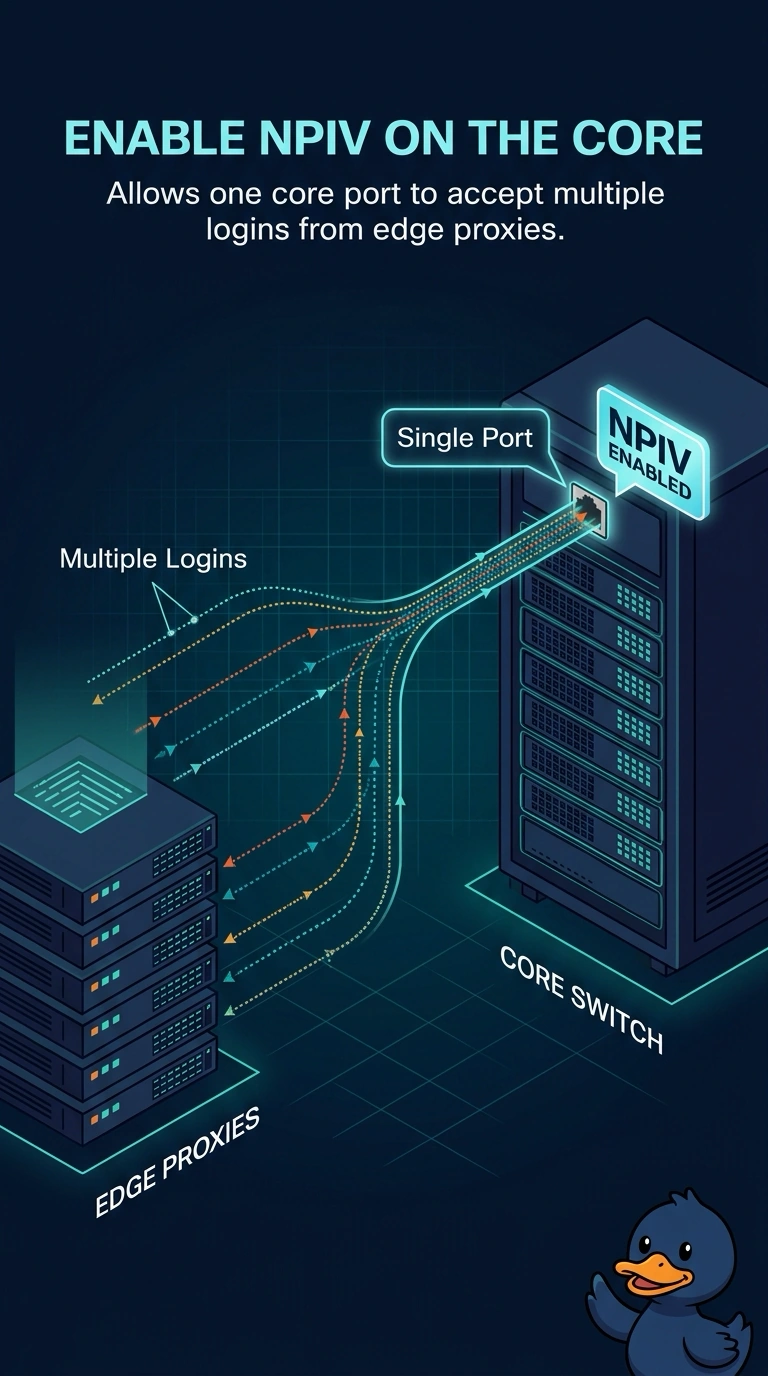
A state university set an edge MDS to NPV mode so the edge would not take a domain ID. The NP port comes up, but hosts behind the edge cannot log in through the core. NPIV is disabled on the core. What should be enabled, and where?
Select an answer to reveal the explanation.
Short Explanation
An NPV edge is a receptionist that does not get its own office number. You still need NPIV on the core so that one core port can accept the many logins the edge proxies. Giving the edge a domain ID undoes NPV, and LACP is not how those logins are carried.
Full Explanation
NPV makes the edge switch stop acting as a Fibre Channel switch. It does not take a domain ID, and it proxies host logins upstream through an NP port. The core sees those logins on what is, from its point of view, one F port that must accept many N port IDs. That is NPIV, and it has to be enabled on the core. With NPIV disabled, the NP link can come up and the hosts behind the university edge still cannot complete login. Assigning a static domain ID on the edge turns it back into a fabric switch, which is the opposite of the NPV design and does not enable NPIV on the core. Ethernet LACP bundles Ethernet links. The NPV uplink is a Fibre Channel NP-to-F relationship, not an LACP bundle. A VSAN has one active zoneset. NPV does not require two active zonesets, and a second one cannot be active beside the first. Caveat: the hosts still need to be zoned on the core fabric, because the edge does not keep a separate zoning enforcement plane for them. Operational check: enable NPIV on the core, confirm the NP port is up, and confirm the core name server shows the host WWPNs that logged in through the edge.