
A factory IoT network has a sensor and a storage array logged into two different VSANs on the same MDS switch, and zoning inside each VSAN still does not let them communicate. Why are the two devices isolated?
Select an answer to reveal the explanation.
Short Explanation
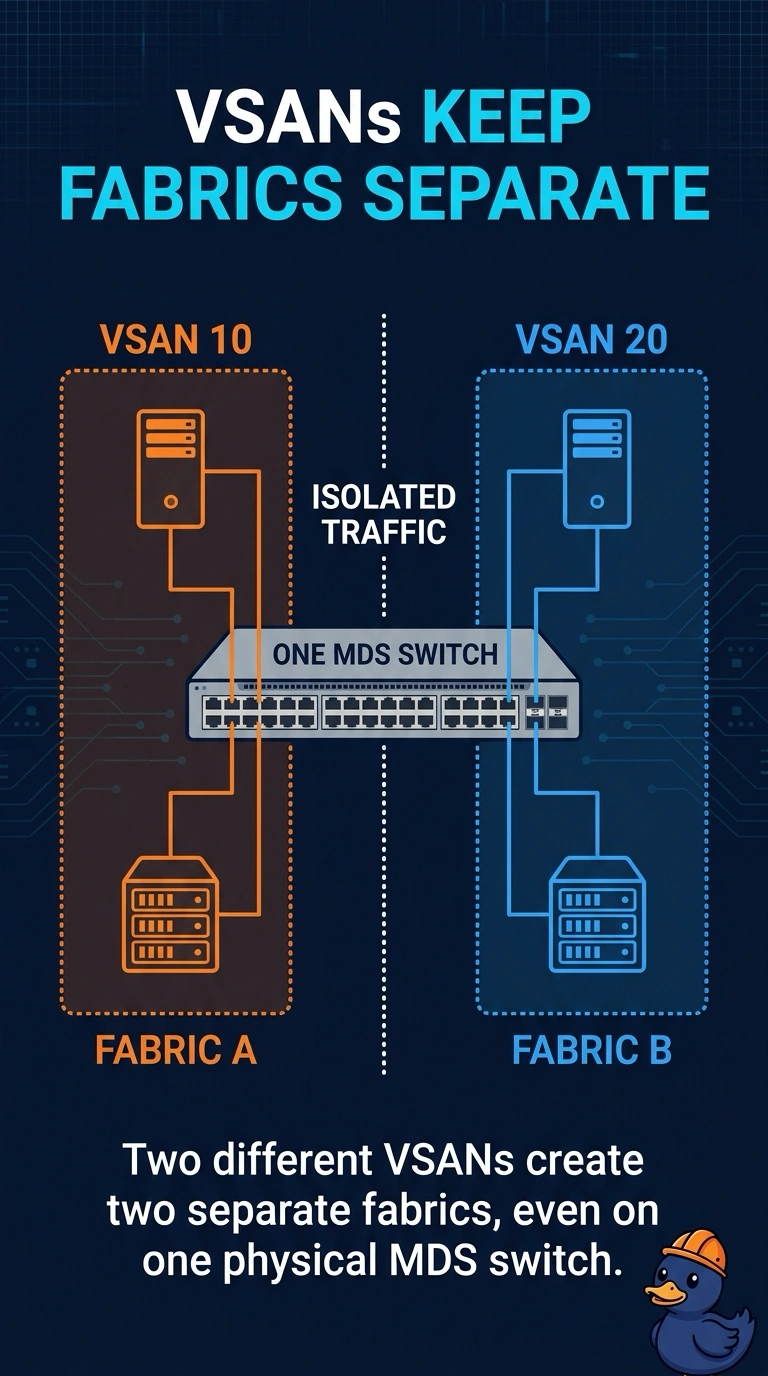
A VSAN is a locked hallway inside one building, not a sticker you can share across hallways. You can zone a sensor to an array only when both of them stand in the same hallway. Put the two devices in one VSAN, then the zone has a single fabric to enforce.
Full Explanation
A VSAN is a separate Fibre Channel fabric that happens to share the same physical switch. Logging the sensor into one VSAN and the array into another means they never share a name server, a zone database, or a routing domain, so a zone built inside either VSAN cannot pair them. The isolation is the VSAN boundary itself. Two zonesets do not merge two VSANs. A VSAN has its own zoning configuration, and activating zones in both places still leaves two fabrics. The name server records devices that have already logged into a VSAN. Clearing it does not move a device from one VSAN to another or rewrite which fabric the port belongs to. Cisco Fabric Services distributes selected configuration, such as device aliases. It is not the wall between VSANs, and turning it off does not let a zone cross that wall. Caveat: inter-VSAN routing is a separate feature with its own configuration, and simply zoning inside each VSAN is not that feature. Operational check: confirm both the sensor and the array FLOGI in the same VSAN, then confirm the zone that pairs them is in the active zoneset for that VSAN.