
A state university host reaches its array by IP and an initiator IQN, but a new Fibre Channel zone does not make the LUN appear. Which control actually admits this iSCSI host?
Select an answer to reveal the explanation.
Short Explanation
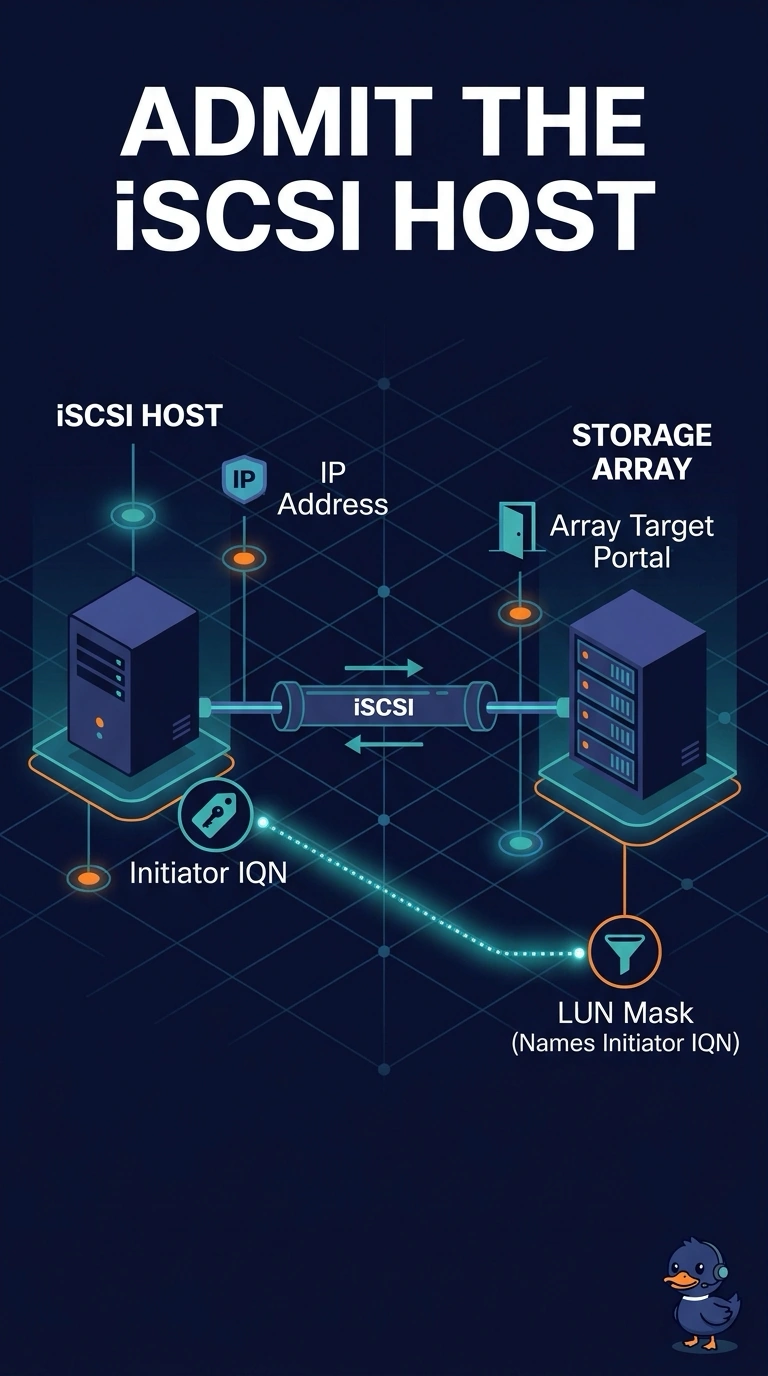
iSCSI is a street address and a name at the door, not a membership list inside the Fibre Channel club. You point the host at the array portal and mask the LUN to that initiator IQN. A Fibre Channel zone never sees this IP session, so activating one cannot reveal the disk.
Full Explanation
iSCSI is SCSI carried over TCP. The host is an initiator with an IQN, and it logs into a target portal on the well-known iSCSI port 3260. The array admits the session by that IQN and by LUN masking, not by a Fibre Channel zone. Building a zone does not create an iSCSI target and does not make the LUN appear to this IP host. An active zoneset controls which WWPNs may communicate inside a VSAN after FLOGI. This host is not logging in with a WWPN on that path, so the zoneset is the wrong control plane. The Fibre Channel name server records Fibre Channel logins. It does not publish iSCSI LUNs and it is not consulted by an IP initiator. NFS is a file protocol, commonly on TCP 2049, and an export grants a mount. iSCSI presents a block LUN, so an NFS export is a different storage service and would not surface this LUN as a disk the same way. Caveat: the IP path still has to exist, including routing and any firewall permission to the portal, or a perfect IQN mask still cannot log in. Operational check: from the host, log into the target portal, confirm the array shows the initiator IQN, and confirm the LUN is masked to it.