
A state university has a SAN port-channel configured on both MDS switches, and one member is already up in the channel. The second ISL stays out and is running at a different speed. What lets that member join?
Select an answer to reveal the explanation.
Short Explanation
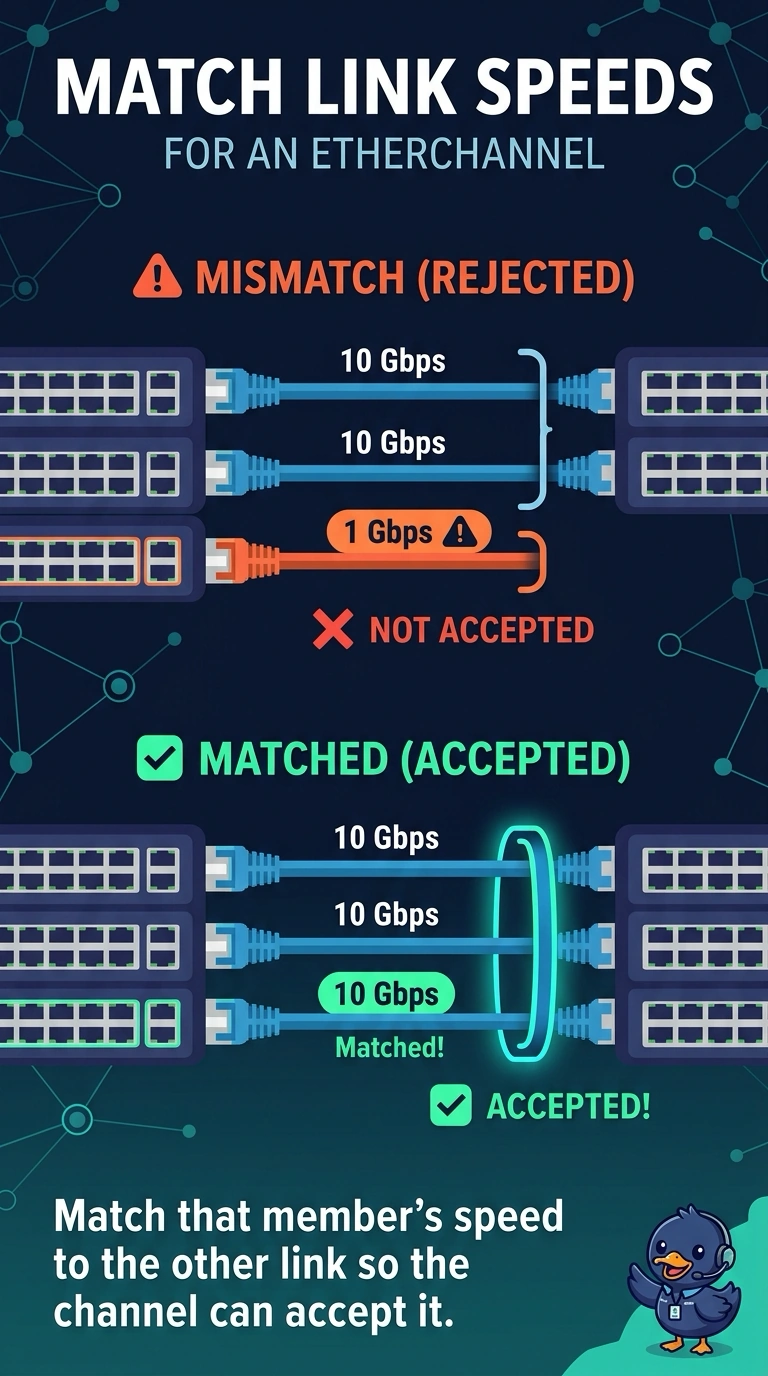
A port-channel is a matched set of lanes, and one lane with a different speed limit stays closed. You match that member's speed to the rest of the channel so the university ISL can join. Ethernet LACP is not the handshake a Fibre Channel port-channel uses.
Full Explanation
An MDS SAN port-channel accepts a member only when that link is compatible with the channel, including the operating speed. The university channel is already configured on both switches and one member is forwarding, so this is not a one-sided channel. The second ISL stays out because it is running at a different speed. Matching the speed lets that member join the existing bundle. Ethernet LACP is the negotiation used by NX-OS Ethernet port-channels. Fibre Channel ISLs on an MDS do not join a SAN port-channel by enabling Ethernet LACP. Identical domain IDs are a fabric-merge failure. Each switch still needs its own domain, and a shared domain ID does not relax member compatibility. CFS distributes selected databases such as device aliases. It is not a gate that must be turned off before a compatible ISL can join a SAN port-channel. Caveat: equal speed is not the only membership check. Trunk mode and the allowed VSAN list also have to agree, or the member can still stay out after the speed is fixed. Operational check: set the same speed, confirm the member moves into the port-channel, and confirm both ISLs are no longer independent E ports.