
Two MDS switches in a SaaS company's new pod are linked by an ISL that isolates as soon as it comes up. Both switches are configured with the same static Fibre Channel domain ID. What change lets the fabrics merge?
Select an answer to reveal the explanation.
Short Explanation
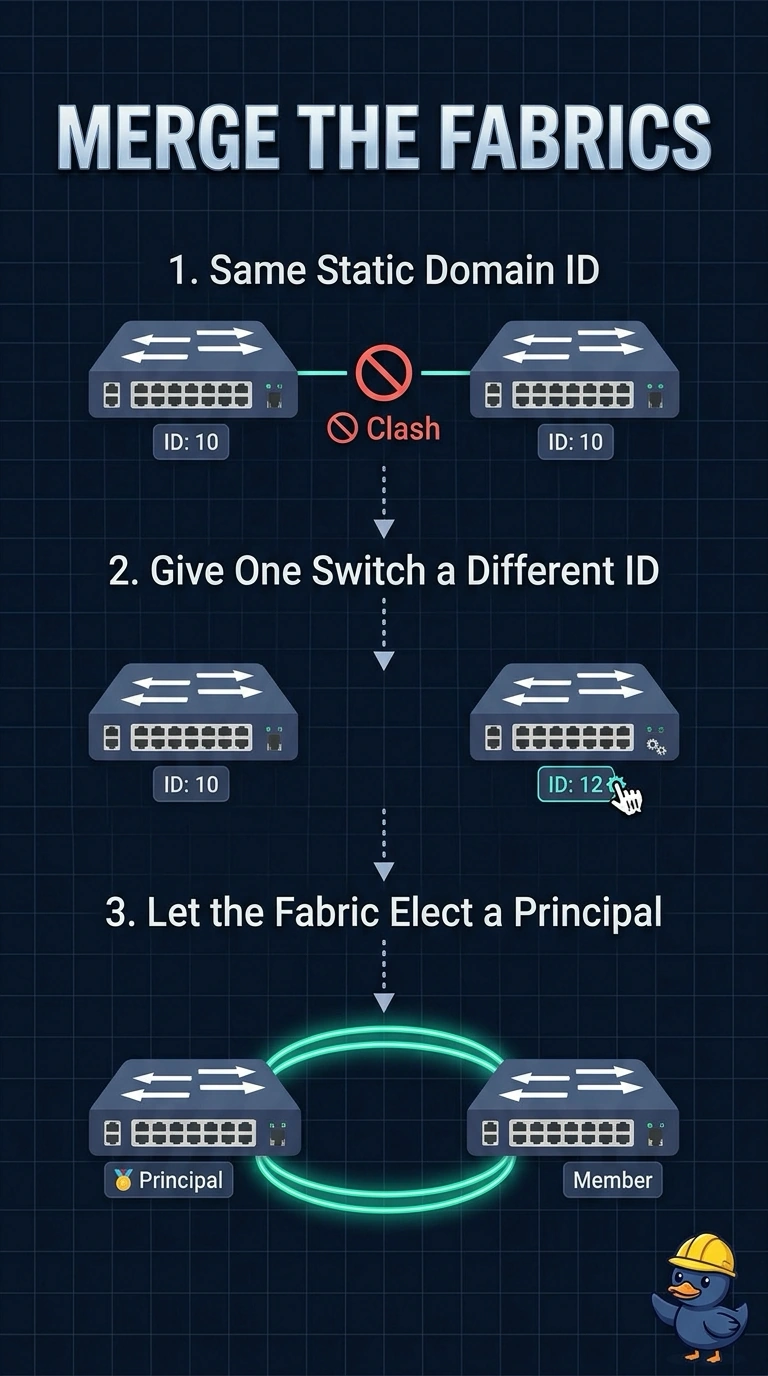
You can merge the fabrics by giving one switch a unique domain ID, so the principal switch can coordinate a single fabric. Permitting the default zone policy will not fix the overlapping IDs or clear the ISL isolation.
Full Explanation
Each switch in a Fibre Channel fabric needs a unique domain ID, and the principal switch coordinates fabric formation. When two MDS switches have the same static domain ID, the fabric detects the overlap and isolates the ISL to prevent both switches from using the same domain. Change one switch to a different domain ID so the principal can form a single fabric and the ISL can join it. Setting the default zone policy to permit affects access for unzoned members within a VSAN; it does not resolve a domain overlap or clear ISL isolation. Enabling NPV on both switches is not a repair: NPV makes a switch an edge device rather than a fabric switch with its own domain ID, changing the fabric design instead of resolving the duplicate IDs. Activating an empty zoneset programs zoning, but does not clear domain-overlap isolation. Exam caveat: after a domain ID change, attached devices may need to perform a new FLOGI because their FCIDs include the domain. Practical check: confirm the ISL isolation reason, assign a unique domain ID, then verify that the link becomes an E port and the fabric is stable.