
After a successful FLOGI, a host in a SaaS storage fabric receives a 24-bit Fibre Channel address. An engineer inspects the high 8 bits of that address. What do those bits identify?
Select an answer to reveal the explanation.
Short Explanation
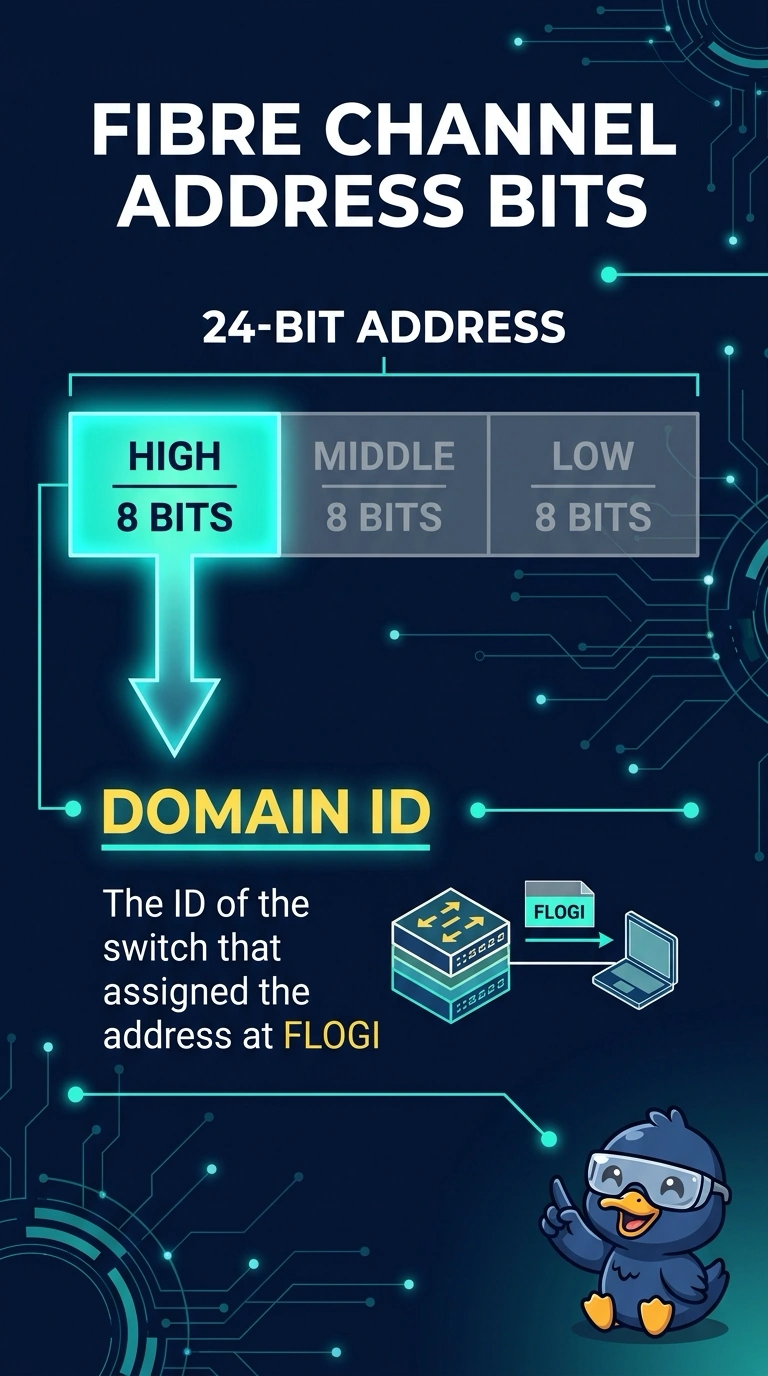
An FCID is a street address, and the high byte is the city. You read that byte as the domain ID of the switch that handed out the address at FLOGI. It is not the VSAN number, even though people mix those up because both feel like a segment ID.
Full Explanation
A Fibre Channel ID is 24 bits, split into domain, area, and port. The switch that accepts the FLOGI assigns the address, and the high 8 bits are that switch's domain ID. Looking at those bits tells the engineer which switch's domain the host logged into. The VSAN is a separate overlay that isolates fabrics on the same hardware. It is selected by the link and the VSAN membership, and it is not encoded as the high byte of the FCID. The active zoneset is a configuration object that decides who may talk to whom. Activating it does not rewrite the high byte of a host address. OSPF areas belong to the IP control plane. They do not appear inside a Fibre Channel ID assigned at FLOGI. Caveat: if the domain ID later changes, logged-in devices keep the old FCID until they log in again, so a stale high byte can point at a previous domain. Operational check: compare the high byte with the switch's domain ID in the FC domain status, and match the full FCID to the FLOGI and name-server entries for that host.