
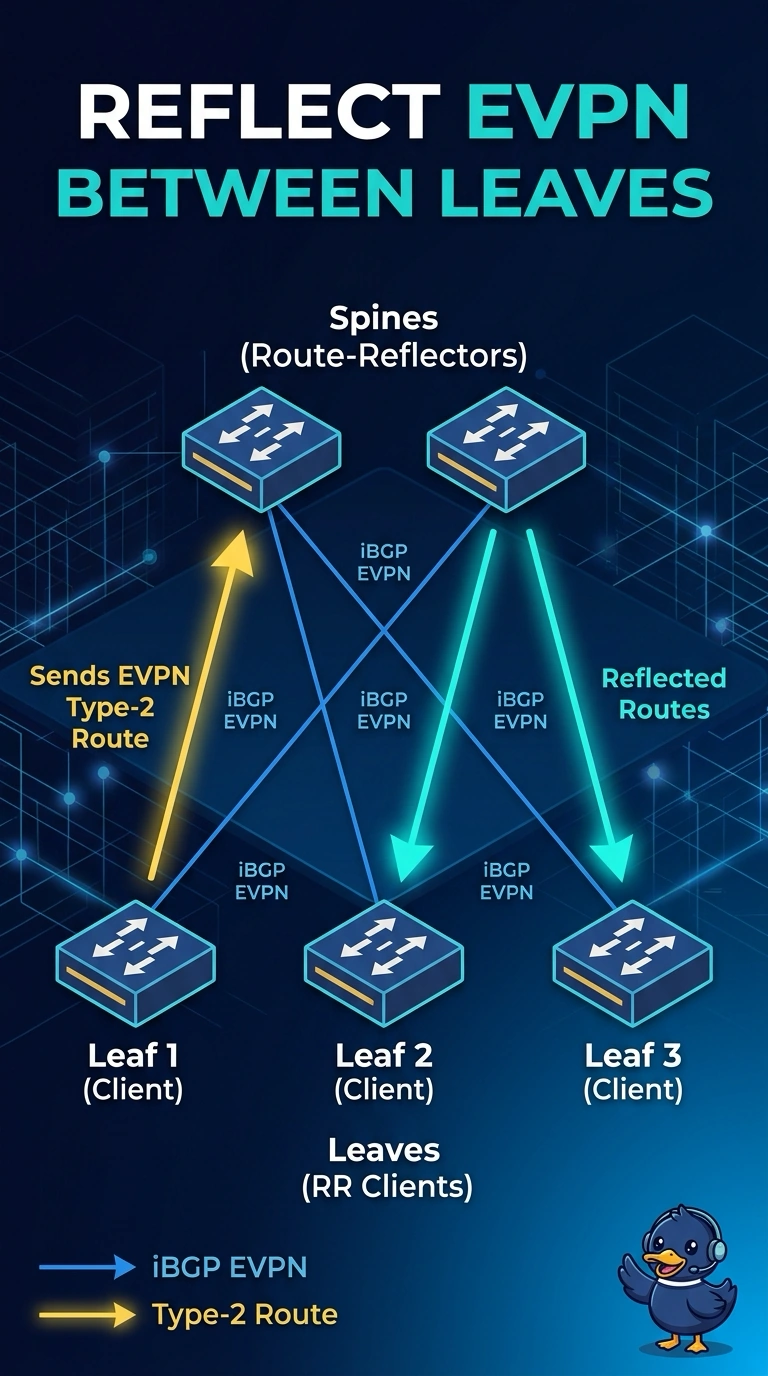
A logistics VXLAN fabric runs iBGP EVPN from the leaves to two spines. Underlay routes exist, and leaf A advertises a type-2 host route that leaf B never receives. The spines are not route reflectors. What is missing?
Select an answer to reveal the explanation.
Short Explanation
Your two branch offices both report to headquarters, and headquarters files each report in its own drawer. Without route-reflector clients, the spines do not advertise leaf A's iBGP-learned type-2 route to leaf B.
Full Explanation
EVPN host routes are BGP advertisements. Leaf B learns leaf A's type-2 route only if some BGP speaker is allowed to reflect it. Making each leaf a route-reflector client of the spines is what lets the spines advertise that iBGP-learned EVPN route onward. OSPF on the host VLAN is not how EVPN carries a host route, and the underlay is already routed. A route distinguisher keeps one tenant's prefixes distinct in BGP. Adding a second one does not turn a non-reflector into a reflector, and a type-2 route is not ignoring the VNI. PIM builds multicast trees. A unicast type-2 host route does not depend on PIM on the NVE loopback, and BUM replication is a separate problem from a missing host route. Caveat: the import route target on leaf B still has to accept the export route target leaf A attached, or the reflected route is received and then dropped by the VRF. Operational check: on a spine, confirm the leaf neighbors are route-reflector clients in the EVPN address family, then look for the type-2 route on leaf B.