
A game studio maps the player VLAN to VNI 10010 on leaf A and to VNI 10020 on leaf B. Hosts on the same leaf can talk. Bridged traffic between the leaves never lands in the same segment. What must match on both VTEPs?
Select an answer to reveal the explanation.
Short Explanation
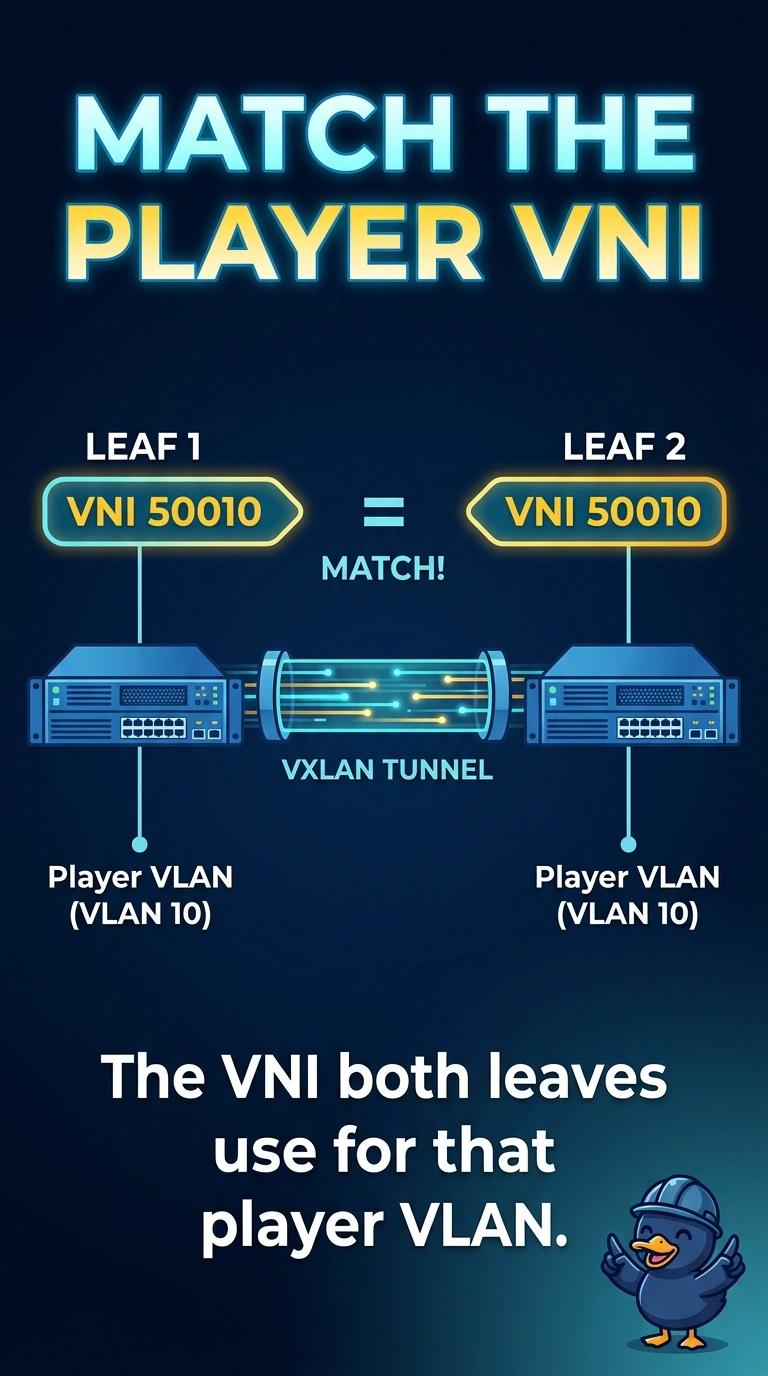
You labeled one end of the tunnel door 10 and the other end door 20. VXLAN delivers a bridged frame into the VNI you put on it. Leaf B is listening on a different VNI, so the player VLAN on leaf A is not the player VLAN on leaf B.
Full Explanation
A VLAN-to-VNI map has to agree on every VTEP that bridges that segment. Leaf A encapsulates into VNI 10010 and leaf B expects VNI 10020, so the decapsulated frame does not join the same bridge domain even though both switches call the local VLAN the player VLAN. Local switching never uses the VNI, which is why hosts on one leaf still talk. The anycast gateway MAC has to match when hosts move and keep the same gateway, and it does not substitute for the VNI. A mismatched MAC is a different break from a mismatched VNI. The OSPF process tag is local to each switch. Underlay neighbors do not need the same tag, and the tag is not the overlay segment identifier. HSRP is not how a VXLAN anycast gateway is built. An HSRP group number on the player VLAN does not map the VNI. Caveat: the underlay still has to provide reachability between the NVE source addresses, or matching VNIs never form a tunnel. Operational check: compare the VLAN-to-VNI map on both leaves and make the player VLAN use one VNI.