
A game studio's VTEPs bridge each VXLAN segment and answer the local anycast gateway, yet a host on one leaf cannot reach a host subnet that lives on another leaf. Which identifier carries that routed traffic in symmetric IRB?
Select an answer to reveal the explanation.
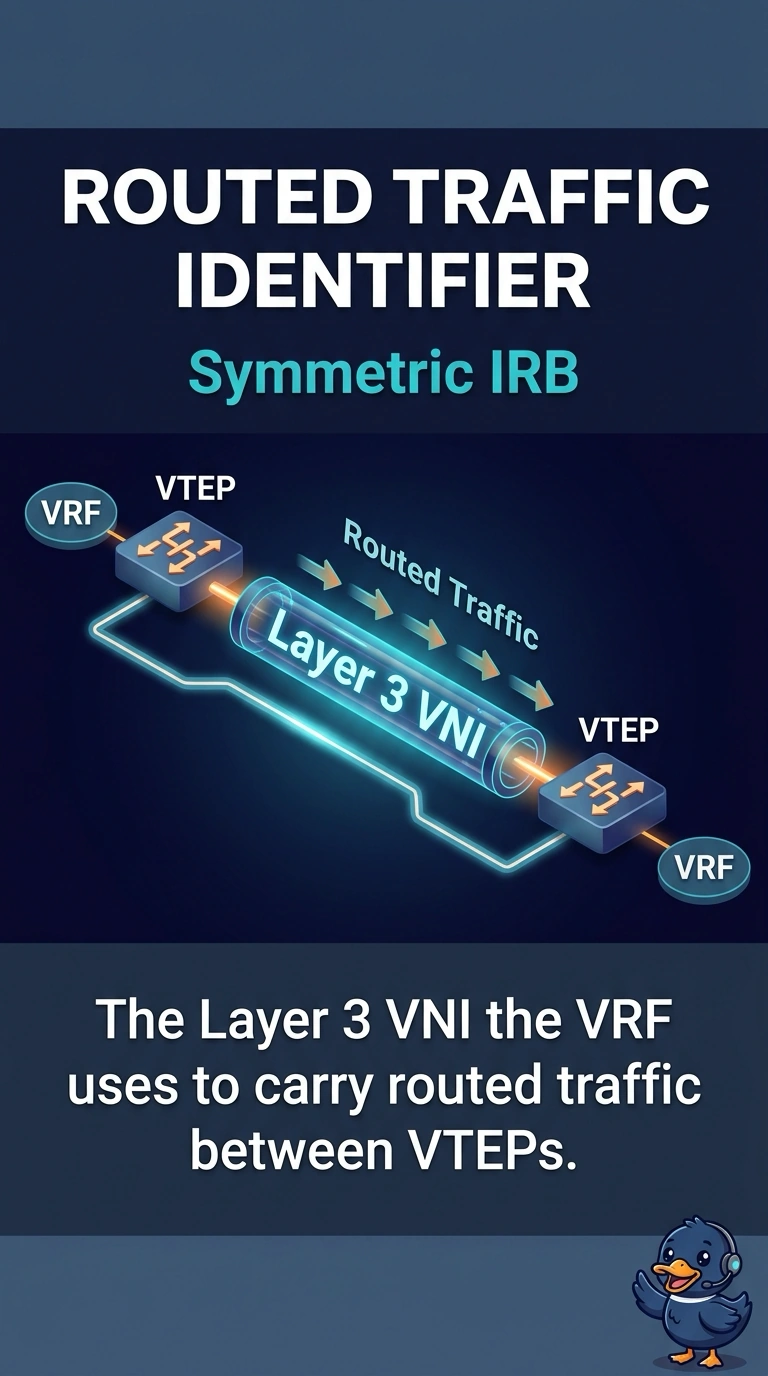
Short Explanation
Local delivery can work while the highway between towns was never paved. You still need the Layer 3 VNI, because that is the overlay symmetric IRB uses to carry routed traffic from one leaf to another. A different gateway MAC on each leaf does not build that road, and it is not the missing identifier here.
Full Explanation
In symmetric IRB, each VTEP routes for its local hosts and then sends the inter-subnet packet across a shared Layer 3 VNI associated with the VRF. Bridging inside a Layer 2 VNI, and answering the local anycast gateway, can both succeed while that Layer 3 VNI is absent, which is why hosts on different leaves in this studio cannot reach each other's subnets. The missing identifier is that Layer 3 VNI on the VTEPs. A unique anycast gateway MAC per leaf breaks gateway recognition for moved hosts. It is not how routed traffic is carried between leaves, and making the MAC unique would add a fault rather than a path. The OSPF process tag is local to each switch. Underlay adjacencies do not require identical tags, and the tag does not identify the routed overlay. The vPC peer-keepalive only tests whether a vPC peer is alive. It does not elect a leaf to route between VXLAN subnets, and these leaves need not be a vPC pair at all. Caveat: the VRF route targets and the underlay reachability between VTEP loopbacks still have to be healthy, or a configured Layer 3 VNI has nowhere to forward. Operational check: confirm the same Layer 3 VNI is up on the VRF on both leaves, then test a host on one leaf pinging a remote subnet and watch the routed overlay counter.