
A national retailer built an ACI VMM domain for vCenter and tied that domain to a static VLAN pool. Port groups for the associated EPGs never appear in vCenter. What kind of VLAN pool does that VMM domain require?
Select an answer to reveal the explanation.
Short Explanation
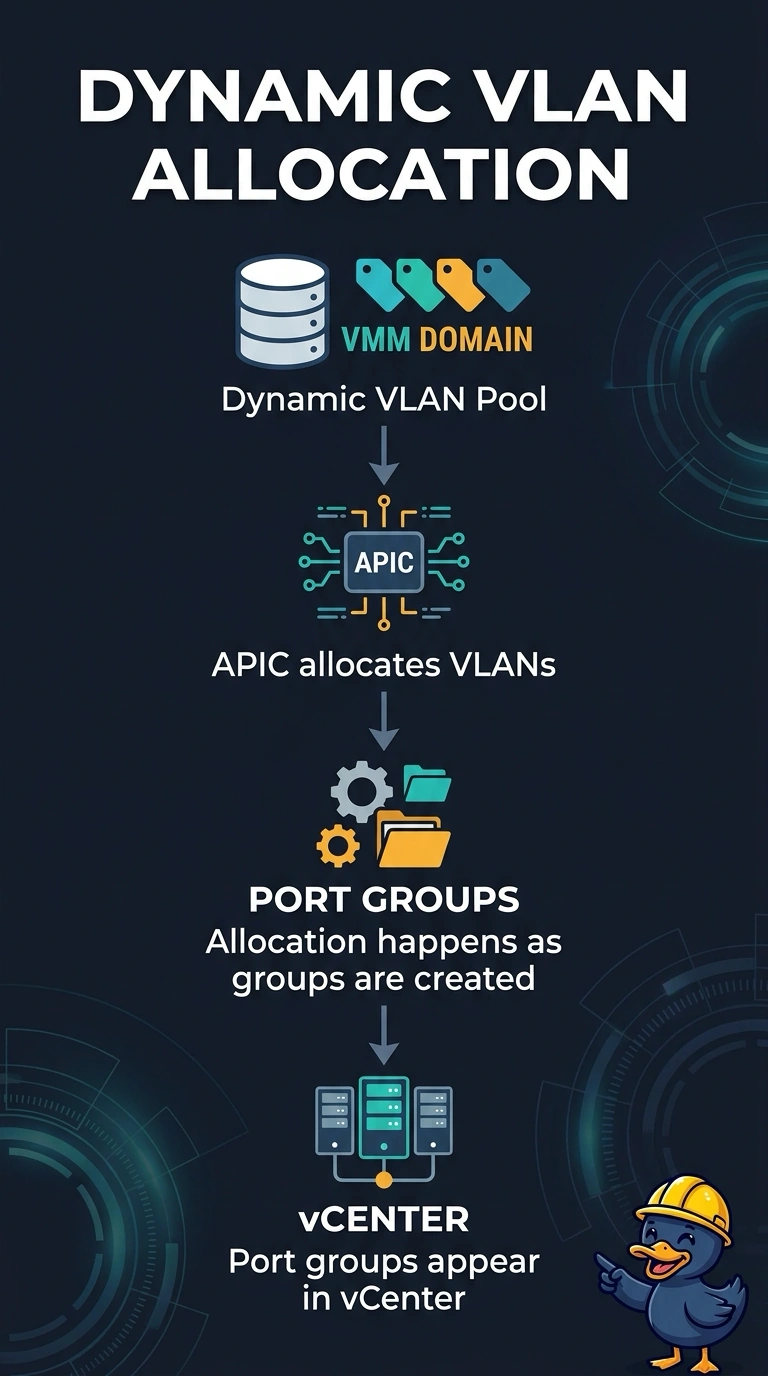
The carpenter is trying to use a box of preprinted room numbers for a building that issues numbers as guests arrive. You give the VMM domain a dynamic VLAN pool so the APIC can allocate a VLAN when it creates each port group in vCenter. A static pool is the wrong drawer for that job.
Full Explanation
An ACI VMM domain for vCenter lets the APIC create port groups on a distributed switch and allocate VLANs for EPGs that use the domain. That allocation comes from a dynamic VLAN pool attached to the VMM domain. The retailer tied the domain to a static pool, which is the kind of pool used for physical domains and fixed bindings, so the APIC does not have a dynamic range to draw from and the port groups never appear. Sharing the physical domain's static pool does not satisfy the VMM requirement. A WWNN pool belongs to server Fibre Channel identity on a compute platform. VMM port groups are Ethernet objects and are not built from node names. The infrastructure VLAN carries ACI fabric control traffic. It is not the VLAN range vCenter uses for tenant EPG port groups, and putting tenant EPGs there would mix endpoint traffic with the fabric. Caveat: the VMM domain also has to be associated with the AAEP on the leaf interfaces, or the port groups can exist in vCenter while the leaves never learn the VLANs. Operational check: attach a dynamic pool to the VMM domain, associate an EPG, and confirm the port group appears in vCenter with a VLAN from that pool.