
On a national retailer vPC pair, a file server sends return traffic to the physical MAC of peer A, but the hash delivers those frames to peer B and the flow fails. Peer-gateway is off. What does enabling peer-gateway change?
Select an answer to reveal the explanation.
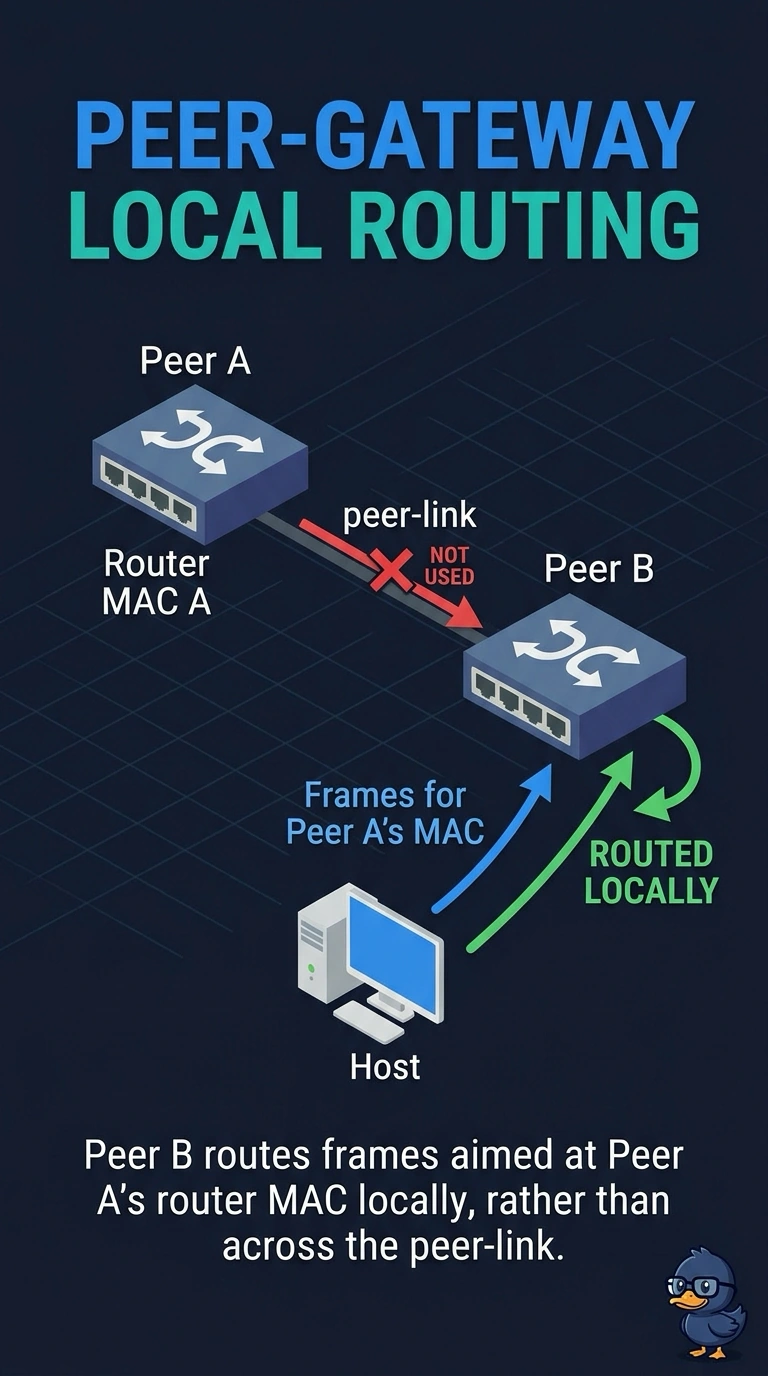
Short Explanation
Peer-gateway lets one coworker sign for a package addressed to the other. You enable it so peer B can route frames that are aimed at peer A's router MAC, instead of trying to hand them across the peer-link where the vPC rules get in the way. Moving the HSRP active role does not fix a hash that lands on the wrong peer.
Full Explanation
A vPC hash can deliver a frame to the peer that does not own the destination router MAC. Without peer-gateway, peer B treats a frame aimed at peer A's physical router MAC as something to bridge across the peer-link, and the vPC loop-avoidance rule then prevents that frame from being sent back out a member port, so the file server flow fails. Peer-gateway allows the receiving peer to route the packet locally for the other peer's router MAC. Enabling it is the change that matches this retailer failure. HSRP preempt decides whether a higher-priority router takes the active role back. It does not make peer B forward frames addressed to peer A's MAC, and preempt is not required for peer-gateway. An anycast gateway MAC is a VXLAN construct that must match across VTEPs. Rewriting it does not change vPC behavior for a file server hashed to the wrong peer. OSPF MTU affects database exchange on a routed adjacency. Raising it on the peer-link does not pin a port-channel hash to peer A. Caveat: peer-gateway is for traffic addressed to the peer router MAC, and it is not a substitute for a broken peer-link. Operational check: enable peer-gateway, resend the file server flow, and confirm peer B forwards it without a trip across the peer-link.