
A retail bank server negotiates LACP, and the Nexus port-channel toward that server is set to on. The channel does not form. What change lets the link bundle?
Select an answer to reveal the explanation.
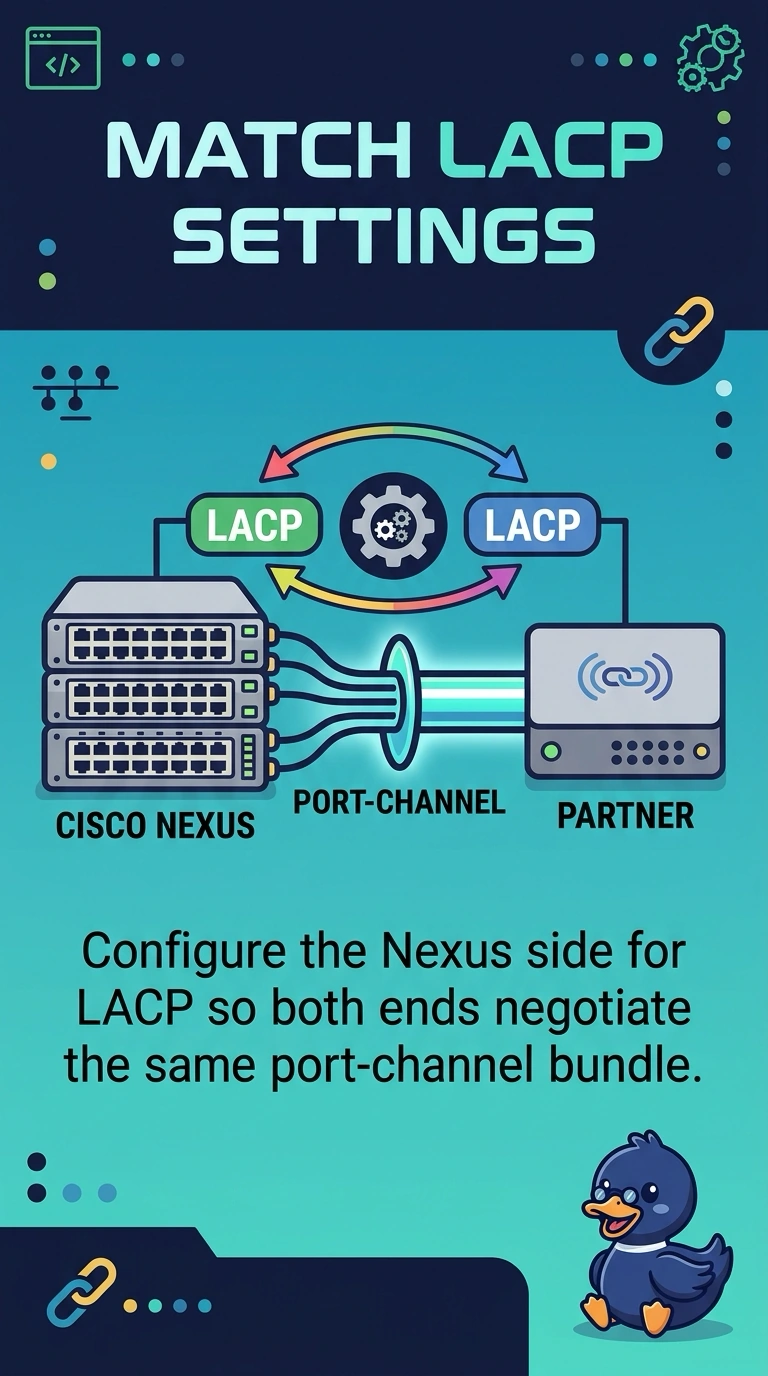
Short Explanation
LACP is a handshake, and one side is offering a handshake while the other side is just holding the cable. You set the Nexus port-channel to participate in LACP so it speaks the same protocol the bank server is already using. Mode on does not send those negotiation frames, so the bundle never agrees.
Full Explanation
Mode on is a static port-channel: the switch brings the members up without LACP negotiation. A server that is set to negotiate LACP sends LACP frames and expects a partner. With the Nexus side on and the server speaking LACP, there is no agreement and the channel does not form. Configuring the switch side for LACP gives both ends the same negotiation and lets the bundle come up. The vPC peer-link is the link between two vPC peers. A server-facing port-channel does not wait for that peer-link to be down, and restoring it is unrelated to this LACP mismatch. Rapid PVST elects a root bridge for spanning tree. LACP does not wait for that election before it can bundle, and moving the root does not make a static side speak LACP. HSRP version 2 changes the gateway group range and the virtual MAC. It does not negotiate Ethernet port-channels. Caveat: one side can be LACP active and the other passive, but at least one side must be active or no negotiation starts. Operational check: set the Nexus port-channel to LACP, confirm both ends show a bundled member, and confirm the server no longer reports an unbundled NIC.