
A national retailer bridge domain uses hardware proxy, and ARP flooding is off. A silent register never transmits, so other servers cannot reach it. Where does unknown unicast for that register go?
Select an answer to reveal the explanation.
Short Explanation
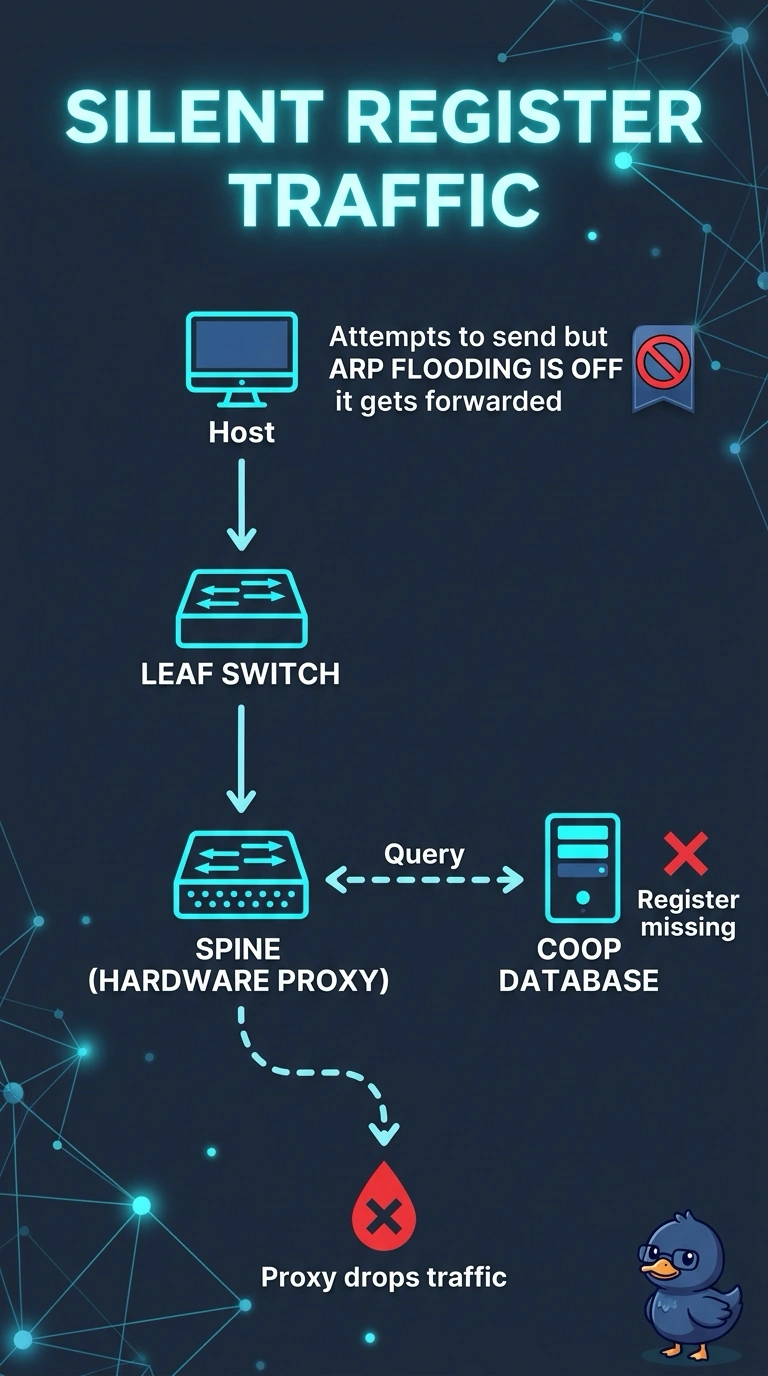
Hardware proxy is a receptionist who only calls people already on the list. You send unknown unicast to the spine, and the spine drops it when this silent register has never been learned. Flooding would shout down every hallway, and that is not the mode this bridge domain is using.
Full Explanation
In a bridge domain set for hardware proxy, a leaf does not flood unknown unicast to the other leaves. It forwards the frame to the spine proxy, and the spine looks for the destination in the COOP endpoint database. A register that has never transmitted is not in that database, so the proxy has no leaf to send the frame to and drops it. That matches servers that cannot reach a silent device. Flood mode is the alternative setting, and it is not the setting in this bridge domain. Broadcast is still a flooded class of traffic, but unknown unicast in hardware-proxy mode is not broadcast. A direct leaf-to-leaf cable is not a fabric path in a standard pod, and the fabric does not build one just because an endpoint is silent. A contract permits traffic between endpoint groups that have already been classified. It does not learn a silent endpoint from an unknown unicast frame, and it is not the lookup the spine performs. Caveat: enabling ARP flooding, or placing a static endpoint, is how you make a silent host discoverable without changing the unknown-unicast mode to flood. Operational check: confirm the bridge domain is hardware proxy with ARP flooding disabled, then check that the register is absent from the endpoint table until it sends traffic.