
During a broadcast storm, a retail bank engineer suggests shutting down Nexus Dashboard to stop the frames. What is the effect on forwarding?
Select an answer to reveal the explanation.
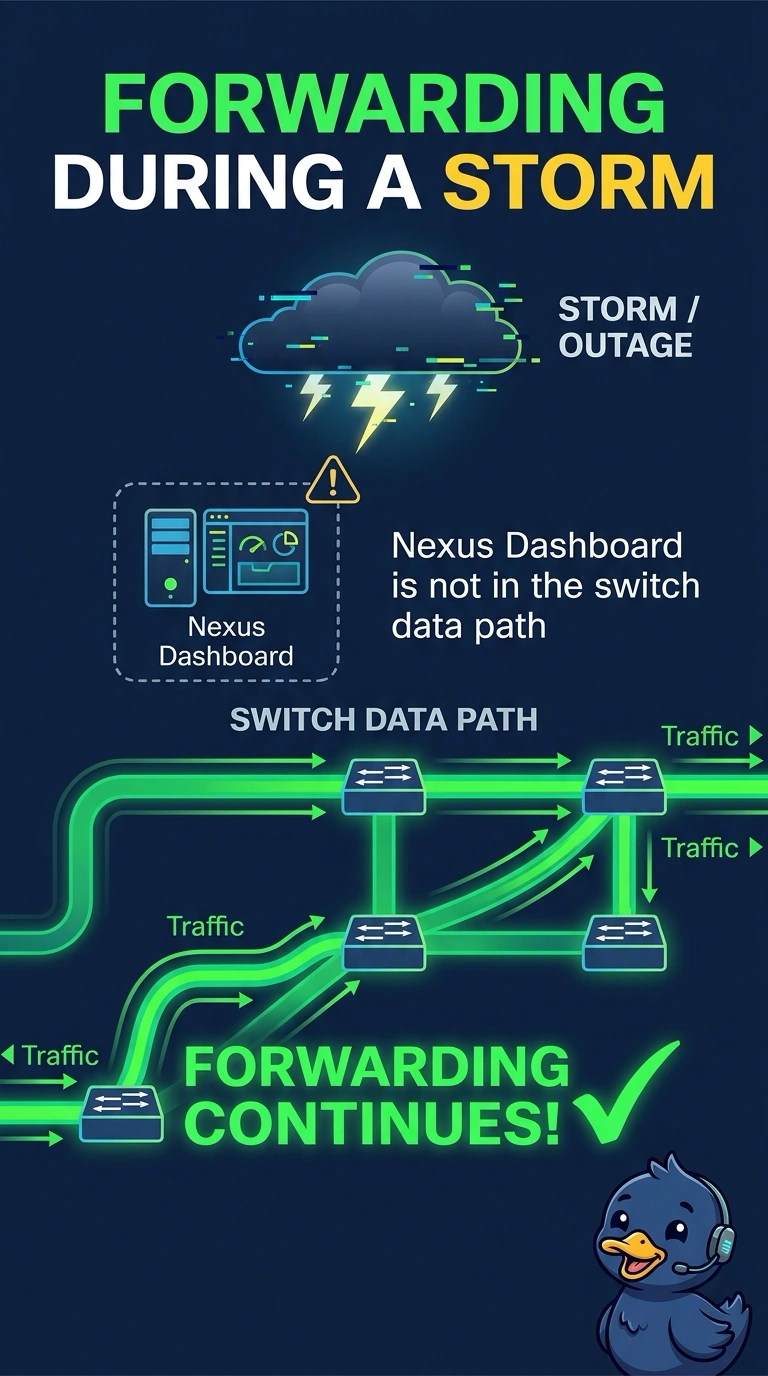
Short Explanation
Nexus Dashboard is a control tower, and the planes do not stop flying because the tower locks its office. You shut the dashboard and the switches keep forwarding the storm, because the dashboard is not a hop in the data path. The storm has to be stopped on the switches that are actually flooding it.
Full Explanation
Nexus Dashboard is the platform for fabric control, orchestration, and insights. It manages and observes the network. It does not sit in the forwarding path of the bank's switches, so shutting it down does not drop, filter, or stop frames the switches are already flooding. The broadcast storm continues until the switching topology is corrected. The dashboard is not a spanning-tree root. Root bridge election happens among the switches, and powering off the dashboard does not change which switch is root. vPC keepalives are links or routed reachability between the peer switches. The dashboard is not that keepalive, and shutting it does not suspend member ports. MACsec keys are negotiated hop by hop on the links where MACsec is configured. The dashboard does not hold a single key that encrypts every hop, and taking it down does not tear down those sessions by itself. Caveat: a controller that is up can still push a bad policy later, but an outage of the dashboard is not a data-plane filter for a storm already in progress. Operational check: during a test, note that interface counters keep increasing with the dashboard unreachable, then stop the storm by correcting the loop on the switches.