
A retail bank's vPC pair runs HSRP. Some hosts address frames to the other peer's own router MAC, and the receiving peer is not routing them locally and forces them toward the peer-link. Which vPC feature lets the receiving peer route them?
Select an answer to reveal the explanation.
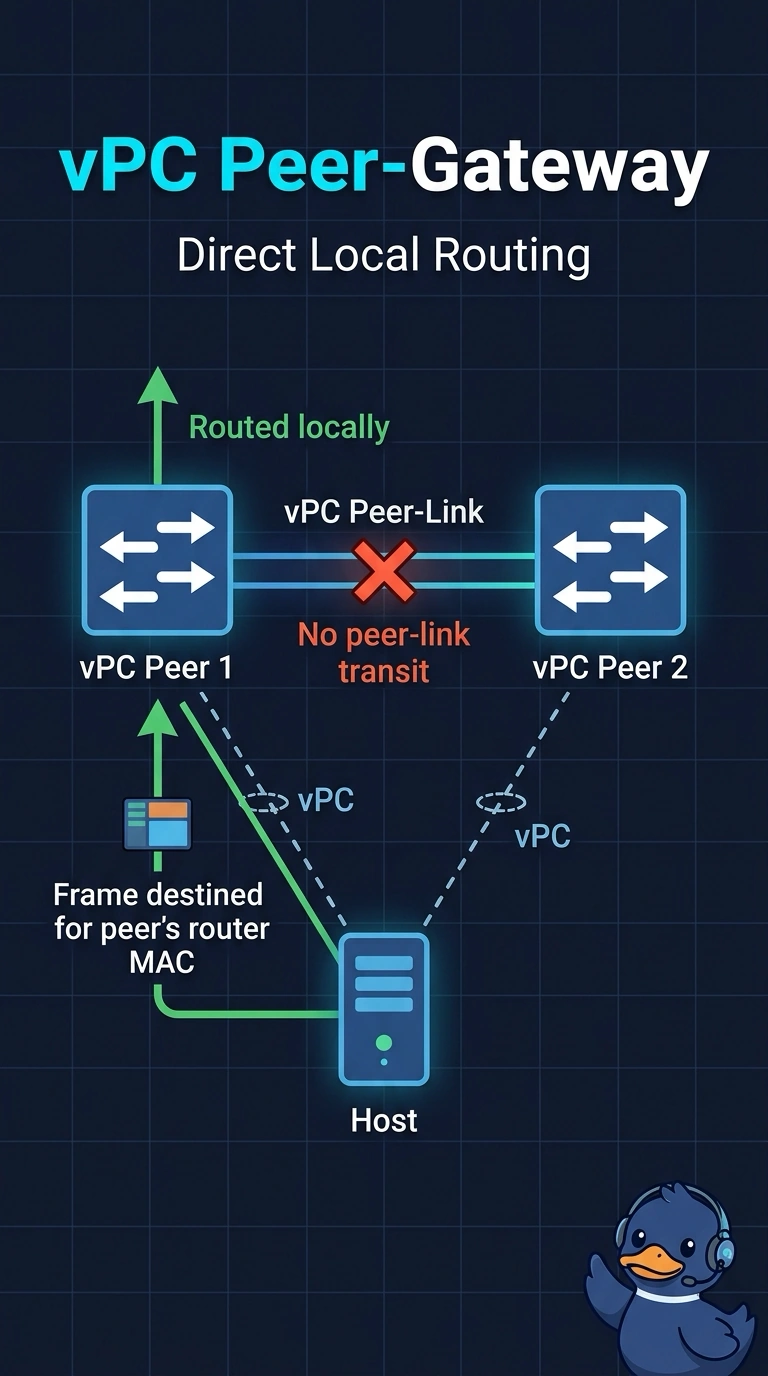
Short Explanation
Peer-gateway lets either teammate catch a pass aimed at the other's jersey. You enable it so the vPC peer that receives a frame for the other peer's router MAC can route that frame locally. A second keepalive does not elect a new gateway for each hashed flow.
Full Explanation
With vPC, a port-channel hash can deliver a frame to the peer that did not own its destination MAC. Some hosts (often storage or load-balancer appliances) address frames to the other peer's own router MAC instead of the HSRP virtual MAC. Without peer-gateway, the receiving peer sends it across the peer-link, and traffic that then needs to go back out a vPC member can be dropped by vPC loop avoidance. Peer-gateway lets each peer route packets addressed to the other peer's router MAC, so the receiving peer handles the gateway frame locally. That is the feature the bank is missing. A second keepalive improves detection of a dead peer. It does not elect an HSRP role per flow, and HSRP still has one active router for the group. Shutting the peer-link is a failure, not a feature. With keepalive still up, the secondary would suspend its vPC member ports, which removes forwarding rather than fixing the hash. An OSPF stub flag is an adjacency option. It does not move an HSRP virtual MAC, and the keepalive VLAN is not what assigns that MAC. Caveat: peer-gateway does not replace HSRP tracking or preempt when you want a specific peer to be active after a failure. Operational check: enable peer-gateway on both peers, send traffic that hashes to the standby peer, and confirm those packets are routed without crossing the peer-link.