
A game studio leaf receives EVPN prefixes for a new VRF, but those prefixes are imported into the production VRF. The route target on the new VRF was copied from production. Which value should change so only the new VRF imports them?
Select an answer to reveal the explanation.
Short Explanation
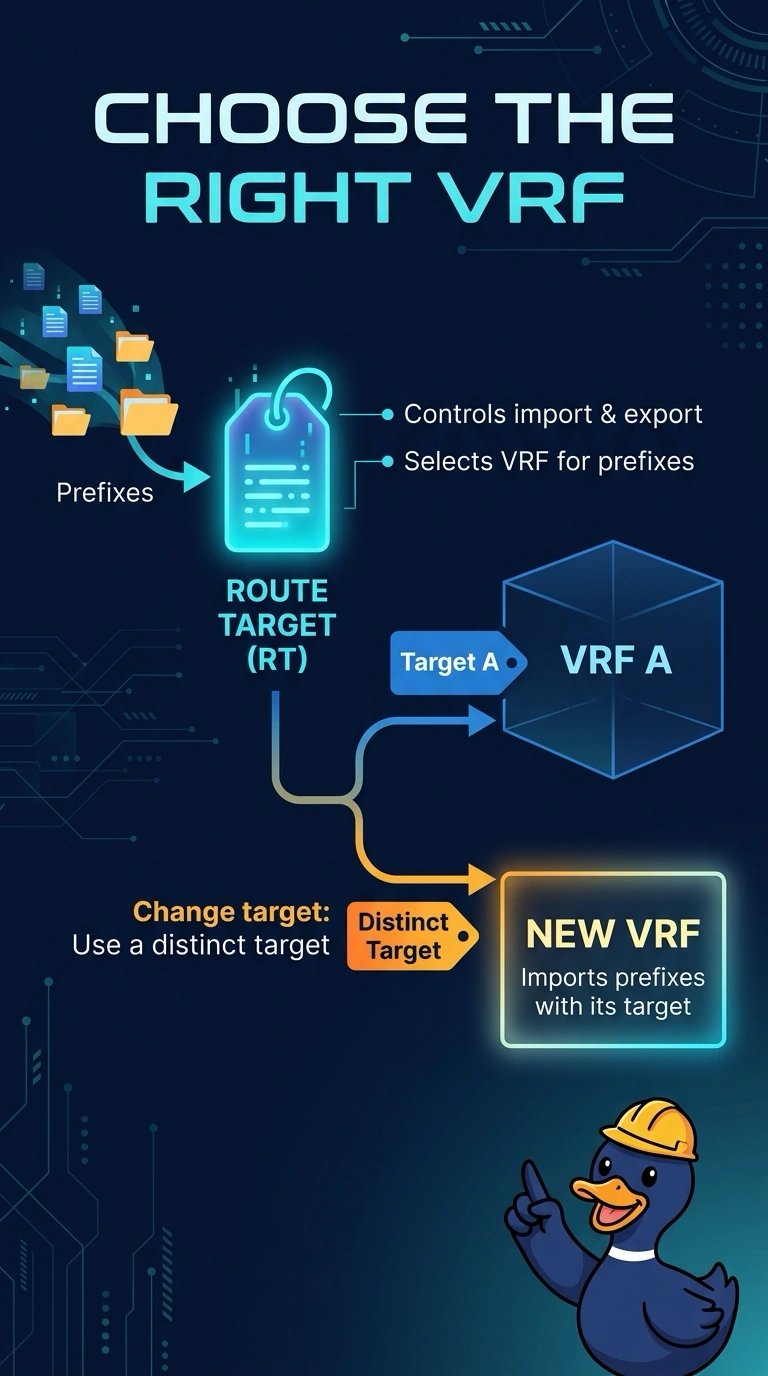
A route target is the luggage tag that decides which VRF unpacks the prefix. You copied the production tag onto the new VRF, so the new prefixes are imported by production. Change the route target, not the underlay process tag or the gateway group.
Full Explanation
In MP-BGP, the route distinguisher makes a prefix unique when address spaces overlap, and the route target is the extended community that controls import and export. The studio prefixes are arriving and landing in the production VRF because the route target was copied, so production's import matches the new VRF's export. Changing the route target so only the new VRF imports its own prefixes stops that leak. The underlay OSPF process tag names the local OSPF process. It is not consulted when a VRF decides which EVPN prefixes to import. HSRP elects a gateway and owns a virtual address. Its group number is not written into a route target, and changing the group does not move prefixes between VRFs. A vPC domain ID identifies a vPC pair. It is not required to equal a route distinguisher, and it does not filter EVPN imports. Caveat: both the export target on the VRF that advertises and the import target on the VRF that should receive have to agree, or fixing only one side still drops or leaks the prefixes. Operational check: set distinct route targets for the new VRF, then confirm the prefixes import there and no longer appear in the production VRF.