
A national retailer has a vCenter VMM domain in ACI. A web EPG is associated only with a physical domain, and no matching port group appears in vCenter. What makes the APIC push that port group?
Select an answer to reveal the explanation.
Short Explanation
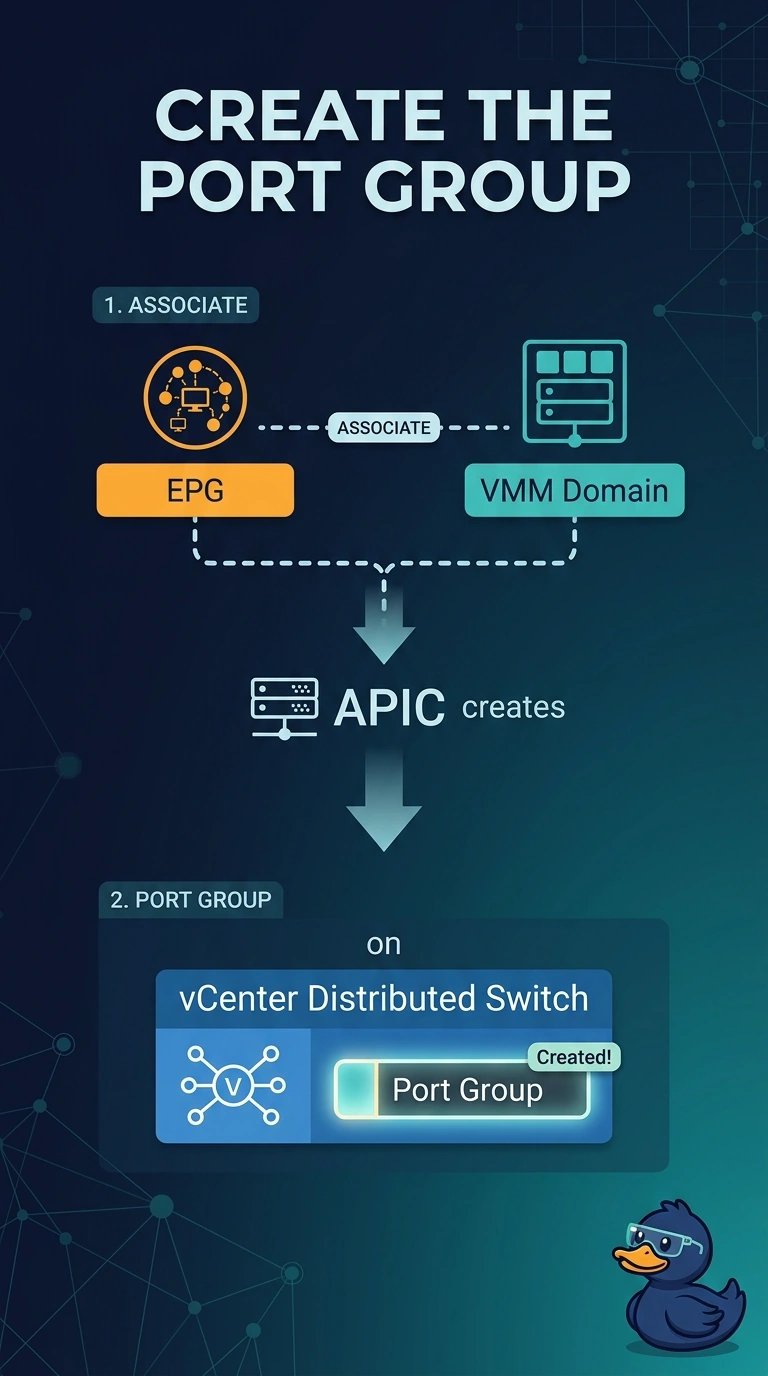
A VMM domain is the bridge between the APIC and vCenter's distributed switch. You associate the EPG with that VMM domain so the APIC pushes a port group, instead of leaving the EPG only on a physical domain. A spine port does not grow vCenter port groups.
Full Explanation
When an EPG is associated with a VMM domain, the APIC pushes a port group for that EPG onto the vCenter distributed switch and can program the corresponding dynamic VLAN on the leaf ports that face the hosts. The retailer associated the web EPG only with a physical domain, so vCenter never receives a port group. Associating the EPG with the VMM domain is the missing push. Creating a port group on a spine has no meaning in this integration. Spines are not the vCenter attachment, and the APIC does not copy handmade spine objects into the distributed switch. A Fibre Channel VSAN is a SAN isolation construct. Binding an EPG to a VSAN does not create a vCenter port group. vPC peer-gateway changes how a vPC pair routes frames destined to a peer gateway MAC. It does not talk to vCenter. Caveat: the VMM domain still needs a dynamic VLAN pool and a link to the attachable access entity profile on the host-facing interfaces, or the new port group has no VLAN programmed on the leaf. Operational check: associate the EPG with the VMM domain, confirm the port group appears in vCenter, and confirm a test VM in that port group is learned as an endpoint.