
A national retailer's VTEPs use the same anycast gateway MAC, and same-subnet bridging works. Routed traffic between two VXLAN subnets in one VRF fails. The leaves use different Layer 3 VNIs for that VRF. What must match?
Select an answer to reveal the explanation.
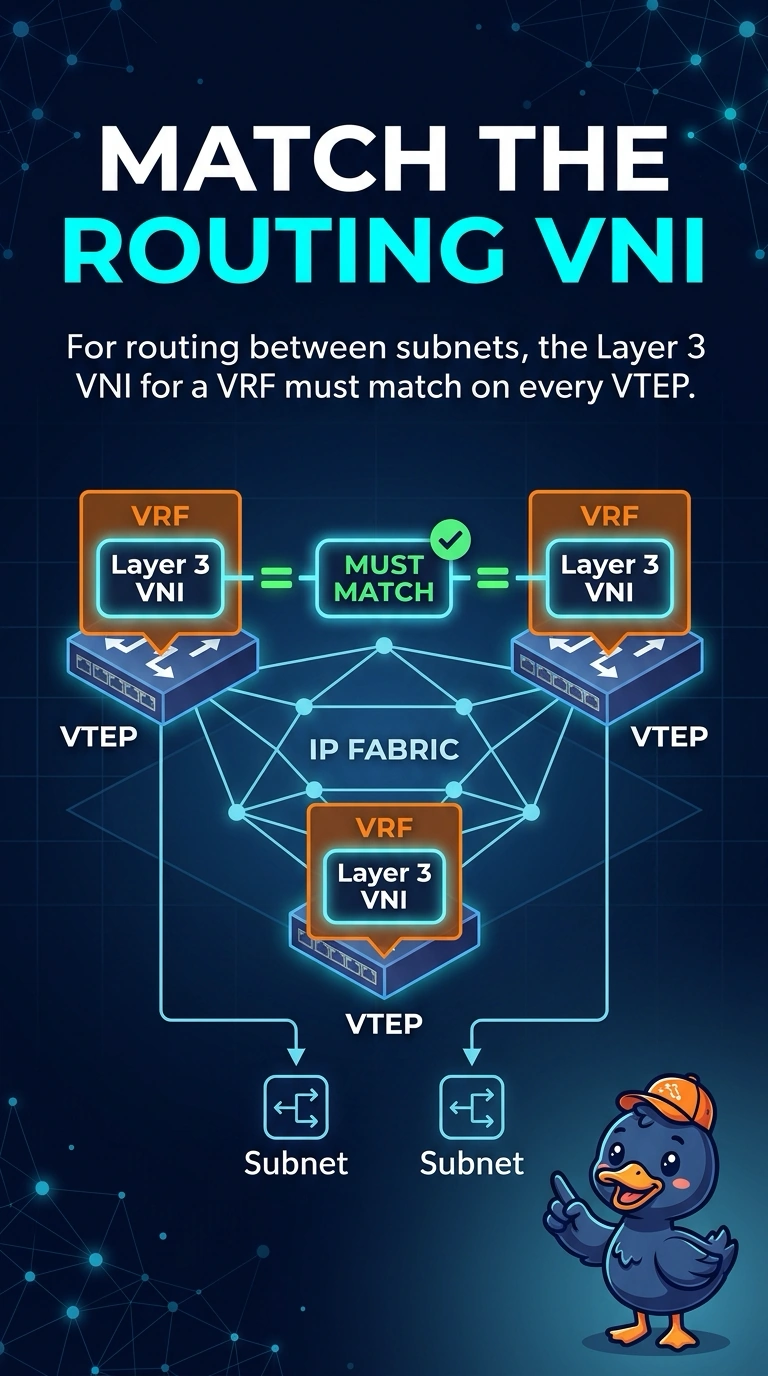
Short Explanation
Same-subnet bridging can succeed while the elevator between floors has two different numbers. You use one Layer 3 VNI for the VRF on every VTEP that routes between these subnets. Matching the anycast MAC was already done, and it does not align the routed overlay.
Full Explanation
Symmetric IRB routes between VXLAN subnets by sending the packet across a per-VRF Layer 3 VNI. Every VTEP that participates in that VRF has to use the same Layer 3 VNI, or the routed packet has no common overlay to land on. The retailer leaves disagree on that VNI, so inter-subnet traffic fails even though bridging works and the anycast gateway MAC already matches. The L2 VNI can be correct for same-subnet traffic without repairing a mismatched L3 VNI. The OSPF process tag is local and does not have to match for underlay adjacency or for IRB. Duplicating a BGP router ID on purpose makes BGP unstable and does not assign a Layer 3 VNI. The vPC peer-keepalive only tests whether a vPC peer is alive. It does not choose the L3 VNI, and VTEPs that are not a vPC pair still need the same L3 VNI. Caveat: the VRF route targets and the L2 VNI mapping still have to agree, or fixing only the L3 VNI leaves host routes unimported. Operational check: set one Layer 3 VNI for the VRF on each VTEP, confirm both leaves show that VNI, and retest a ping between the two subnets.