
A retail bank bridge domain uses hardware proxy for unknown unicast. A frame arrives for a MAC address that no leaf has learned. How does the fabric handle that frame?
Select an answer to reveal the explanation.
Short Explanation
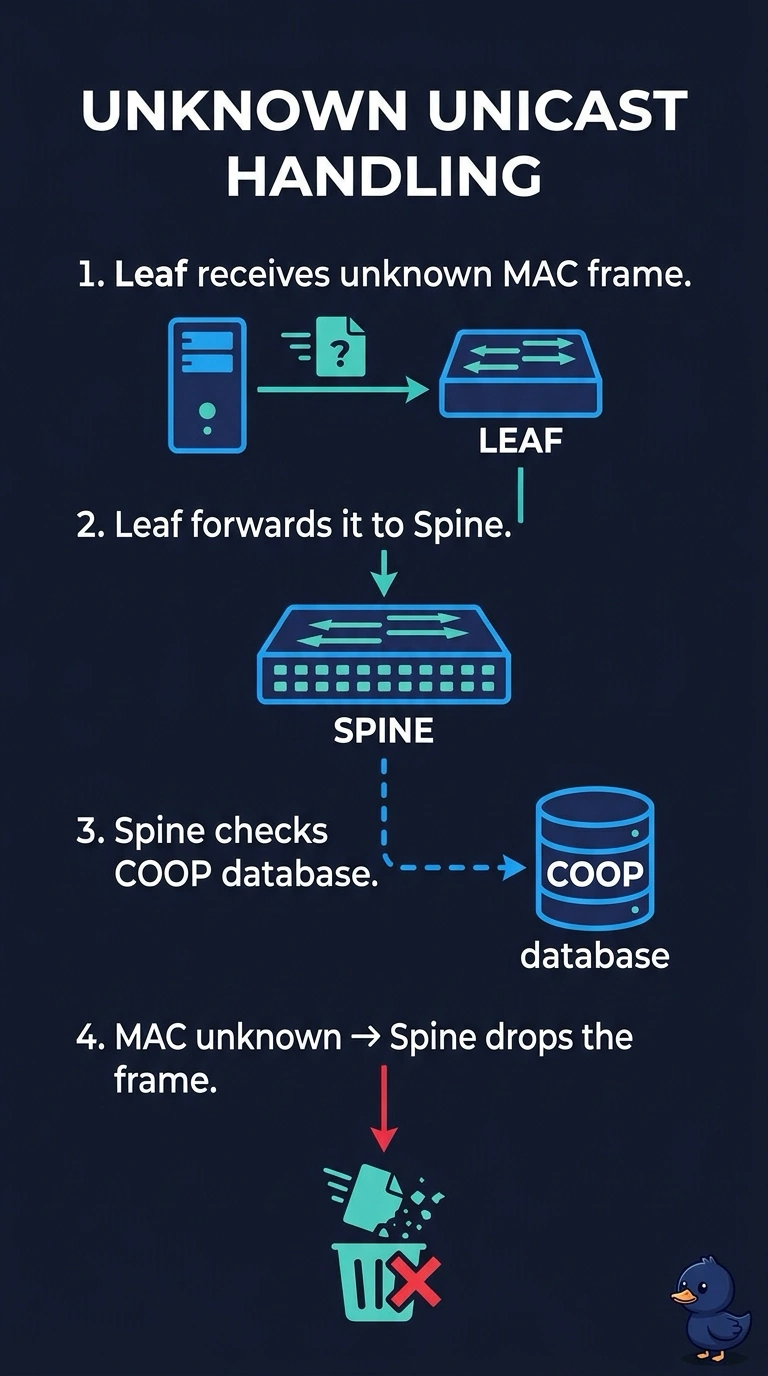
Hardware proxy is a receptionist with a directory, not a shout down every hall. You send the unknown unicast to the spine, which checks COOP and drops the frame when that MAC is absent. Flooding every server port is the opposite of this bridge domain setting.
Full Explanation
In a bridge domain set for hardware proxy, a leaf does not flood unknown unicast to every other leaf. It forwards the frame to a spine proxy. The spine looks up the MAC in the COOP endpoint directory. If some leaf has reported the endpoint, the spine forwards the frame there. If no leaf has learned the MAC, the spine drops the frame. That is how the bank fabric handles this unknown destination. The APIC is the controller. It does not forward tenant frames out the out-of-band port. Hardware proxy is the alternative to flood. Reading it as permission to flood every server port reverses the setting. A PIM rendezvous point is the root of a multicast shared tree. Unknown unicast in an ACI bridge domain is not sent there for COOP lookup. Caveat: a bridge domain set to flood behaves differently and will flood unknown unicast, so the proxy drop applies only while this bridge domain stays on hardware proxy. Operational check: confirm the bridge domain L2 unknown-unicast setting is hardware proxy, then verify a learned MAC is forwarded and an unknown MAC is not flooded to the other leaves.