
A national retailer cabled two ACI leaves directly to each other for extra bandwidth. That link never becomes a fabric port. How should a standard ACI fabric be cabled instead?
Select an answer to reveal the explanation.
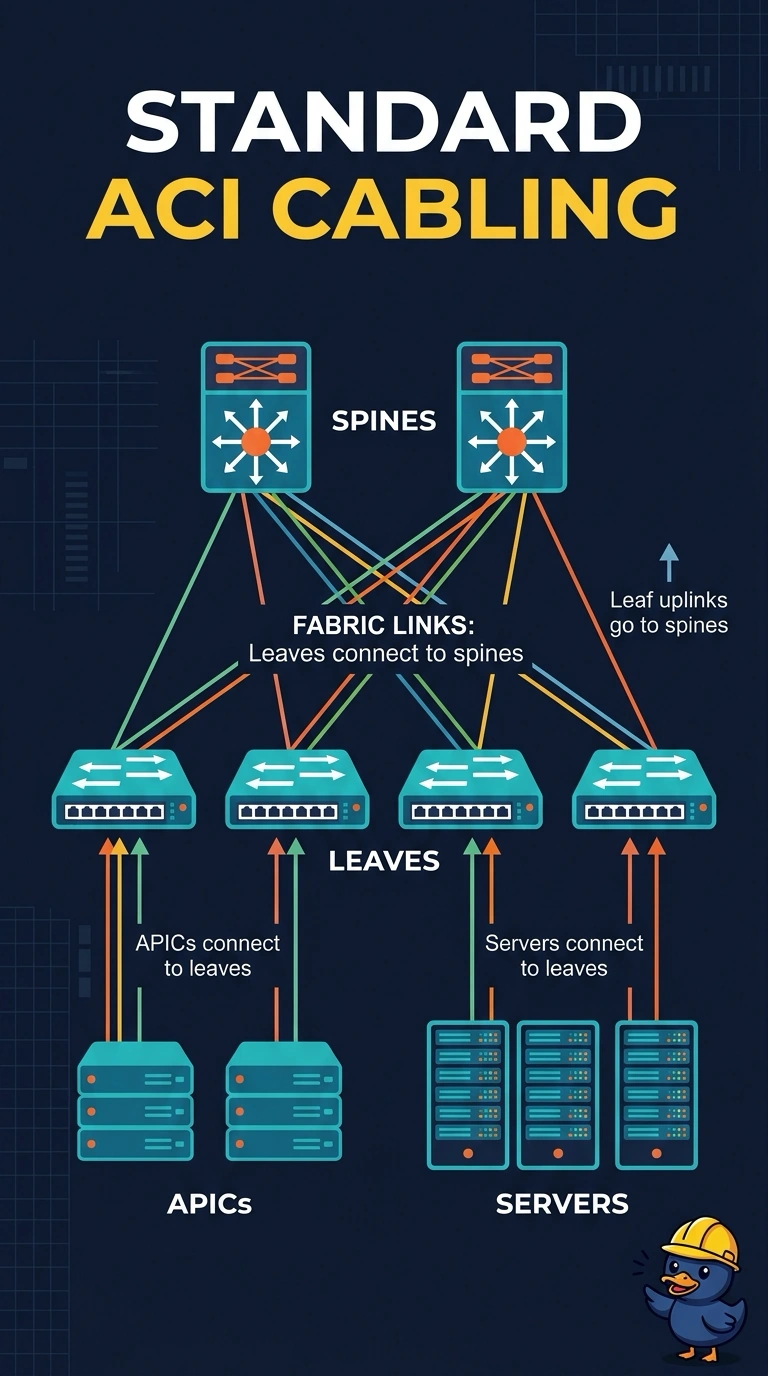
Short Explanation
ACI is a hub-and-spoke of spines and leaves, not a daisy chain of leaves. You connect leaves only upward to spines, hang servers on leaves, and attach the APICs to leaves too. A leaf-to-leaf patch is not a fabric link, so it will not become one because you wanted more bandwidth.
Full Explanation
A standard ACI fabric is a Clos: every leaf uplinks to the spines, and leaves do not form fabric ports to other leaves. Servers and other endpoints attach to leaves. The APICs also attach to leaf ports, which is how the controllers join the fabric they manage. A direct leaf-to-leaf cable has no role in that discovery and stays outside the fabric, which is why the retailer's extra link never becomes a fabric port. Cabling leaves into a ring and hanging spines only off the APICs inverts the design. The spines are the fabric core, not attachments of the controllers. Cabling APICs to spines and leaves only to APICs is the mirror-image mistake. Controllers are not the transit path between leaves. vPC peer-links are an NX-OS construct. ACI fabric discovery does not require a vPC peer-link between leaves, and adding one does not turn a leaf-to-leaf cable into a fabric port. Caveat: multi-pod and remote-leaf designs add their own links, and those still are not a random leaf-to-leaf patch inside one pod. Operational check: move the extra cable so each of those leaves uplinks to the spines, then confirm both leaves discover as fabric nodes and the former leaf-to-leaf port is no longer expected to be one.