
A bank sets a vNIC template MTU to 9000. The QoS system class that vNIC uses still has an MTU of 1500. Large frames from the blade are dropped. Which MTU has to be raised so those 9000-byte frames can pass?
Select an answer to reveal the explanation.
Short Explanation
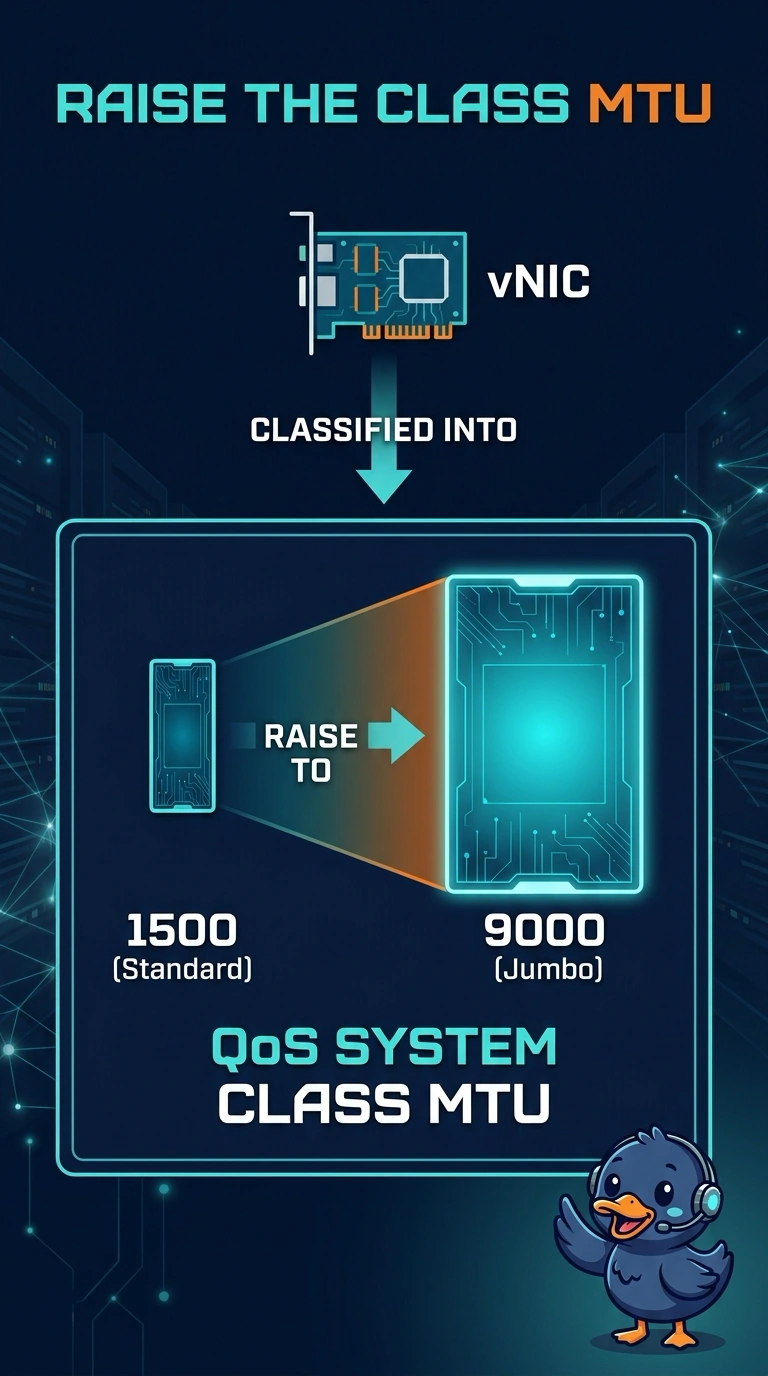
You printed a shipping label for a crate the doorway cannot admit. The vNIC is allowed to build a 9000-byte frame, and the QoS system class is still a 1500-byte door. UCS drops frames when the vNIC MTU is larger than that class MTU, so the class is what you raise.
Full Explanation
UCS classifies a vNIC into a QoS system class, and the class MTU is the ceiling for frames on that vNIC. Cisco's vNIC MTU guidance is an integer from 1500 to 9000, and that value must be less than or equal to the MTU of the QoS system class or packets can be dropped. The bank set 9000 on the template and left the class at 1500, so the oversized frames never make it. Raising the class MTU to cover 9000 removes that drop. The chassis discovery link count decides how many IOM links are required to discover a chassis. It does not cap a vNIC MTU. A WWPN pool hands out Fibre Channel port names. It has no frame-size setting. Fabric interconnect cluster priority is not an MTU knob, and changing it does not widen the QoS class. Caveat: the path north of the fabric interconnect, including the uplink and the switch it lands on, also has to pass the larger frame or the drop just moves one hop upstream. Operational check: raise the system class MTU, then send a 9000-byte frame from the blade and confirm it is not dropped on the fabric interconnect.