
A regional hospital applied a new host firmware package to a service profile. Blade BIOS can change, but the chassis IOM and the fabric interconnects stay on the previous code. Which package updates the IOM and the fabric interconnects?
Select an answer to reveal the explanation.
Short Explanation
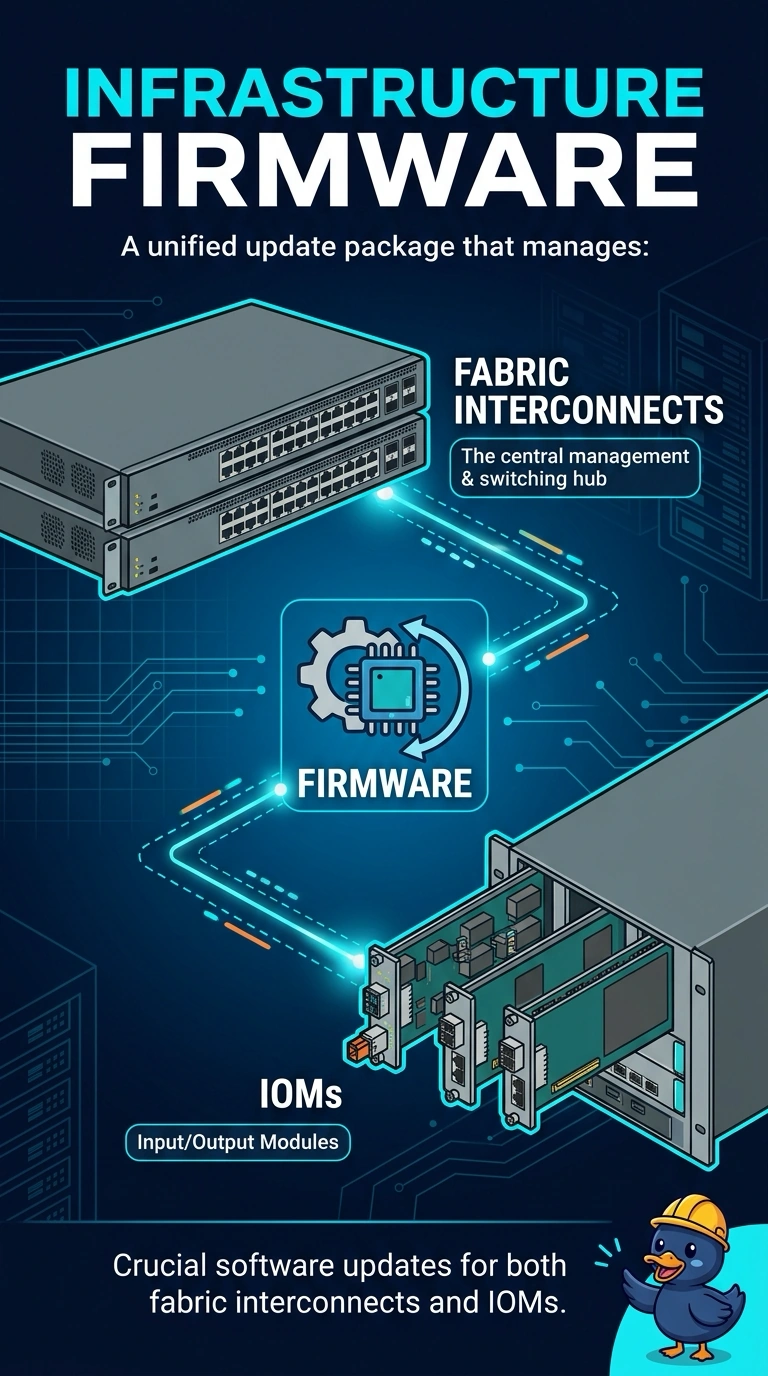
The blade's toolbox and the building's electrical room are updated from different crates. You use the infrastructure firmware to move the fabric interconnect and the IOM, not the host firmware package that targets the server. A boot policy does not select the IOM image.
Full Explanation
UCS splits server firmware from infrastructure firmware. A host firmware package on a service profile updates server components such as BIOS, adapter, and CIMC, subject to the maintenance policy. It does not reimage the fabric interconnects or the chassis IOMs. Those stay on their current code until the infrastructure firmware is applied, which is why the hospital blades can move while the IOMs do not. Applying another host firmware package repeats the same server-scoped update. It still does not carry the interconnect and IOM images. A boot policy selects the disk, SAN target, or PXE path the server uses. It does not choose firmware for the fabric interconnect or the IOM. Grid is a chassis power-redundancy policy for two independent feeds. It has no firmware image for an IOM or a fabric interconnect. Caveat: infrastructure firmware and server firmware still need to be a compatible combination, so updating only one side can leave the domain unsupported even after the correct package type is chosen. Operational check: stage the infrastructure firmware, confirm the running interconnect and IOM versions change, and confirm the host package version is a separate field on the service profile.