
A media company loses traffic for one blade vNIC when a single uplink fails. That vNIC is in a LAN pin group that names only the failed uplink. Other vNICs on the blade keep forwarding. Why did this vNIC stay down?
Select an answer to reveal the explanation.
Short Explanation
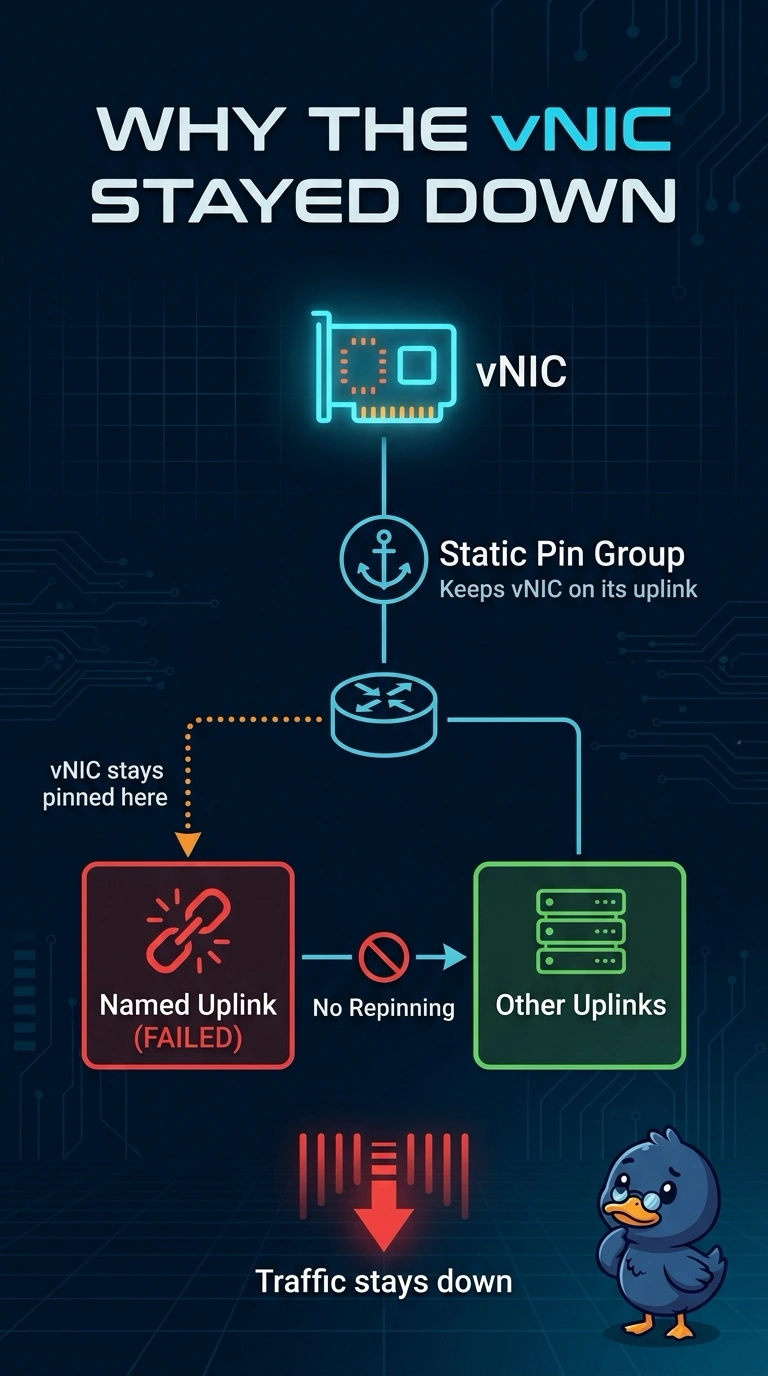
A pin group is a leash, not a load balancer. You tied this vNIC to one uplink, so when that uplink fails the vNIC does not move to a path you did not name. The other vNICs keep working because they were free to use the remaining uplinks.
Full Explanation
A LAN pin group statically pins a vNIC to a chosen uplink port or port-channel. UCS does not move that vNIC to some other uplink when the pinned uplink fails, so the media vNIC stays down while vNICs that use dynamic pinning can keep forwarding on the remaining uplinks. That pinning, not a fabric-wide outage, is why only one vNIC failed. A WWNN pool allocates Fibre Channel node names. It does not pin Ethernet vNICs, and an empty WWNN pool would not take down a single pinned vNIC while others forward. Grid describes how chassis power supplies are divided across two utility feeds. It does not select an uplink for a vNIC. An initial service profile template stops later template edits from flowing to existing profiles. It does not disable uplink failover, and the behavior here comes from the pin group bound to this vNIC. Caveat: a pin group aimed at a port-channel can survive a single member failure inside that channel, but if the whole pinned channel is down the vNIC still has no alternate uplink. Operational check: confirm the vNIC pin group names the failed uplink, then either restore that uplink or move the vNIC to dynamic pinning and retest.