
A media company wants a new service profile to associate only to blades that have a specific VIC model. Other blades in the same chassis must not receive it. Which object filters that hardware?
Select an answer to reveal the explanation.
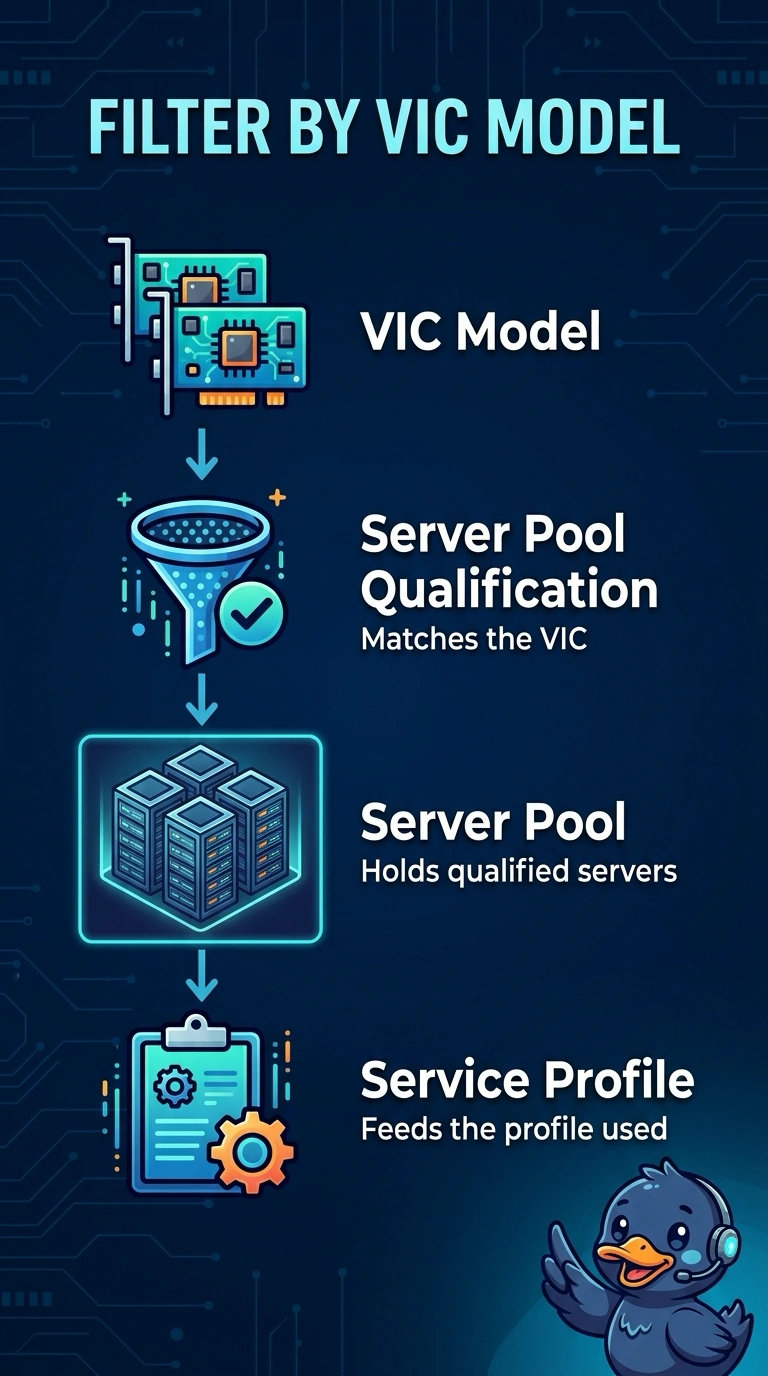
Short Explanation
A server pool qualification is the velvet rope at the door. You match the VIC model in that qualification so the profile lands only on blades that have it. A boot policy chooses disks, not which blade is allowed to receive the profile.
Full Explanation
UCS server pool qualifications select servers by hardware attributes such as adapter type, memory, or chassis. A server pool that uses a qualification for this VIC model contains only the matching blades, and a service profile associated to that pool will not land on the other blades in the media chassis. That qualification is the filter. A boot policy sets the boot order: local disk, SAN target, or PXE. It does not inspect the VIC model or decide which blade may receive the profile. A WWNN pool allocates Fibre Channel node identities to vHBAs. It does not select servers by Ethernet adapter type. The chassis power policy describes power redundancy. It does not bind service profiles to blades. Caveat: the qualification has to match an attribute UCS actually inventories on the blade, or the pool stays empty and the profile never associates. Operational check: confirm the pool lists only the blades with that VIC, associate a test profile to the pool, and confirm it does not select a blade that lacks the adapter.