
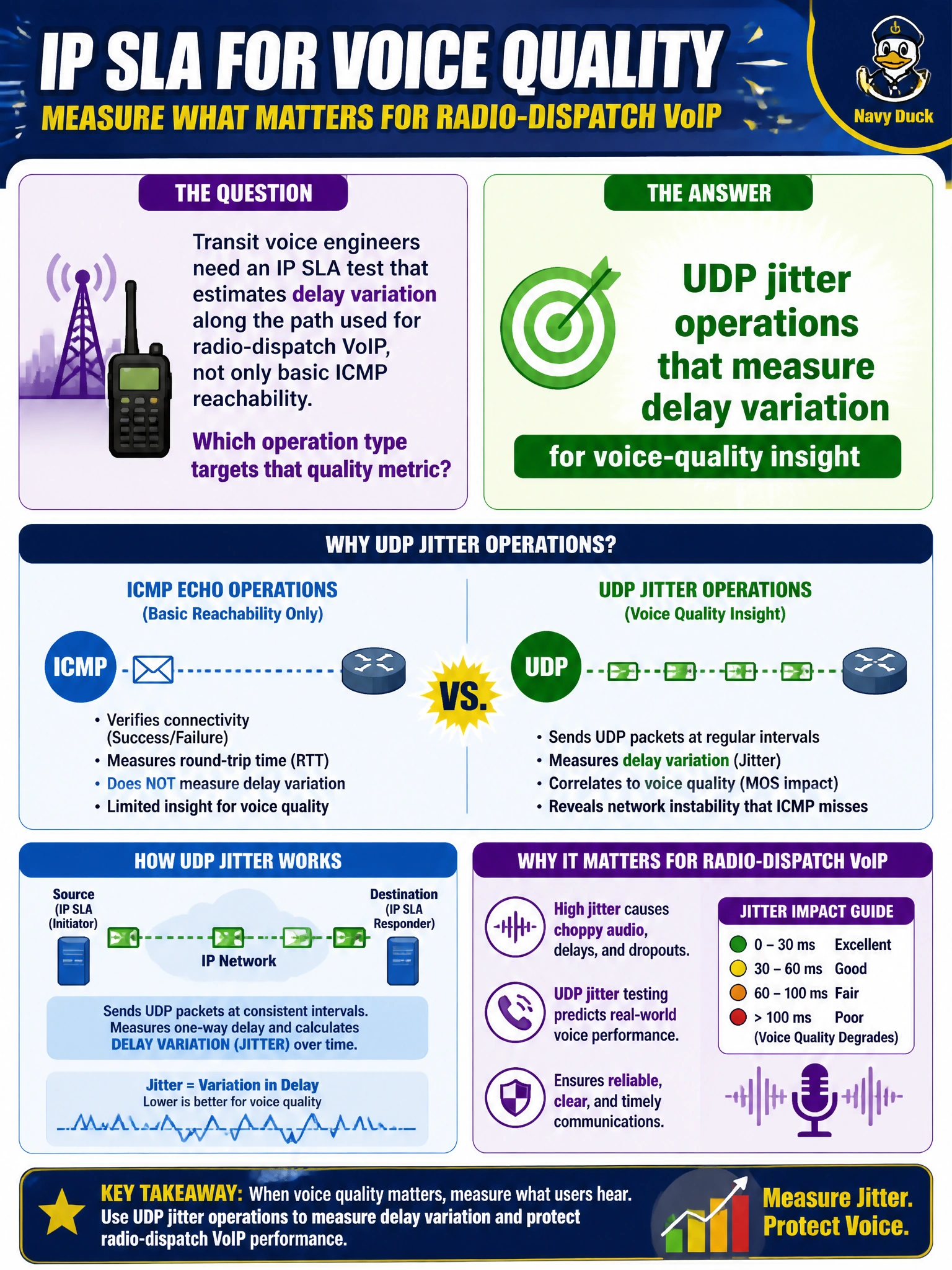
Transit voice engineers need an IP SLA test that estimates delay variation along the path used for radio-dispatch VoIP, not only basic ICMP reachability. Which operation type targets that quality metric?
Select an answer to reveal the explanation.
Short Explanation
Reachability says the phone path is alive; jitter says whether the path is smooth enough for voice. UDP jitter SLA is the bumpy-road meter for VoIP.
Full Explanation
Transit voice engineers need an IP SLA test that estimates delay variation along the path used for radio-dispatch VoIP, not only basic ICMP reachability. UDP jitter operations are the operation type that measures delay variation and related voice-quality insight (latency, jitter, often loss patterns depending on configuration), which aligns with assessing a VoIP/radio-dispatch path rather than answering only “is the far end pingable.”
DHCP snooping binding refresh via IP SLA fails by concept—DHCP snooping is a security binding feature, not an IP SLA voice-quality operation. ICMP echo alone does not make jitter equal packet loss percentage; echo primarily validates reachability/RTT and is not the dedicated jitter operation. SNMP trap replay of CDP neighbor changes reports topology adjacency events; it does not measure path delay variation for VoIP.
Exam caveat: map IP SLA operation types to the metric you need—ICMP echo for connectivity, UDP jitter for voice-oriented delay variation. Remember many two-way jitter tests expect an IP SLA responder on the far end.
Operational check for transit voice: enable UDP jitter toward the radio-dispatch path endpoints (with responder where required), baseline jitter during quiet and busy dispatch periods, and correlate IP SLA results with user-reported voice quality before changing QoS or routing.