
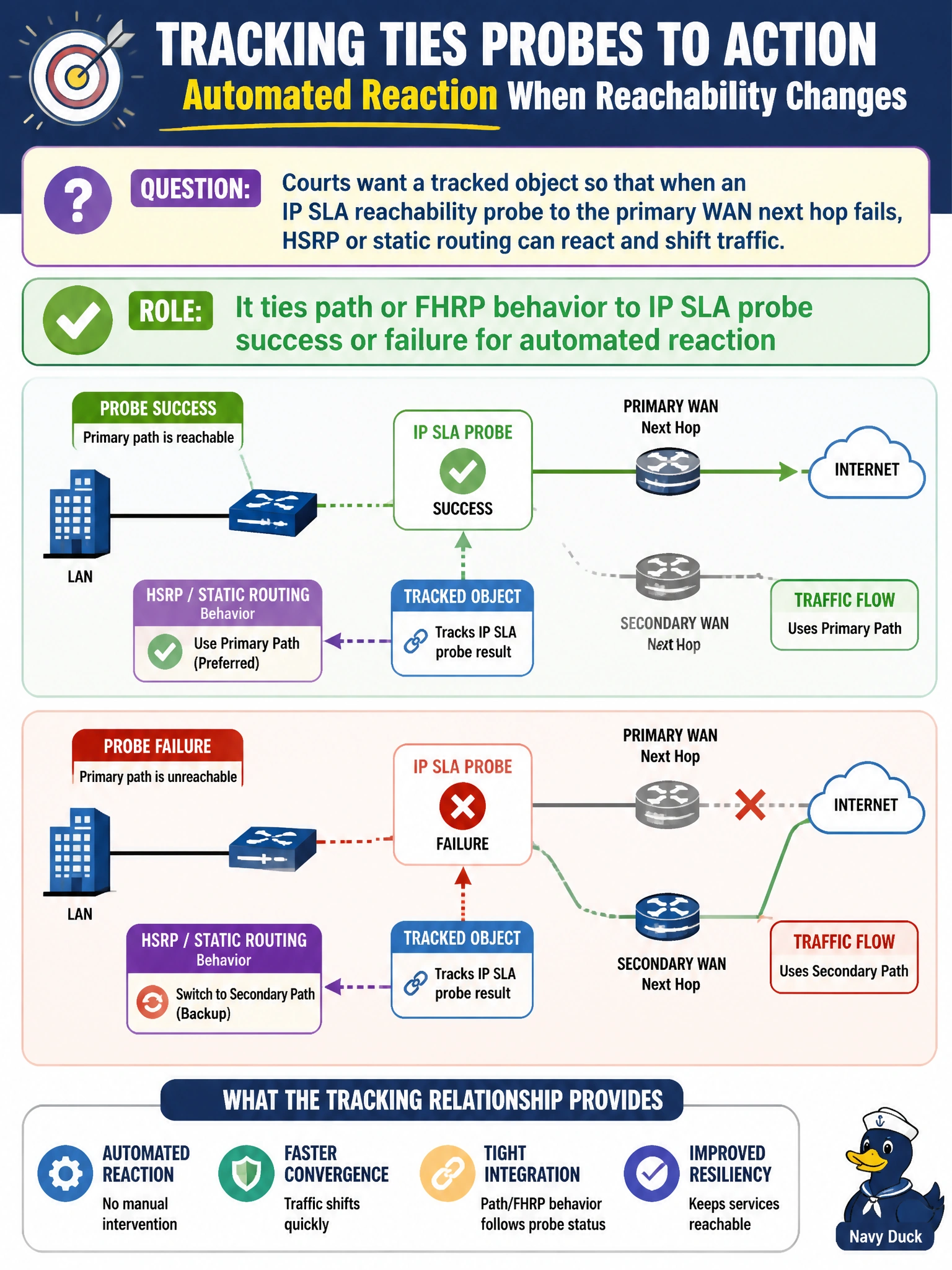
Courts want a tracked object so that when an IP SLA reachability probe to the primary WAN next hop fails, HSRP or static routing can react and shift traffic. What role does that tracking relationship provide?
Select an answer to reveal the explanation.
Short Explanation
Tracking is the glue between “the probe failed” and “move the traffic.” IP SLA watches the path; the tracked object tells HSRP or a route to react instead of waiting for a human.
Full Explanation
Courts want a tracked object so that when an IP SLA reachability probe to the primary WAN next hop fails, HSRP or static routing can react and shift traffic. That tracking relationship ties path or FHRP behavior to IP SLA probe success or failure for automated reaction: the SLA operation measures the primary path, tracking reports up/down, and HSRP priority or static route metrics/object tracking can withdraw or demote the primary path so traffic moves without waiting for a human to notice a dead next hop.
Converting every failed probe into an ERSPAN session toward the standby router fails by concept—tracking does not spawn SPAN sessions; mirroring is unrelated to FHRP/static failover logic. Forcing OSPF to change its process ID whenever jitter exceeds one millisecond is nonsensical and destructive; process-ID changes are administrative redesigns, not probe reactions. Replacing AAA authorization lists with IP SLA responder passwords confuses authentication/authorization with reachability tracking.
Exam caveat: IP SLA + object tracking + HSRP/static routes is a standard ENCOR pattern for reliable WAN edge failover. Distinguish measurement (IP SLA) from reaction (tracking consumers like FHRP or route tracking).
Operational check for the courts WAN: verify the IP SLA operation to the primary next hop, confirm the track object follows SLA state, test failover by simulating next-hop loss, and validate HSRP/static routing shifts traffic cleanly and returns when the probe recovers.