
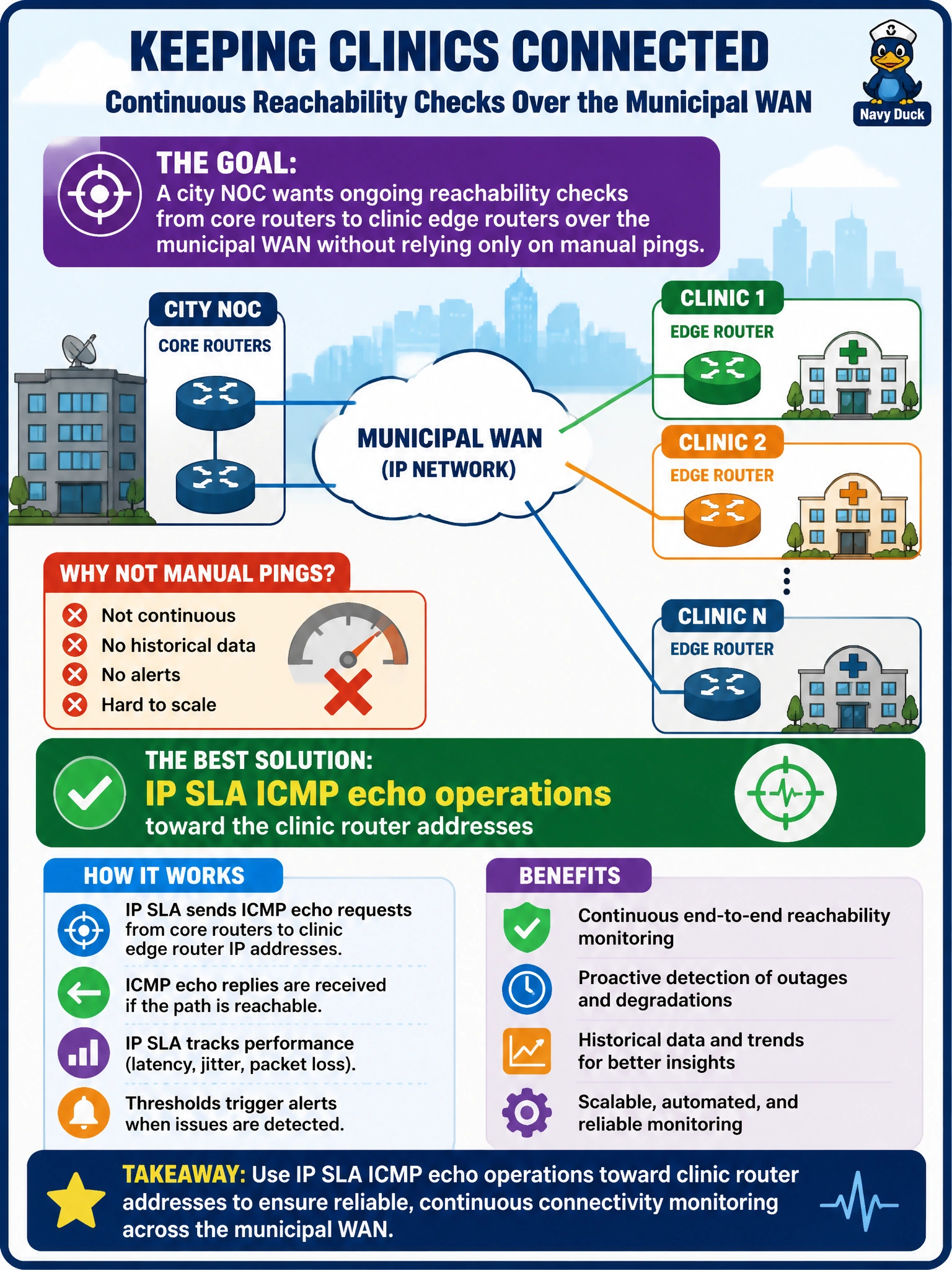
A city NOC wants ongoing reachability checks from core routers to clinic edge routers over the municipal WAN without relying only on manual pings. Which IP SLA operation best matches that connectivity-monitoring goal?
Select an answer to reveal the explanation.
Short Explanation
IP SLA ICMP echo is your scheduled reachability check: it keeps probing the clinic routers and recording results. Manual ping is a one-off, while IP SLA makes monitoring continuous for you.
Full Explanation
IP SLA ICMP echo operations toward the clinic router addresses match the city NOC’s goal: each core router generates periodic echo probes and records success or failure and round-trip time (RTT). Those results can feed tracking or alerting, giving operators ongoing visibility into WAN reachability instead of relying on ad-hoc CLI pings during incidents. Flexible NetFlow cache export interval tuning alone changes flow-export timing; it does not send synthetic reachability probes to clinic addresses. A SPAN session that mirrors WAN-interface traffic to a monitoring server provides traffic for review, but it does not perform scheduled ICMP tests or supply their reachability metrics. A RESTCONF GET of the running OSPF process without probes reads configuration or state through an API, but it does not continuously test forwarding-path reachability to clinic edge routers. Exam caveat: ICMP echo is the basic IP SLA connectivity operation; use UDP jitter when the goal is measuring delay variation for voice. Pair IP SLA with tracking when an automated reaction is needed, but the question asks for the monitoring operation itself. Practical check: configure ICMP echo operations to clinic loopbacks or WAN addresses, verify IP SLA statistics show periodic successes, set timeout and threshold values to match operational SLOs, and make sure probe frequency will not saturate constrained backup links.