
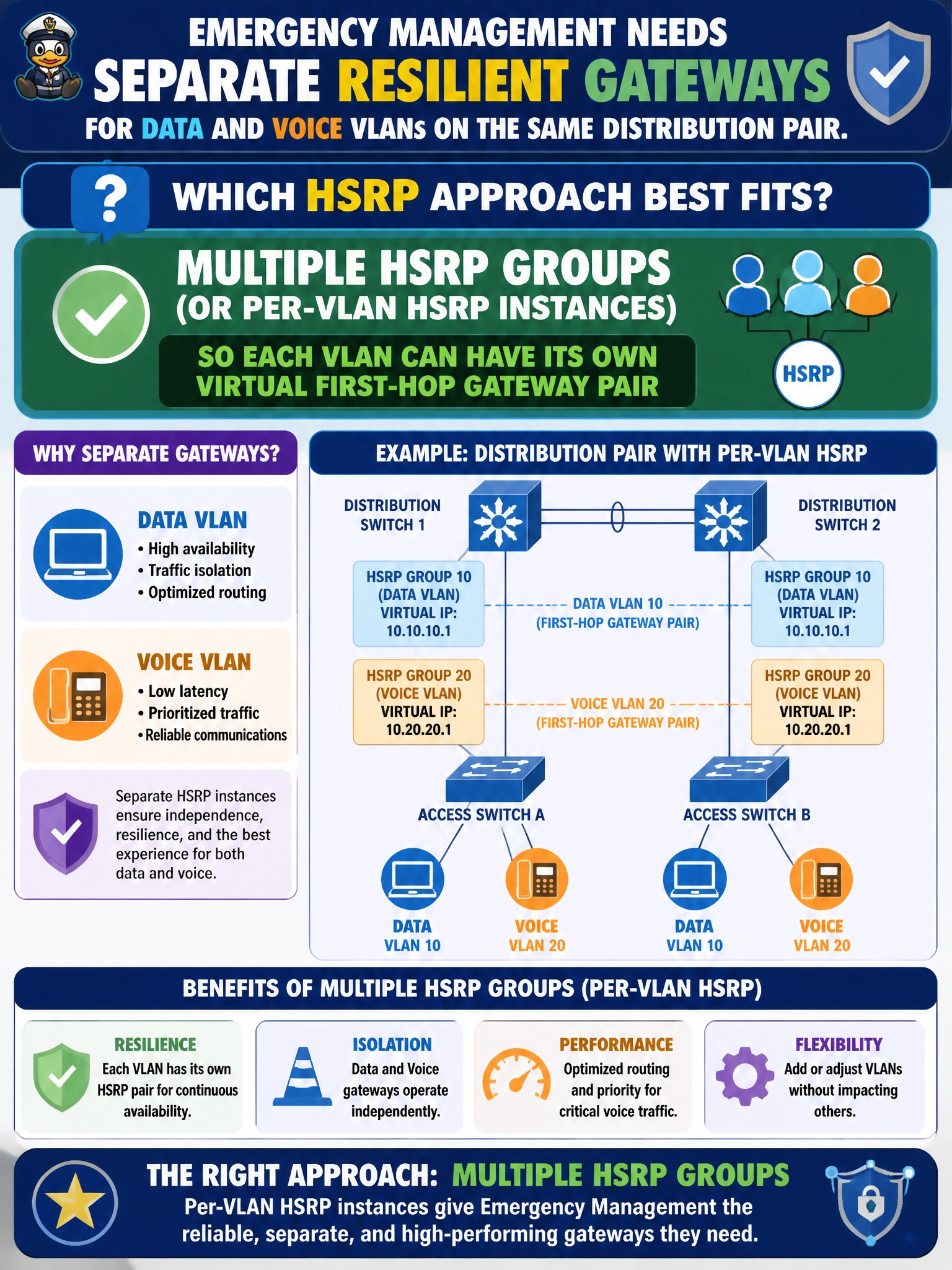
Emergency management needs separate resilient gateways for data and voice VLANs on the same distribution pair. Which HSRP approach best fits?
Select an answer to reveal the explanation.
Short Explanation
Data and voice are two different desks with two different phone numbers. Run two HSRP groups—one VIP per VLAN—so each community keeps its own gateway pair. One shared group for everything is like one receptionist trying to answer every department’s line.
Full Explanation
Emergency management needing separate resilient gateways for data and voice VLANs on the same distribution pair should use multiple HSRP groups (or per-VLAN HSRP instances) so each VLAN can have its own virtual first-hop gateway pair. Data and voice often need distinct gateway IPs, priorities, or tracking policies; per-VLAN HSRP instances keep those first-hop domains independent while still using the same physical distribution pair. That fits municipal emergency-management designs where voice continuity and data continuity are related but not identical failure domains.
A single HSRP group whose virtual IP is reused as the gateway on every VLAN without subinterfaces fails because one shared VIP/group cannot correctly serve separate VLAN gateway spaces as described. One VRRP group that disables HSRP preempt globally for voice only fails because mixing “one VRRP group” with a global HSRP preempt disable does not create per-VLAN resilient gateways for both data and voice. PAT overload tied to the HSRP virtual MAC to load-share voice RTP fails because PAT is address translation, not per-VLAN first-hop redundancy design.
Exam caveat: one FHRP group per VLAN/SVI (or equivalent instance) is the standard way to give each VLAN its own virtual gateway. GLBP/HSRP load-sharing themes are different from “separate gateways per VLAN.” Read whether the stem wants per-VLAN instances or load balancing within a subnet.
Operational check: show standby brief across data and voice SVIs, confirm unique virtual IPs per VLAN, validate tracking/preempt per group, and fail a distribution uplink while ensuring both voice and data gateways recover as designed.