
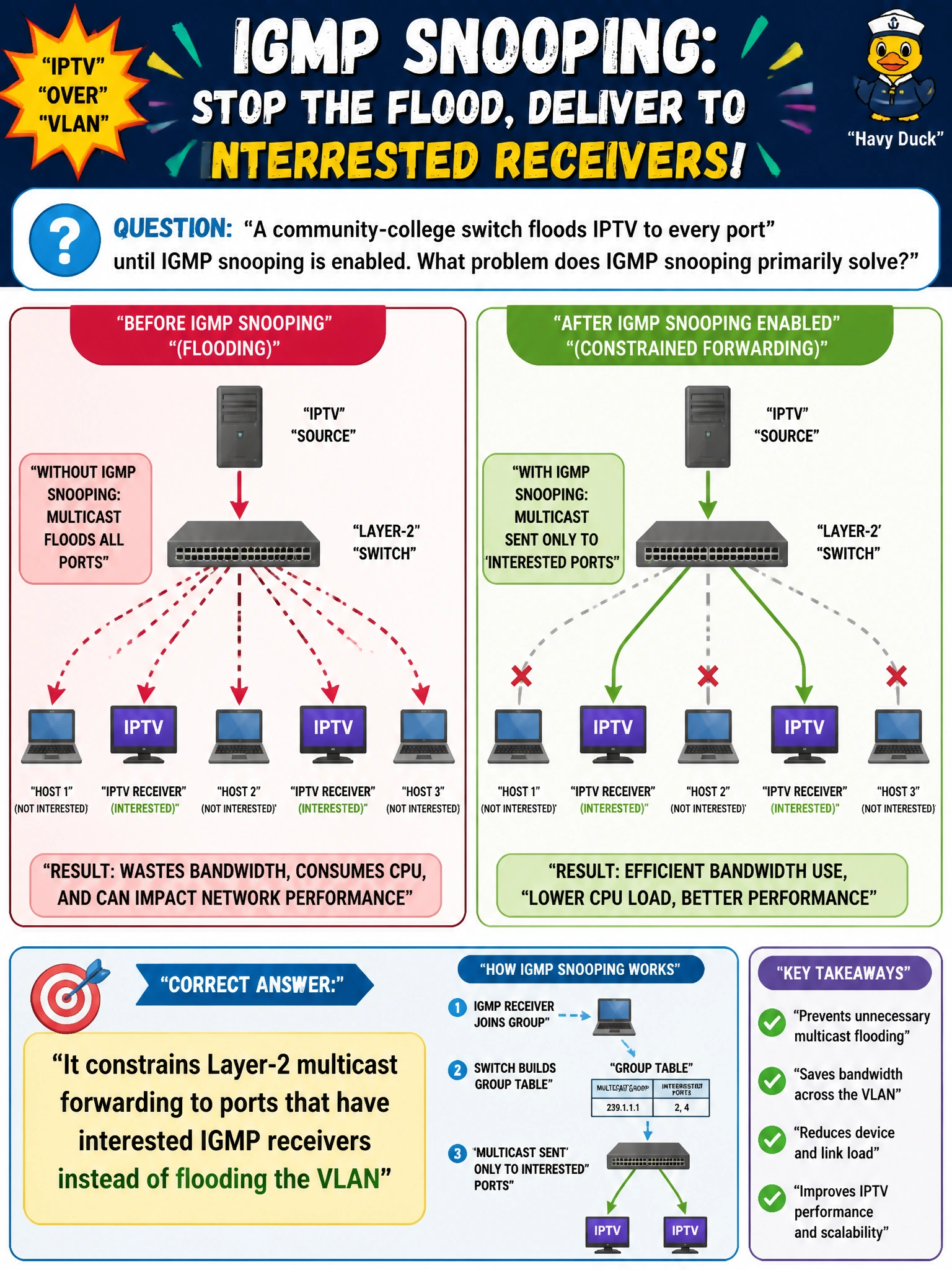
A community-college switch floods IPTV to every port until IGMP snooping is enabled. What problem does IGMP snooping primarily solve?
Select an answer to reveal the explanation.
Short Explanation
Without snooping, multicast is a hallway bullhorn—every dorm port hears every channel. IGMP snooping listens for who actually joined and only aims the speakers at those rooms. Bandwidth and sanity both improve.
Full Explanation
A community-college switch that floods IPTV to every port until IGMP snooping is enabled shows what snooping primarily solves. IGMP snooping constrains Layer-2 multicast forwarding to ports that have interested IGMP receivers instead of flooding the VLAN. Once enabled, the switch listens to joins/leaves (and querier activity) so classroom IPTV streams hit subscribed ports rather than every dorm and lab port in the broadcast domain. That is the classic campus multicast bandwidth-control fix at Layer 2 when receivers are sparse inside a large VLAN.
Electing the OSPF DR on every access VLAN based on IGMP querier priority fails because IGMP snooping does not perform OSPF DR election. Authenticating NTP peers before stratum values are accepted fails because snooping is not an NTP authentication mechanism. Building PIM source trees across the WAN without an RP fails because PIM tree building is a Layer-3 multicast routing function; snooping does not replace PIM or eliminate RP needs by itself.
Exam caveat: IGMP = host signaling; IGMP snooping = switch optimization of L2 flood behavior; PIM = router multicast routing. Keep those three layers distinct on ENCOR items. Flooding until snooping is enabled is the textbook symptom for missing snooping.
Operational check: compare multicast egress before/after snooping with show mac address-table multicast / igmp snooping groups, confirm only receiver ports are in the group, and validate querier presence so membership state does not age out incorrectly.