
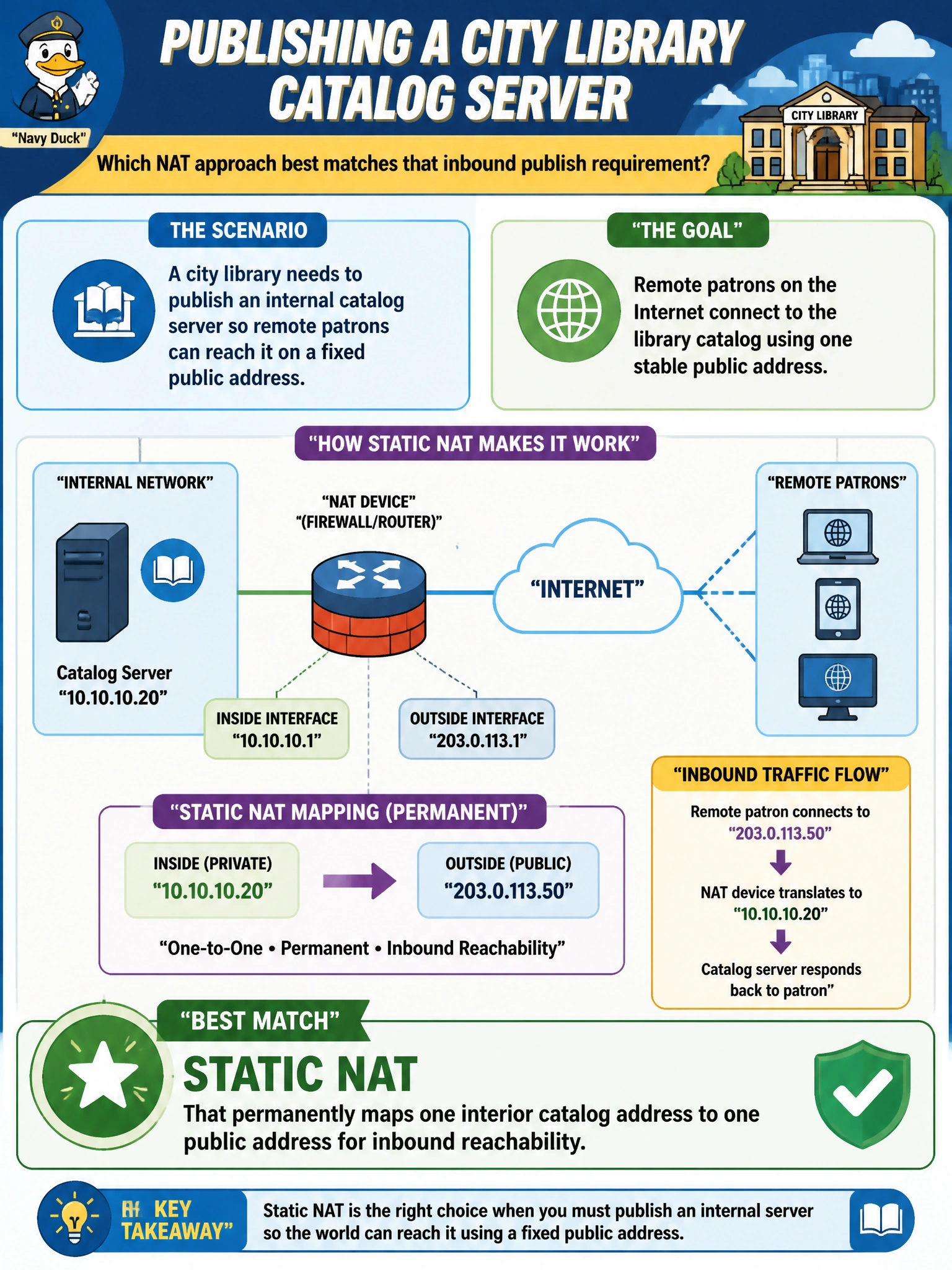
A city library needs to publish an internal catalog server so remote patrons reach it on a fixed public address. Which NAT approach best matches that inbound publish requirement?
Select an answer to reveal the explanation.
Short Explanation
Picture the catalog like a storefront with a permanent street number. Static NAT gives that one-to-one public door so outsiders can walk straight in. PAT is the busy shared lobby for outbound web surfing—great for many staff, wrong for publishing one server.
Full Explanation
For a city library that must publish an internal catalog server on a fixed public address, static NAT is the inbound publish model that matches the requirement. Static NAT creates a permanent one-to-one mapping between an inside local address and an outside global address, so remote patrons can initiate sessions to a stable public IP that always lands on the catalog host. That fixed binding is what municipal operators need when a service must be reachable from the Internet or remote campuses without depending on an outbound-initiated translation that appears only after an interior host browses out.
PAT overload fails by concept because it many-to-ones many interior hosts onto one public address primarily for outbound browsing and the return path of those sessions; it does not give the catalog a durable inbound door. Dynamic NAT fails because it hands temporary public addresses only after interior hosts open outbound sessions—there is no permanent publish address waiting for inbound patrons. Destination-based policy routing fails because it can steer next-hop or path selection without performing the address translation that actually publishes an interior host on a public address.
Exam caveat: do not confuse static NAT with PAT simply because both mention NAT. ENCOR-style stems hinge on directionality and permanence—inbound publish with a fixed public address points to static one-to-one NAT, while shared outbound Internet access points to overload. Also remember that static NAT still requires edge ACL/firewall policy to permit the published ports; translation alone is not permission.
Operational check: verify the static mapping with show ip nat translations (or platform equivalent) for the catalog’s inside and outside addresses, confirm the outside interface owns or routes the public IP, and test inbound reachability from an external vantage while reviewing ACL counters on the published ports.