
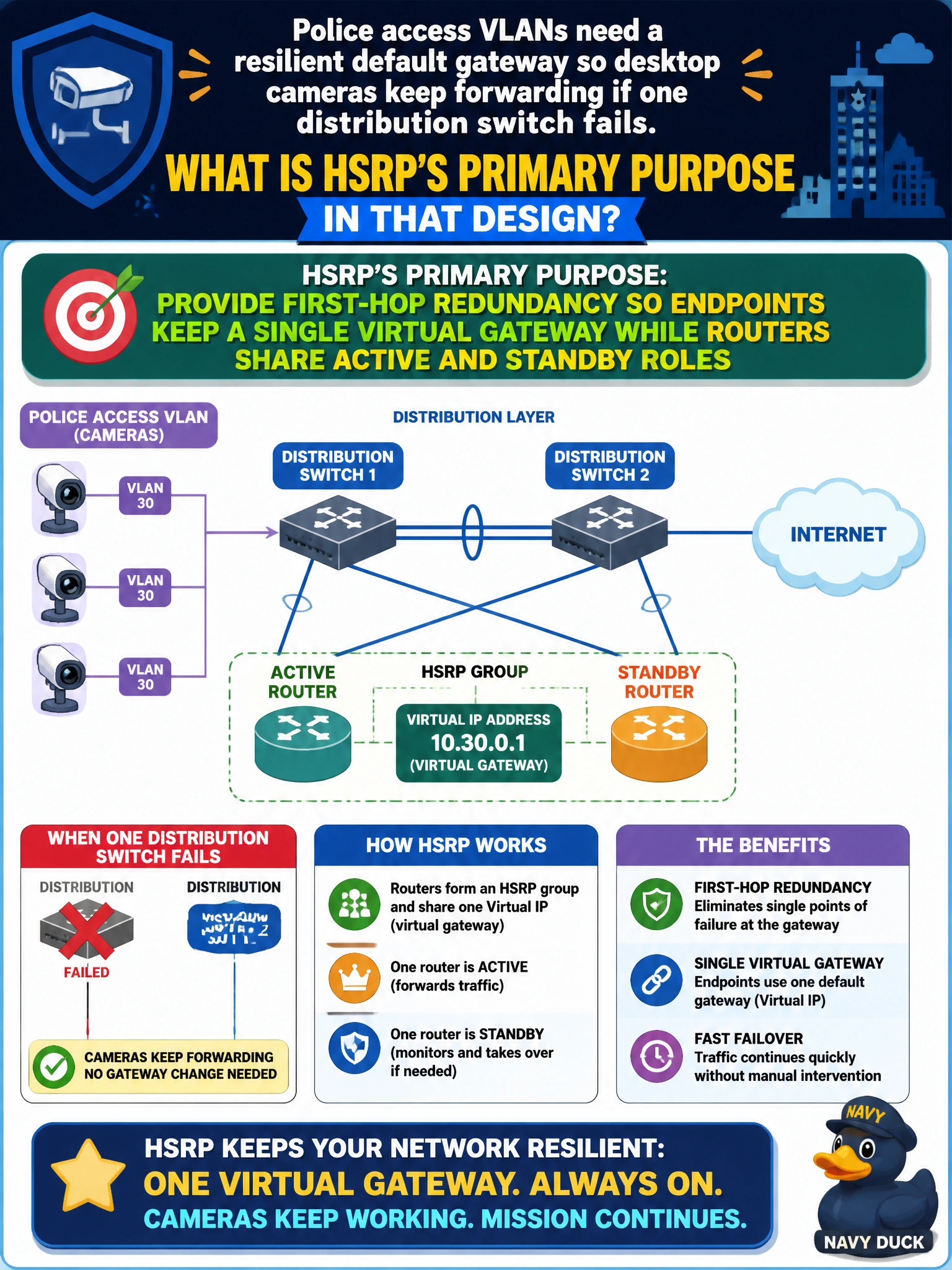
Police access VLANs need a resilient default gateway so desktop cameras keep forwarding if one distribution switch fails. What is HSRP’s primary purpose in that design?
Select an answer to reveal the explanation.
Short Explanation
Think of HSRP like two fire trucks sharing one station number on the radio. Patrol cars dial the same gateway IP; one truck is active, the other stands by. If the active dies, the standby answers the same number—no reconfiguring every camera.
Full Explanation
Police access VLANs need a resilient default gateway so desktop cameras keep forwarding if one distribution switch fails. HSRP’s primary purpose in that design is first-hop redundancy: endpoints keep a single virtual gateway IP and MAC while routers share active and standby roles. When the active HSRP router fails, the standby assumes the virtual address so cameras and desktops do not need to renumber or wait for a new DHCP gateway advertisement. That is the municipal resilience pattern for access VLANs that must survive a distribution-node loss without rewriting every endpoint’s default route.
Replacing OSPF adjacency formation with a proprietary Layer-2 flood tree fails conceptually—HSRP is not a substitute for IGP adjacency mechanics and does not build an L2 flood tree in place of OSPF. Encrypting multicast video between access ports without a wireless controller fails because HSRP does not provide media encryption or wireless-controller functions. Translating private RFC1918 addresses for court evidence uploads fails because that is NAT, not first-hop redundancy.
Exam caveat: HSRP, VRRP, and GLBP are all FHRPs, but their purpose statements differ from routing protocols, security encryption, and NAT. On the exam, map “single virtual gateway / active-standby” language to HSRP’s core role; do not pick answers that invent unrelated Layer-2, crypto, or address-translation jobs for HSRP. Also distinguish HSRP’s first-hop job from OSPF’s path computation job when both exist in the same campus.
Operational check: verify HSRP state with show standby (brief and interface detail), confirm the virtual IP matches the cameras’ gateway, validate preempt and priority as designed, and fail over the active path in a maintenance window while confirming camera streams continue without gateway renumbering.