
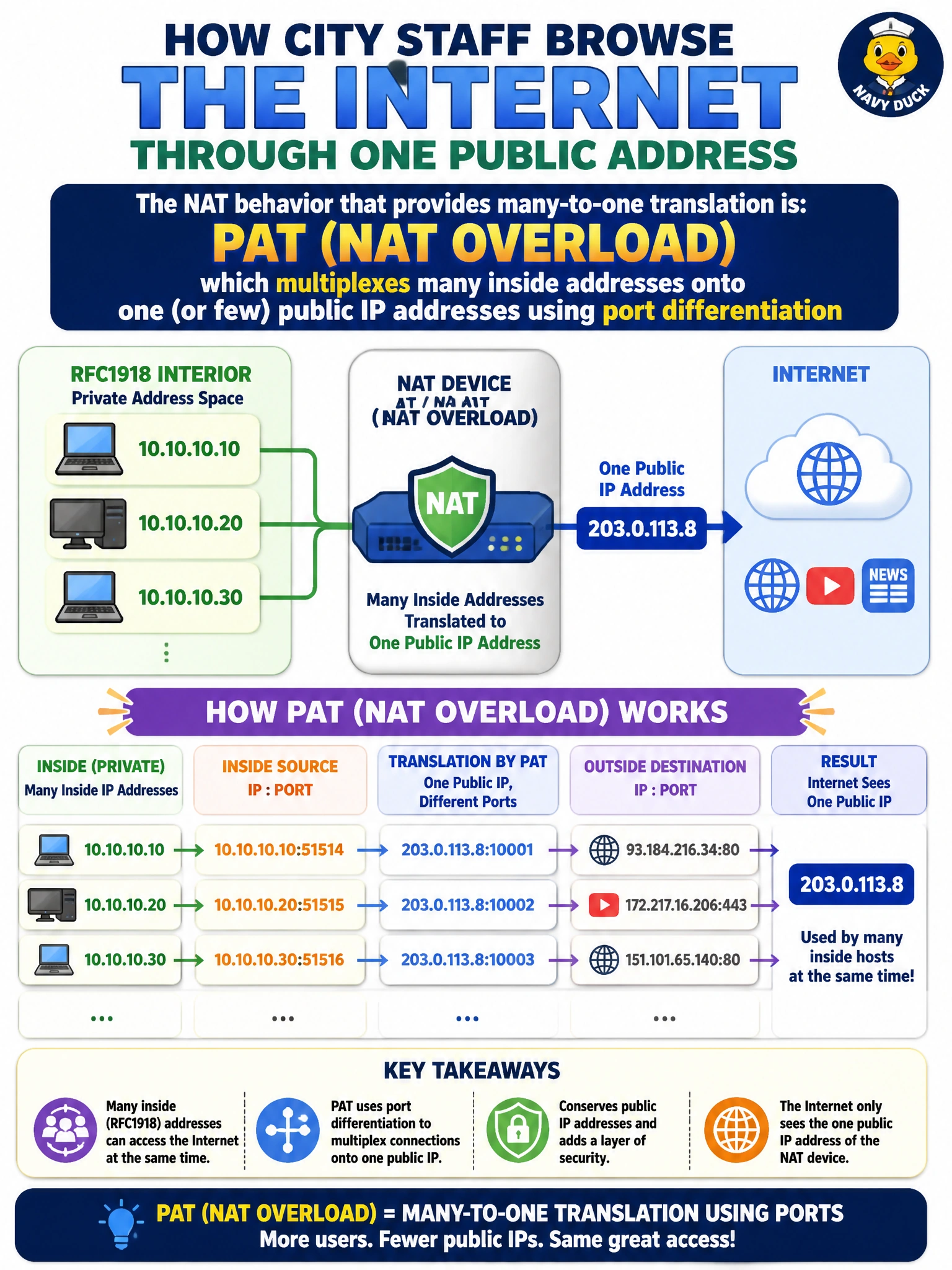
City staff on RFC1918 interiors browse the Internet through one public address. Which NAT behavior provides that many-to-one translation?
Select an answer to reveal the explanation.
Short Explanation
PAT is the apartment buzzer — lots of inside apartments share one street address, sorted by port numbers. Static one-to-one would burn a public IP per laptop.
Full Explanation
City staff on RFC1918 interiors browsing the Internet through one public address need PAT (NAT overload): many inside addresses multiplex onto one or few public IPs differentiated by transport port numbers. That many-to-one behavior conserves scarce public IPv4 while allowing concurrent outbound sessions from the municipal inside network used by city employees.
Static one-to-one NAT only fails this requirement because each inside host would consume its own dedicated public IP rather than sharing one address. NAT exemption that bypasses translation for all outbound staff traffic fails because exemption preserves inside addresses without providing the many-to-one public access pattern described. Identity NAT that preserves inside addresses end-to-end on the public Internet fails similarly—RFC1918 addresses are not globally routable, and identity NAT does not implement shared public overload.
Exam caveat: PAT tracks ports and has finite concurrent-session scale on a single public IP; very large staff populations may need a small public pool, still as overload—not a retreat to one-to-one static mappings for every laptop. Also distinguish overload from static NAT used for inbound published civic services.
Operational check: Confirm the edge NAT rule is overload/PAT on the designated public IP; generate multiple inside sessions and verify distinct port mappings in the translation table; validate return traffic and that static one-to-one is used only where a dedicated public mapping is intentionally required.