
An animal shelter Wi-Fi survey records RSSI and noise floor readings at a kennel doorway. How should engineers relate these to SNR?
Select an answer to reveal the explanation.
Short Explanation
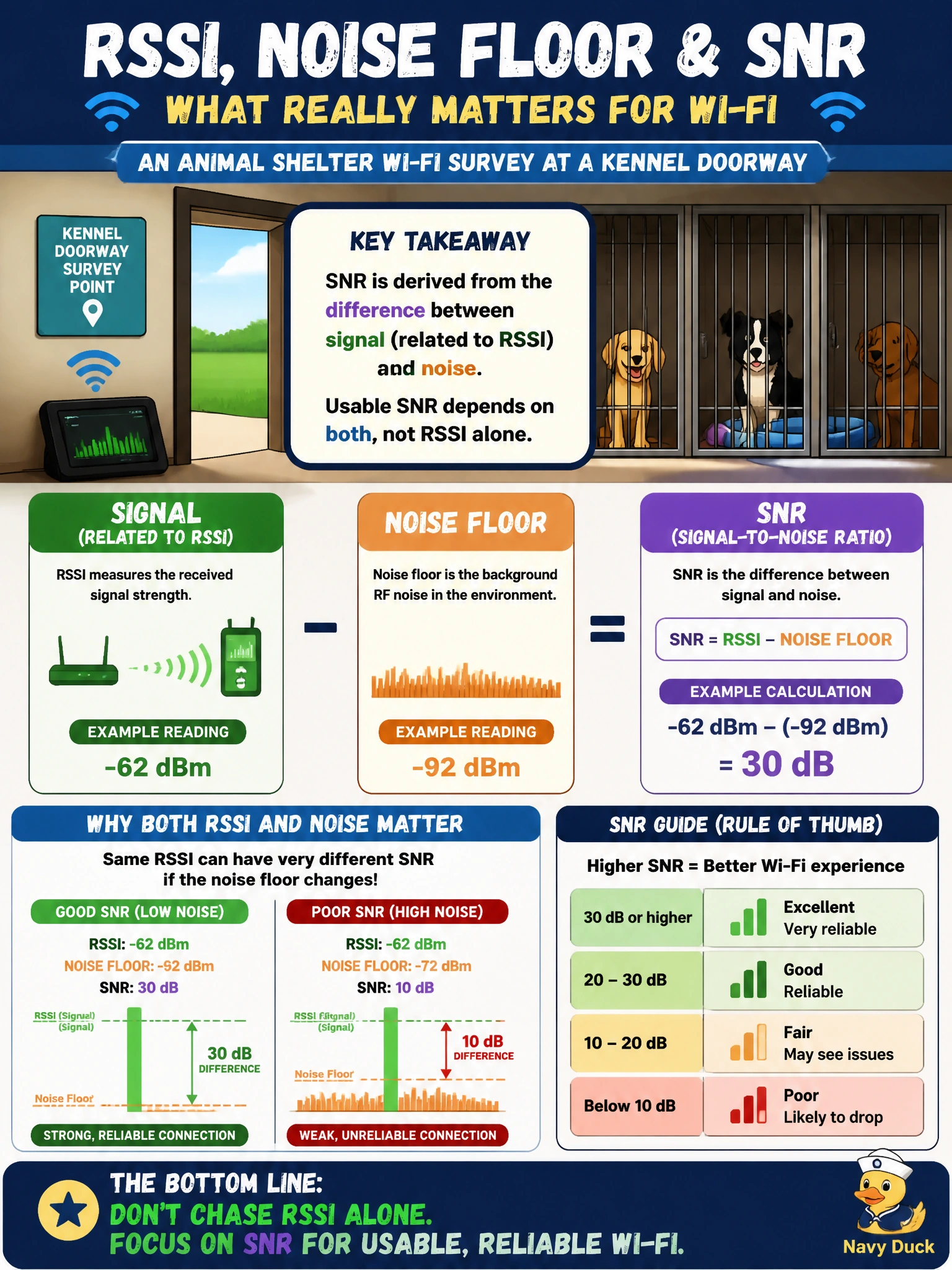
SNR is simply signal minus noise — strong RSSI next to a loud noise floor still yields a skinny gap. You cannot multiply RSSI by OSPF cost and call it wireless math.
Full Explanation
At an animal-shelter kennel doorway, survey readings of RSSI and noise floor relate to SNR as a difference: usable SNR depends on how far the wanted signal (related to RSSI) sits above the noise. Strong RSSI beside a high noise floor still yields a weak SNR and poor client performance; engineers must interpret both measurements together, not RSSI in isolation, when judging whether tablets and staff phones will work at that doorway.
Equating SNR to RSSI multiplied by OSPF cost fails by concept—SNR is an RF quality ratio or difference, not an IGP metric product. Declaring the noise floor irrelevant once RSSI exceeds −90 dBm fails because noise can still destroy SNR at stronger RSSI values in a loud kennel environment. Configuring SNR as a static ACL entry on the WLC fails because SNR is measured RF quality, not an access-list object operators paste into security policy.
Exam caveat: Exact SNR thresholds vary by PHY and MCS needs; ENCOR cares that you can explain the RSSI–noise–SNR relationship and use it in survey interpretation rather than memorize one magic dB number for every kennel doorway.
Operational check: Record RSSI and noise at the doorway; compute or observe SNR; compare to a quieter reference point; remediate noise or channel plan if SNR is inadequate despite seemingly acceptable RSSI; retest client rates at the kennel door after changes.