
A port authority wants wireless roam domains designed so devices stay on the same subnet across a contiguous terminal whenever possible. Which principle applies?
Select an answer to reveal the explanation.
Short Explanation
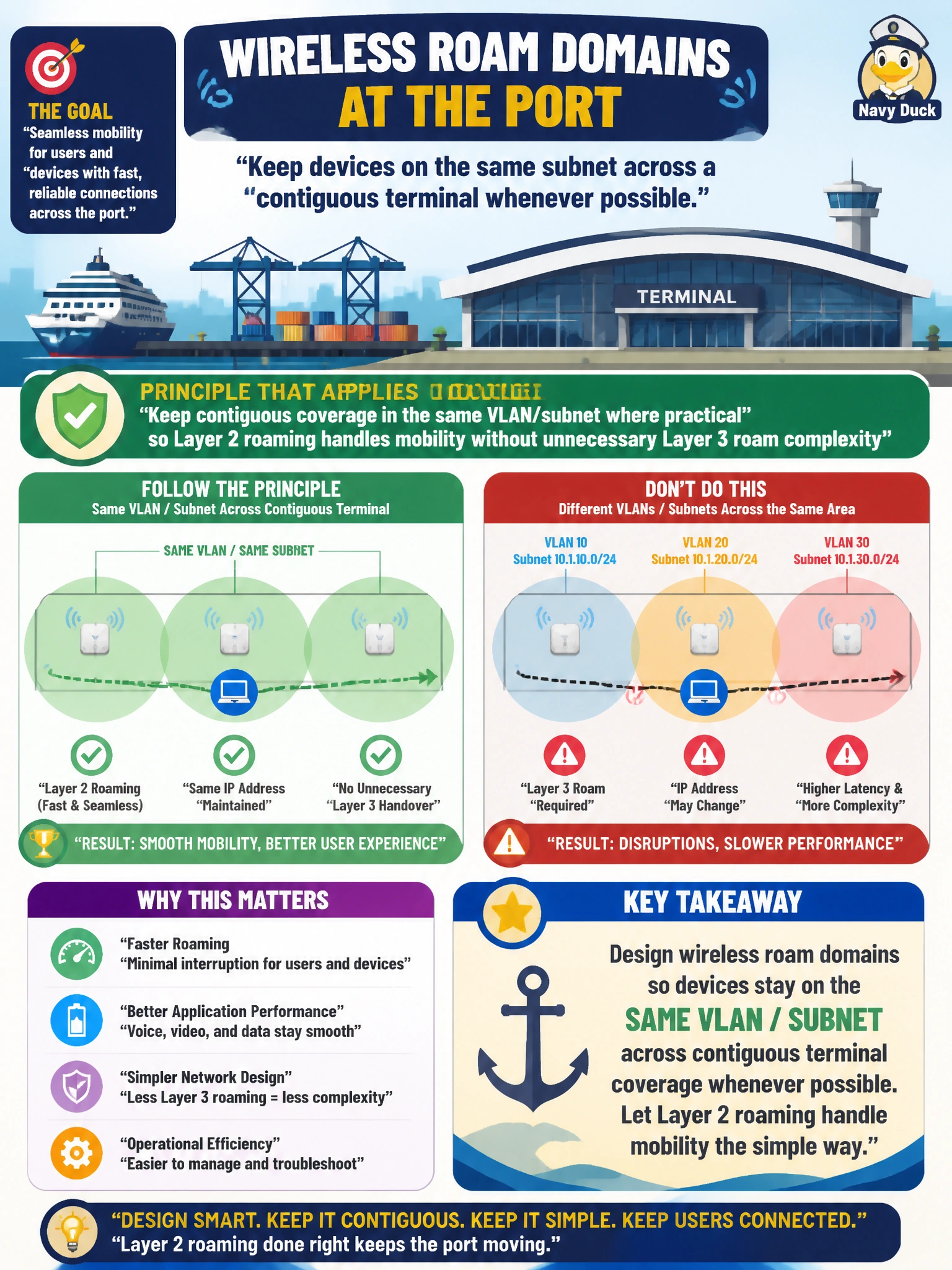
If the whole terminal can share one subnet, let L2 roaming do the easy walk between APs. Inventing L3 anchors for every hop is extra baggage on the jetway.
Full Explanation
A port authority that wants roam domains where devices stay on the same subnet across a contiguous terminal should keep contiguous coverage in the same VLAN/subnet where practical so Layer 2 roaming handles mobility without unnecessary Layer 3 roam complexity. Same-subnet design preserves addressing simplicity for scanners, carts, and staff devices moving along the terminal.
Forcing Layer 3 roam anchors for every AP change including same-VLAN moves fails by adding needless mobility overhead inside one subnet. Eliminating all mobility by assigning a /32 per client on every AP fails operationally and is not how enterprise WLAN roam domains are built. Preferring Layer 3 roaming exclusively even when a single large VLAN would suffice fails the design goal of simplifying contiguous-terminal mobility.
Exam caveat: Very large L2 domains have broadcast/failure-domain tradeoffs; “prefer L2 where practical” is not a mandate for unbounded VLANs across an entire campus—scope the contiguous terminal reasonably and use L3 roam at true subnet boundaries.
Operational check: Map terminal AP coverage to one (or few) contiguous client VLANs; roam a test device end-to-end and confirm the IP remains stable via L2 roam; introduce L3 mobility only where buildings/subnets truly diverge.