
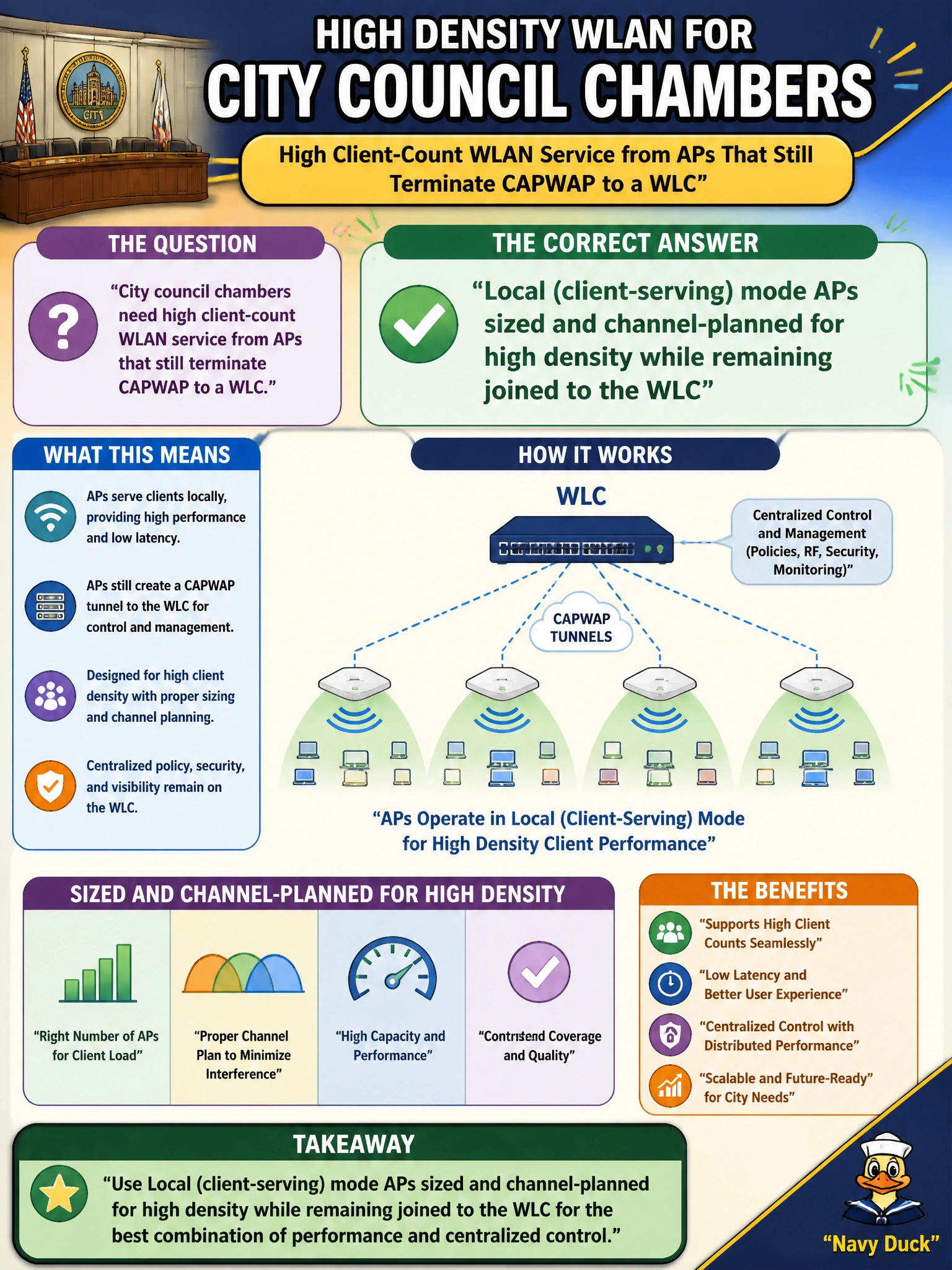
City council chambers need high client-count WLAN service from APs that still terminate CAPWAP to a WLC. Which mode concept is appropriate?
Select an answer to reveal the explanation.
Short Explanation
High density still wants real client-serving local mode APs — just planned tighter — not a room full of sniffers that refuse associations. Monitor mode watches; it does not host the council.
Full Explanation
City council chambers that need high client-count WLAN service from APs that still terminate CAPWAP to a WLC require local (client-serving) mode APs sized and channel-planned for high density while remaining joined to the controller. Local mode is the standard production access role: serve associations at scale, with RF design (channels, power, maybe additional APs) handling the density.
Using sniffer mode as the primary client-serving role fails because sniffer APs forward frames to a capture server and do not host production associations for hundreds of laptops. Monitor mode exclusively fails because monitor APs do not allow client association. Bridge mode used only to replace the entire wired campus core fails the requirement and overscopes bridge roles far beyond chamber access.
Exam caveat: “Local mode” alone does not guarantee density success—channel reuse, band steering, sufficient APs, and wired uplink capacity are part of the design. ENCOR contrasts client-serving modes with monitor/sniffer specialty modes.
Operational check: Deploy local-mode APs with a high-density channel/power plan; load-test with representative laptop counts; confirm CAPWAP remains up to the WLC; verify throughput and association success during peak council sessions.