
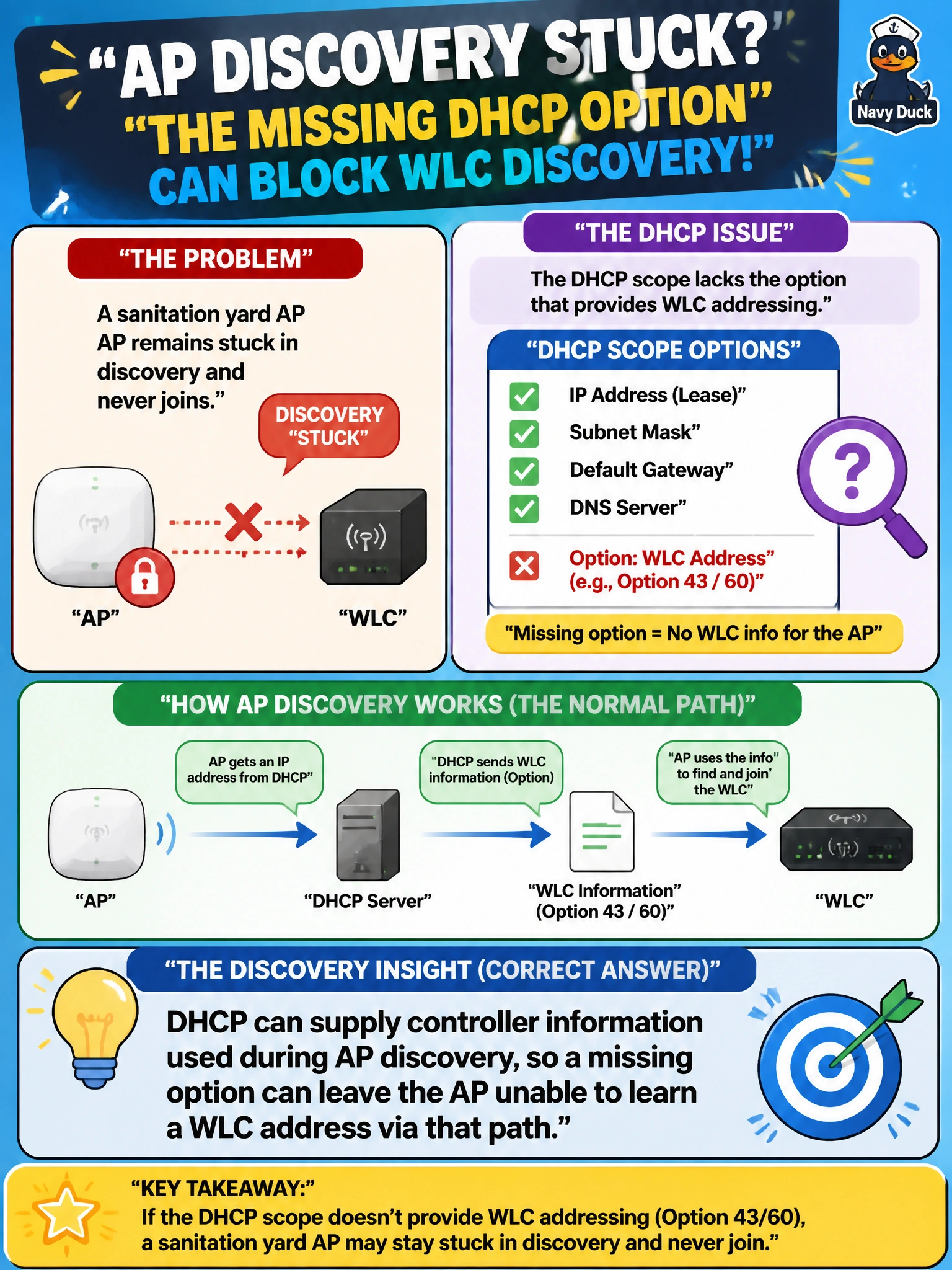
A sanitation yard AP remains stuck in discovery and never joins. The DHCP scope lacks the option that provides WLC addressing. Which discovery insight is correct?
Select an answer to reveal the explanation.
Short Explanation
No DHCP hint, no map to the WLC — the AP keeps searching with an empty address book for that path. BGP communities will not CAPWAP-join a lightweight AP.
Full Explanation
A sanitation-yard AP stuck in discovery often lacks a DHCP-provided controller address when the scope is missing the option used for WLC discovery (commonly option 43). DHCP is a primary discovery path for lightweight APs; without that hint—and without working DNS priming or static controller config—the AP may never learn a reachable WLC address via the DHCP method and remain in discovery.
Discovering WLCs only through BGP route-reflection communities fails by concept; BGP communities are not CAPWAP discovery. Succeeding only if the AP receives an IPv6 RA with OSPFv3 parameters fails because OSPFv3/RA is not the CAPWAP join discovery mechanism ENCOR emphasizes. Claiming missing DHCP options are irrelevant because APs always hard-code the WLC in ROM permanently fails—many deployments rely on DHCP/DNS/priming rather than factory-permanent WLC addresses.
Exam caveat: Other discovery methods can still succeed if configured; absence of DHCP option 43 is decisive only when that path was the intended (or only) discovery method. Check DNS and primed controllers before assuming DHCP is the sole failure.
Operational check: Inspect the AP’s DHCP lease and options; add the correct WLC discovery option to the sanitation scope; renew; confirm the AP learns the controller IP and progresses to joined; optionally validate DNS CAPWAP name resolution as a backup path.