
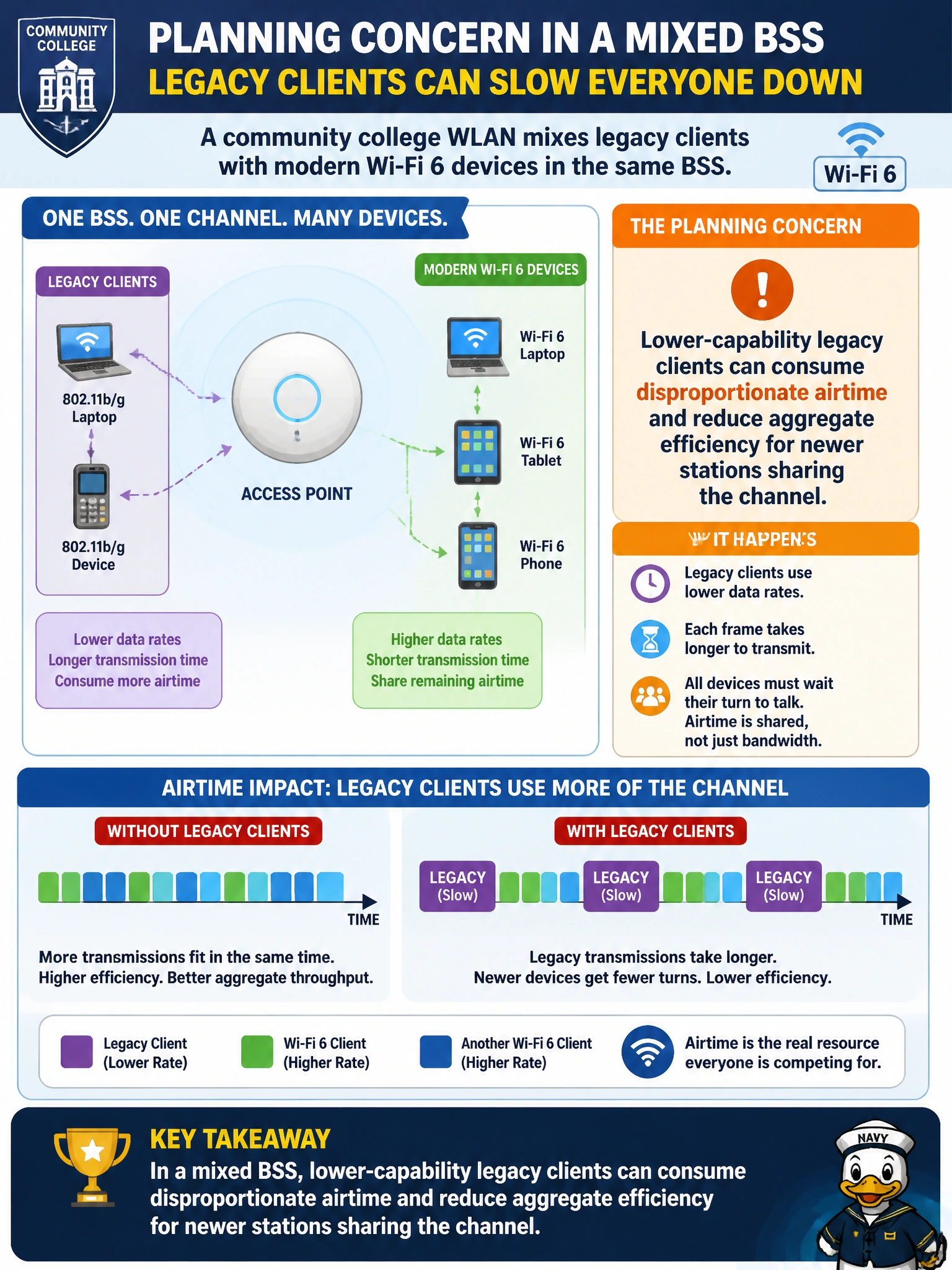
A community college WLAN mixes legacy clients with modern Wi-Fi 6 devices in the same BSS. Which planning concern is most accurate?
Select an answer to reveal the explanation.
Short Explanation
Slow talkers hog the chalkboard — a legacy client chewing airtime makes everyone wait, including Wi-Fi 6 laptops. CAPWAP being up does not erase PHY differences.
Full Explanation
On a community-college BSS that mixes legacy clients with modern Wi-Fi 6 devices, the accurate planning concern is airtime: lower-capability legacy stations often use slower PHYs, longer protection, and more retransmissions, consuming disproportionate channel time and reducing aggregate efficiency for newer stations sharing the same medium. Capacity planning must account for that mix—not assume Wi-Fi 6 alone sets cell throughput.
Claiming legacy clients never consume airtime because only Wi-Fi 6 stations transmit fails by concept; legacy clients absolutely contend for and occupy the shared channel. Saying client PHY capability is irrelevant once CAPWAP is up fails because CAPWAP join status does not erase mixed-PHY airtime effects on the radio. Asserting airtime fairness problems are solved only by enabling IP SLA ICMP echo on the WLC fails because IP SLA measures IP reachability/latency, not 802.11 airtime scheduling fairness.
Exam caveat: Mitigations include band steering, separate SSIDs/bands for legacy, airtime fairness features, and realistic density planning—ENCOR tests recognition of the airtime problem, not a single vendor checkbox as a magic fix.
Operational check: Inventory client PHY capabilities in the BSS; measure airtime and retry rates with legacy devices active; test steering or SSID/band separation; validate that peak lecture-hall density still meets throughput SLOs with the mixed client set.