
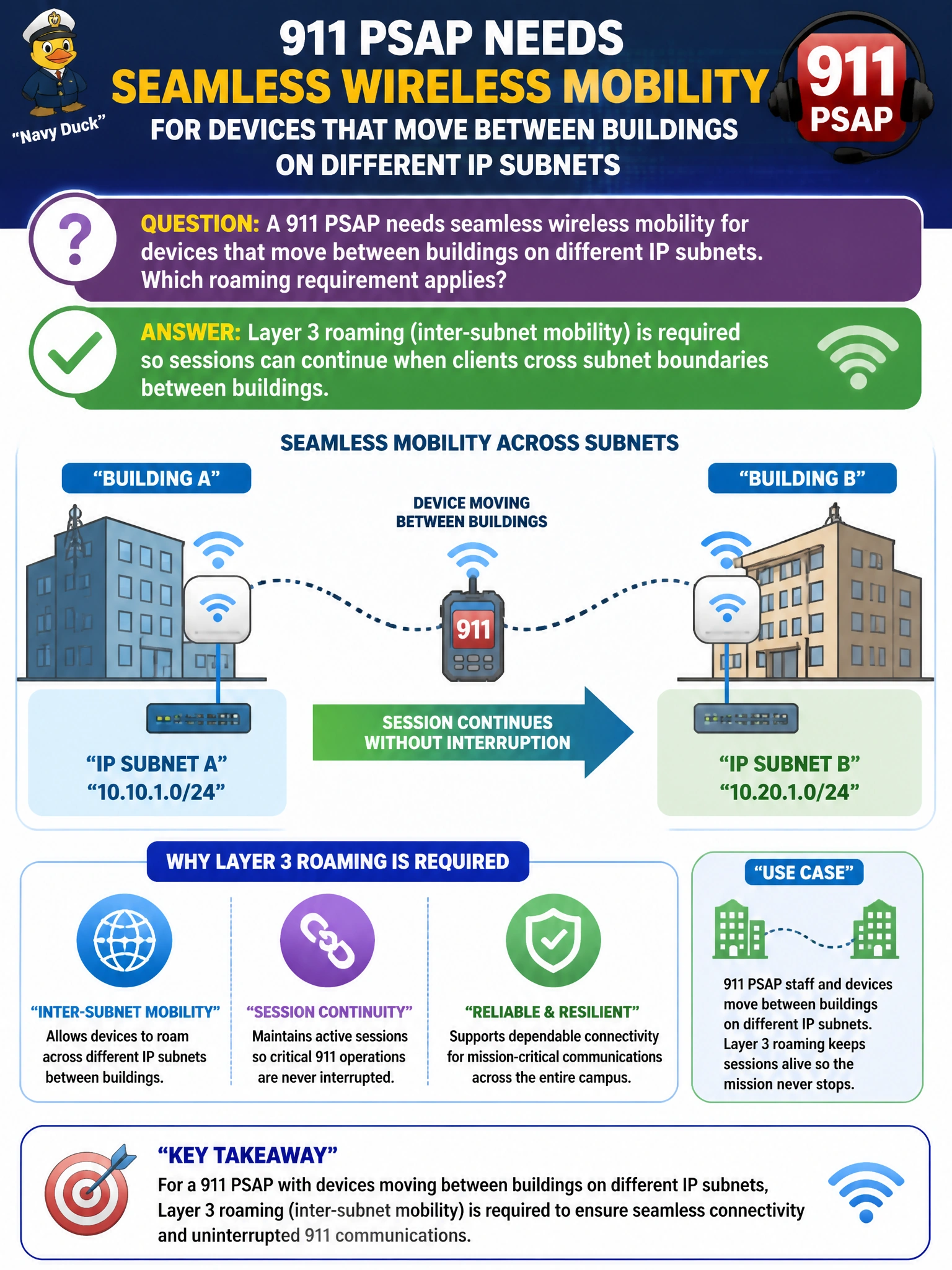
A 911 PSAP needs seamless wireless mobility for devices that move between buildings on different IP subnets. Which roaming requirement applies?
Select an answer to reveal the explanation.
Short Explanation
Different buildings, different subnets — that is an inter-subnet move, so you need Layer 3 roaming, not a pretend same-VLAN hop. PBR on APs is not a mobility service.
Full Explanation
A 911 PSAP whose wireless devices move between buildings on different IP subnets requires Layer 3 roaming (inter-subnet mobility). When the client’s point of attachment crosses subnet boundaries, mobility anchoring or inter-controller L3 roam services keep the session alive so emergency workflows are not forced through a disruptive readdress on every building change.
Requiring only Layer 2 roaming because subnet changes “never occur” between buildings fails the stated design: different buildings on different subnets are exactly an inter-subnet case. Disabling mobility and forcing full re-authentication with a new DHCP lease on every AP change—including same-VLAN moves—fails operationally for seamless PSAP mobility and misunderstands when DHCP is required. Replacing wireless roaming with static host routes via PBR on each AP fails by concept; APs are not the platform for per-client PBR mobility services in controller-based WLANs.
Exam caveat: L3 roam still needs correct mobility group design, latency budgets, and security (CCKM/OKC/802.11r as applicable); “L3 roam required” does not remove the need for wired underlay reachability between WLCs.
Operational check: Move a test PSAP device across the building subnet boundary; confirm the session survives via configured L3 mobility; verify voice/video continuity metrics; ensure same-subnet moves still use simpler L2 roam where the VLAN is contiguous.