
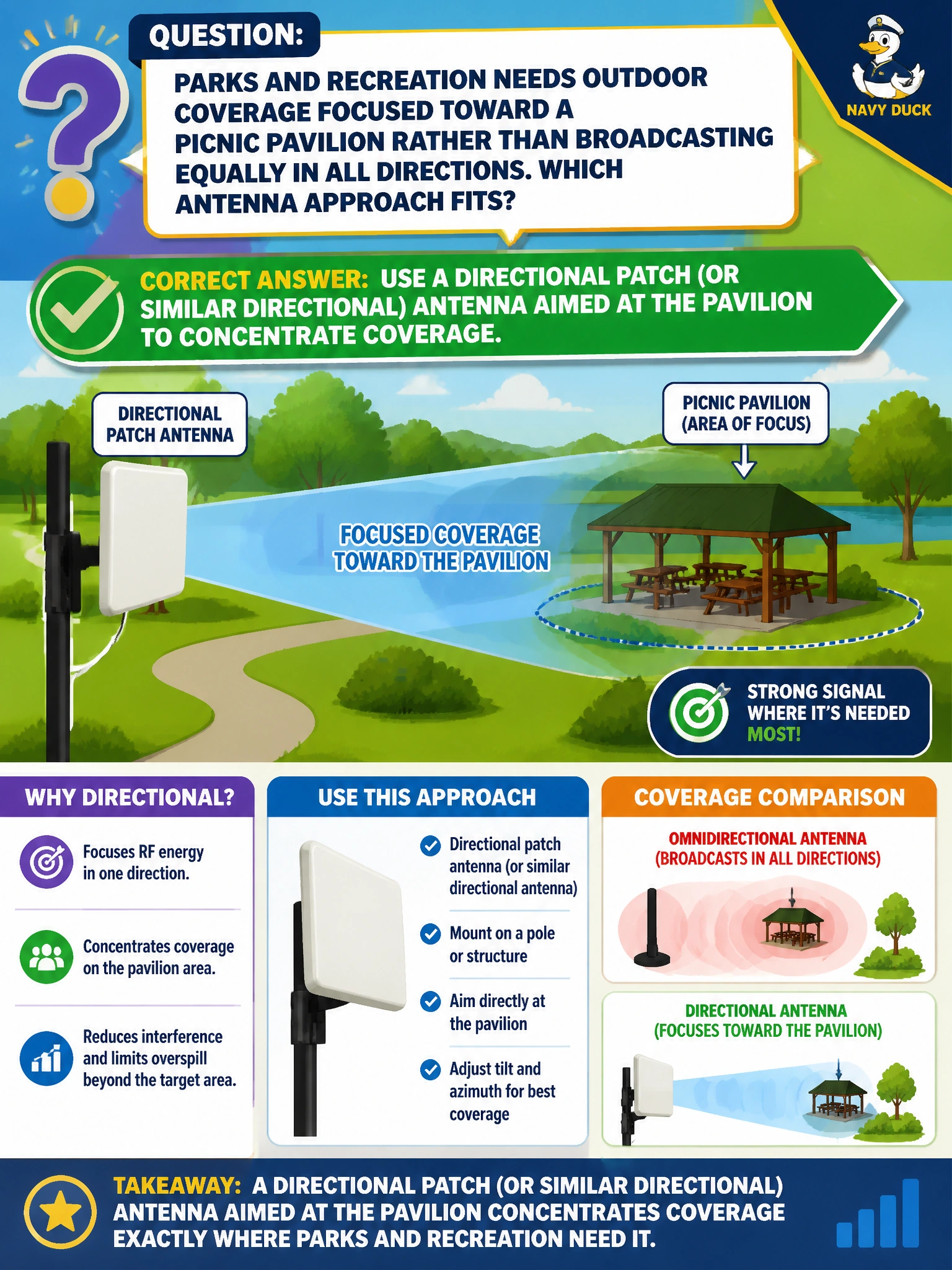
Parks and recreation needs outdoor coverage focused toward a picnic pavilion rather than broadcasting equally in all directions. Which antenna approach fits?
Select an answer to reveal the explanation.
Short Explanation
Point a patch like a spotlight at the pavilion instead of lighting the whole park. An omni stuffed in a metal shed or hoping STP will carry Wi-Fi will disappoint picnic guests.
Full Explanation
Parks and recreation outdoor coverage aimed at a picnic pavilion—not equal radiation in all directions—fits a directional patch (or similar directional) antenna pointed at the pavilion. Concentrating RF toward the seating area improves pavilion SNR and reduces wasted energy into empty fields, parking lots, or neighboring properties compared with an omnidirectional spray.
Using only an indoor rubber-duck omni inside a metal shed fails by concept: metal attenuates RF severely and an indoor omni is the wrong pattern and environment for focused outdoor pavilion coverage. Relying on a passive optical tap to radiate 802.11 fails because optical taps do not emit Wi-Fi toward clients. Disabling RF and “extending coverage” with longer STP diameters alone fails because spanning-tree diameter does not create a wireless cell at the pavilion.
Exam caveat: Outdoor directional mounts need weather-rated antennas, correct grounding/lightning practices, and regulatory EIRP limits—pattern choice alone does not satisfy outdoor deployment rules.
Operational check: Aim the patch at pavilion seating; measure RSSI/SNR under the pavilion and at undesired backlobes; adjust azimuth/downtilt; confirm AP remains within allowed EIRP and that wired backhaul/PoE still meet outdoor AP requirements.